
Last Updated: October 26, 2026
Quick Summary
A leather checkbook cover keeps checks flat and legible, holds your checks, register and cards in one place, and outlasts vinyl and pleather through everyday wear. It offers a slim profile, wallet-style slots and craftsmanship you can see, though it protects the checks themselves rather than your personal information.
- Full-grain leather is the strongest grade and the best choice for an item that folds daily.
- Most synthetic covers show edge wear and spine cracking within a year or two of daily carry.
- Condition a leather cover with balm twice a year to keep the hide supple.
- Standard US personal checks are commonly 6 inches by 2.75 inches, so measure your pad before ordering.
- Look for saddle stitching in heavy thread at the spine and corners, which outlasts glued seams.
Table of Contents
- Why a Leather Checkbook Cover Beats a Plastic Sleeve
- Eight Practical Benefits for Everyday Check Writers
- Checkbook Cover Protection: What It Does and Doesn't Do
- Leather vs. Synthetic: How Each Ages Over Time
- When a Leather Checkbook Wallet Makes Sense
- How to Use a Checkbook Cover Correctly
- How to Care for a Leather Checkbook Cover
- What to Check Before You Order One
- Frequently Asked Questions
Why a Leather Checkbook Cover Beats a Plastic Sleeve
A leather checkbook cover is a protective holder for personal checks, a register, and cards, made from tanned animal hide rather than the vinyl sleeve that ships with a check order. At AnchorsAweighLeather, the Leather Rose Checkbook Cover is handcrafted from vegetable-tanned leather.
Here's the honest part most guides skip. A cover protects the checkbook, not your identity. According to Carousel Checks' guide to leather checkbook covers, covers shield the checks themselves but do not contain personal or confidential information.
Below, we cover practical considerations and buying checks.
Eight Practical Benefits for Everyday Check Writers
The benefits of using a leather checkbook cover depend on the features of the cover.
- Checks stay flat and legible instead of curling at the edges.
- One place for checks, register, and cards so nothing goes missing.
- Durability through everyday wear that outlasts vinyl and pleather.
- A slim, compact profile that fits a pocket or bag without bulk.
- Protection for the checkbook contents against bending and spills.
- Wallet-style functionality with slots for cards and a pocket for cash.
- Craftsmanship you can see, from stitching to tooling.
- Style and color options for men and women alike.
Checks Stay Flat and Legible
A check that has spent a week in a back pocket curls at the corners and picks up creases, and banks want a clean, flat document. A leather cover presses the check pad flat against a firm backing, so every check you tear out is crisp. Top-tear and side-tear books both benefit; the cover keeps the pad aligned and square.
One Place for Checks, Register, and Cards
For a deeper look, our guide on what tactical everyday carry means in practice walks through building a lean, functional kit.
Checkbook Cover Protection: What It Does and Doesn't Do
That distinction matters because marketing language blurs it. RFID blocking gets attached to leather goods as a selling point, but RFID only matters for cards with a radio chip, and paper checks have no chip. The real protection a cover offers is mechanical: a firm barrier against the wear and tear that ruins a check before it reaches the teller.
Leather vs. Synthetic: How Each Ages Over Time
The failure pattern is predictable. On a checkbook cover, the highest-stress points are the spine fold and corners, where the material flexes every time you open and close it. A plastic coating tolerates a finite number of flexes before it micro-cracks and peels from the backing, so most synthetic covers show edge wear and spine cracking within a year or two of daily carry. Genuine leather at the same stress points softens, takes a crease, and holds it, because the fibers move with the fold instead of resisting it.
Leather grades and what they mean for a checkbook cover
Not all genuine leather is equal, and the grade determines how a cover ages:
- Full-grain leather is the outermost hide layer with the grain intact. It is the strongest and most durable grade, develops a patina with handling, and is the best choice for an item that folds daily.
- Top-grain leather has the outermost layer lightly sanded to remove imperfections. It is smoother and more uniform out of the box, still durable, but develops less character than full-grain.
- Bonded leather is leather scraps ground up and bonded with adhesive onto a backing. It is the lowest grade, can flake at the edges, and is a poor match for a cover that sees daily flexing.
- Genuine leather on a label is a broad legal term that can describe any of the above, including bonded. Treat the word alone as a starting point, not a guarantee.
Tanning method matters too. Vegetable-tanned hides are tanned with plant-based tannins, tend to be firmer and hold their shape well, and age into a deep finish. Chrome-tanned hides are softer and more pliable out of the box. For a cover that needs to press checks flat, a firmer vegetable-tanned hide has an advantage.
The cost-per-year math
A synthetic cover is cheaper up front, but it is a consumable. If a plastic-coated cover fails at the spine in roughly a year of daily use, you replace it, and the low sticker price repeats. A well-made genuine leather cover costs more once and typically outlasts several synthetic covers, so the cost per year falls the longer you keep it. Frequent users come out ahead with leather; occasional users may not.
How to tell them apart before you buy
Our article on choosing a leather journal cover for travel digs into how leather goods wear with handling, which applies just as well to a cover that rides in a bag daily.
When a Leather Checkbook Wallet Makes Sense
Who should skip it? If you write two checks a year and pay everything by card or phone, a plastic sleeve is fine. A Bogleheads forum participant called a leather cover a pricey upgrade over the free plastic one, a fair call for light users. For anyone writing checks weekly, the math flips: a sturdy cover outlasts several plastic sleeves and keeps your checks presentable.
How to Use a Checkbook Cover Correctly
Using a cover correctly takes about a minute and prevents the most common annoyance: a register that won't stay put.
- Slide the check pad under the retaining flap so the top check sits flush with the cover edge.
- Tuck the register into its slot behind the pad, spine facing the fold.
- Store cards in the slots and cash in the bill pocket if your cover has one.
- Close the cover and press the fold to set the crease.
- Keep the cover flat rather than jammed into a crowded pocket, which stresses the stitching.
Watch out: forcing a thick register into a slim cover stretches the leather and can pull the stitching. Match the cover's capacity to what you actually carry.
Leather Rose Checkbook Cover →
How to Care for a Leather Checkbook Cover
Caring for a leather checkbook cover means keeping it dry, wiping it clean, and conditioning it a couple of times a year to keep the hide supple and prevent cracking at the fold.
- Wipe spills immediately with a dry cloth; leather tolerates light moisture but not soaking.
- Condition with a leather balm twice a year, or more if the cover lives in dry heat.
- Keep it out of direct sun for long stretches, which fades dye and dries the hide.
- Store it flat when not in use rather than folded under heavy items.
Skip harsh soaps and alcohol wipes, which strip the natural oils that keep leather from drying out. A little maintenance goes a long way toward wear resistance over years of daily use.
What to Check Before You Order One
Use this checklist to consider what you carry.
1. Measure your checks, not just the cover
Standard personal checks in the United States are commonly 6 inches by 2.75 inches, and covers are typically sized to hold a pad of that size with a little clearance. Before ordering, measure the check pad you own, including the binding, and compare it to the cover's listed interior dimensions. A cover that lists no dimensions is a red flag.
Also confirm the binding style. Top-tear books and side-tear books load differently, and a cover designed for one may not hold the other flat. If you use a side-tear book, verify the cover accommodates that orientation.
2. Plan for the register
The register is the item most likely to be squeezed. A thick register forced into a slim cover stretches the leather and can pull stitching at the spine. Decide whether you carry a full or compact register and match the cover's capacity to it; if there's a dedicated slot behind the check pad, check that its depth fits your register's height.
3. Decide which extras you actually need
Wallet-style covers add card slots and a bill pocket, useful if the cover doubles as your everyday payment carrier, but every added slot adds bulk. If you already carry a separate wallet, a slimmer cover with just the check pad and register may suit you better. Match the feature set to your routine rather than buying the most slots available.
4. Choose a closure you will actually use
Closures vary, and each has a trade-off:
- No closure or a simple fold is the slimmest option and easiest to open one-handed, but offers less protection against checks sliding out in a bag.
- A strap or snap keeps the cover closed and checks secure, at the cost of a little bulk and an extra step to open.
- A zipper offers the most containment for cards and cash but adds the most bulk and the most potential wear points.
5. Judge construction at the stress points
Look for saddle stitching in heavy thread at the spine and corners, which outlasts glued seams. Hand-sewn and burnished edges are signs of craftsmanship worth paying for. Skip covers with glued seams at the fold, which fail first.
6. Treat security claims as a bonus
Here is a quick reference for the buying decision:
| What to Check | Why It Matters | Red Flag |
|---|---|---|
| Interior dimensions listed | Checks stay flat and usable | No size listed |
| Binding style match | Top-tear and side-tear books load differently | Cover only fits one style, unstated |
| Register slot depth | Prevents stretched leather and pulled stitching | Slot too shallow for a full register |
| Genuine leather grade | Ages well, holds shape | "PU leather," pleather, or bonded leather |
| Saddle stitching | Survives daily folding | Glued seams at the spine |
| Closure type | Balances security and bulk | Closure that adds bulk you will not carry |
| Vegetable-tanned hide | Durable, develops patina | Vague "genuine leather" claims |
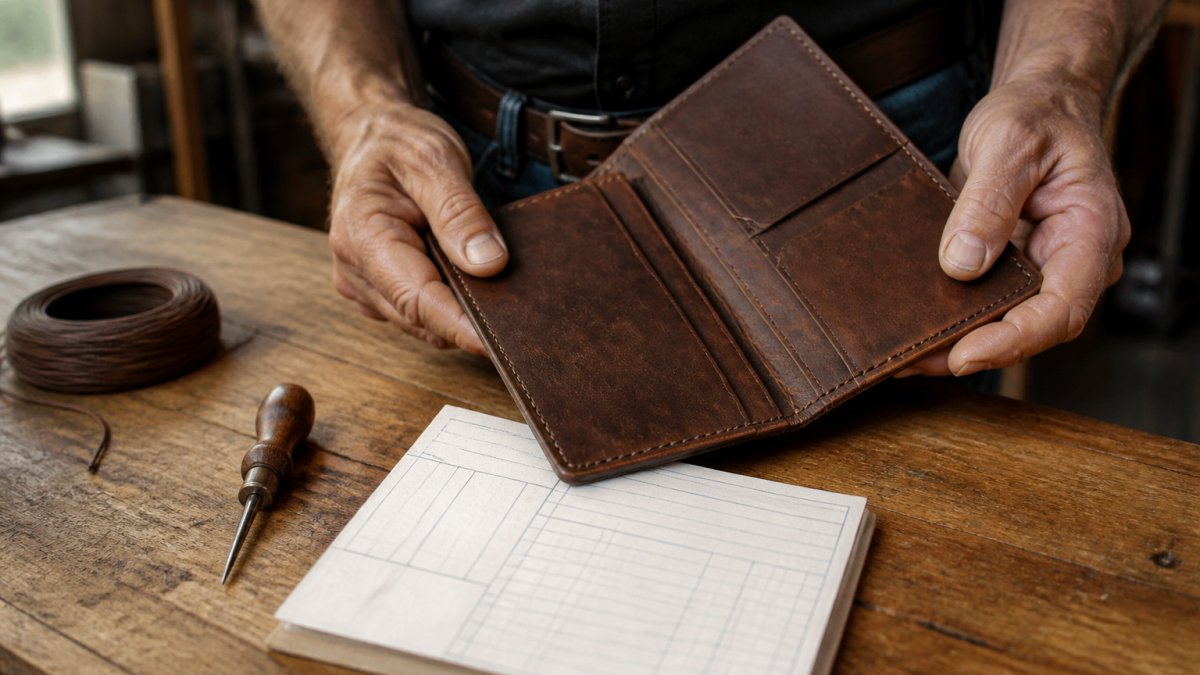
When you're ready to see the details up close, our Leather Rose Checkbook Cover is hand-sewn from vegetable-tanned leather, tooled with a rose, and designed to fit standard-size personal checks.

Frequently Asked Questions
Does a leather checkbook cover actually protect checks from damage?
The Leather Rose Checkbook Cover is designed to fit standard-size personal checks.
How do I use a checkbook cover?
Slide your checks into the flap or pocket so the top edge stays aligned with the duplicate page behind it, then tuck your register into the slot on the opposite side. When you write a check, press down firmly so the carbon or duplicate copy transfers cleanly. Keep the cover closed between uses so the checks do not curl, and refill from the back of the pad so the next check is always on top.
How do I care for a leather checkbook cover?
The Leather Rose Checkbook Cover is made from 5 oz vegetable-tanned leather.
Is a leather checkbook wallet worth it over a cheap plastic cover?
A plastic sleeve that ships with your check order is free and works fine until it splits at the fold, which usually happens within a year of daily use. Leather costs more up front but holds its shape, resists everyday wear, and can carry cards and cash alongside your checks. If you write more than a couple of checks a month or want one item for checks and cards, leather earns its price. If you write two checks a year, the free sleeve is fine.
Still writing checks every month? A flimsy sleeve isn't doing your checkbook any favors. At AnchorsAweighLeather, we handcraft American-made leather goods built to last, and our checkbook covers carry the same standards: vegetable-tanned leather, saddle stitching in heavy nylon thread, and a shape that holds up to daily use. Every order over $100 ships free. Get started with AnchorsAweighLeather and carry a checkbook cover that looks as solid as it feels.

0 comments