
Last Updated: October 30, 2026
Quick Summary
Choosing the perfect leather phone holster for work starts with how you actually spend your day, then measuring your phone both bare and inside the case you carry. Match the belt attachment to your body mechanics, pick full-grain leather with secure closure, and care for it like a pair of work boots.
- Measure your phone bare and again inside your everyday case, sizing for the bulkiest case you own.
- A sewn belt loop is the most secure attachment, while plain spring clips are the first part to fatigue.
- Match the attachment to your motions: fixed loops for bending, squatting, climbing, and reaching overhead.
- Test retention by holding the holster upside down and shaking it; the phone should stay put.
- Expect new full-grain leather to feel tight and ease over the first few weeks of daily wear.
Table of Contents
- Start With Your Workday, Not the Holster
- How to Measure a Phone for a Holster
- Phone Holster vs Clip-On Case for Work Carry
- Phone Holster Belt Attachment Options Compared
- Leather Quality, Closure Security, and Drop Protection
- Leather Phone Holster Care and Long-Term Ownership
- Pick Your Holster From the AnchorsAweighLeather Lineup
- Frequently Asked Questions
Start With Your Workday, Not the Holster
The right leather phone holster for work starts with an honest look at how you actually spend your day, not with a catalog. If you're on a roof, in a truck cab, or crawling under a sink, your phone needs to survive the same conditions you do. At AnchorsAweighLeather, we build holsters for people who work with their hands, and the first question we ask is never about leather color.
Ask yourself three things before you shop:
- Where does your phone live? Pocket, belt, or truck console.
- What hits it? Dust, moisture, drops, or constant vibration.
- How often do you reach for it? Every ten minutes, or twice a shift.
A desk worker and a ranch hand need different gear. Buying for your job, not your aesthetic, is the difference between a holster you keep for years and one that sits in a drawer.
How to Measure a Phone for a Holster
Measuring a phone for a holster takes two steps: measure the bare phone, then measure it again inside the case you actually use. Skip either step and you'll order a holster that's too tight or too loose.
Here's the practical method:
- Lay the phone flat and measure height, width, and depth in millimeters.
- Slide it into your everyday case and repeat all three measurements.
- Write both sets down and compare them to the holster's stated interior fit.
Depth is the number people forget. A thin case can add several millimeters, and that's often the difference between a snug fit and a fight every time you holster the phone.
Measure the Phone, Then Measure the Case
The case measurement is the one that matters most, because that's the phone you'll actually carry. If you swap cases often, measure the bulkiest one you own. A holster built for a bare phone will grip a thin case, but a thick rugged case usually needs a holster sized for it. When in doubt, size for the case, not the phone.
Phone Holster vs Clip-On Case for Work Carry
A phone holster protects the phone and keeps it off your body; a clip-on case attaches directly to the device and adds bulk to it. For work carry, the holster wins on protection and the clip-on wins on convenience.
The trade-offs break down like this:
- Holster: Shields the screen and body, keeps the phone off your hip pocket, and lets you swap phones without rebuying gear.
- Clip-on case: Faster to grab, but the clip is the weak point and the case stays on the phone all day.
- Work setting: On a jobsite, a holster keeps dust and debris off the device and out of your pocket.
A belt holster isn't for everyone. If you sit at a desk all day, a slim case may suit you better. But if your phone takes a beating, the enclosed pouch design earns its keep.
Phone Holster Belt Attachment Options Compared
The attachment you choose should be matched to how your body moves on the job, not just to how the holster looks on a shelf.
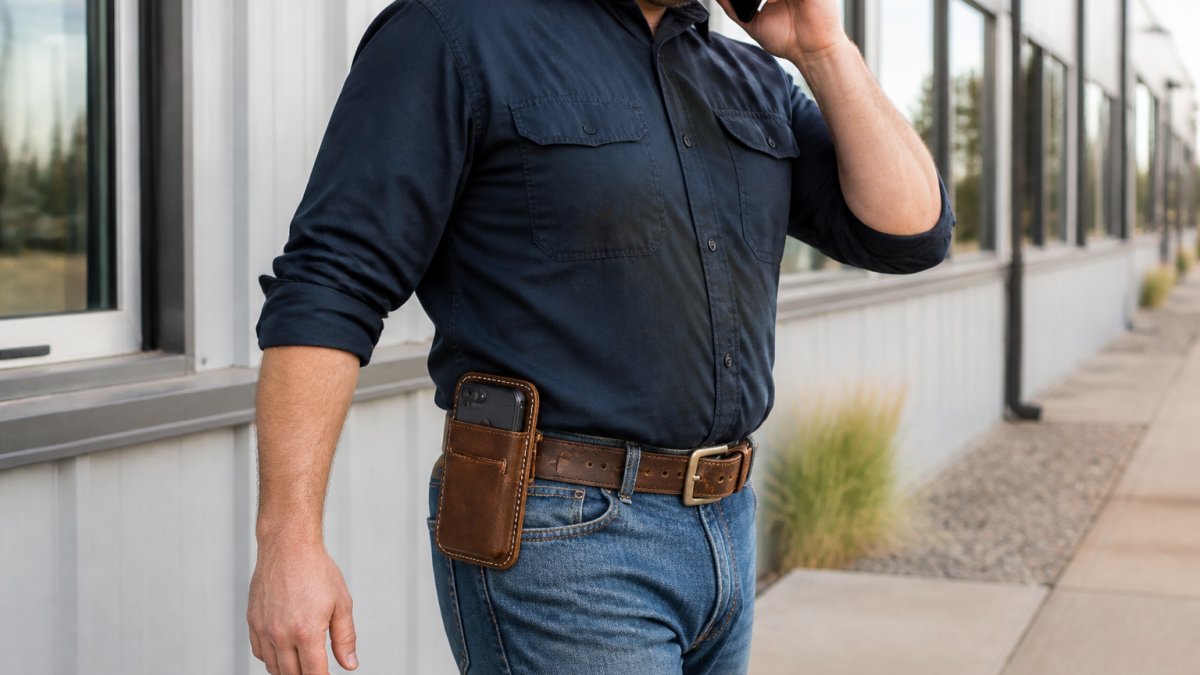
Loops, Clips, and Locking Clips
- Belt loop: Most secure. The holster rides fixed and won't twist or slide. A sewn loop distributes load across the belt rather than pinching a single point, which matters when you're carrying a phone plus tools all day.
- Belt clip: Quick on and off, but check the tension regularly. Plain spring clips are the first part to fatigue; a clip that has loosened will let the holster rotate or slide down the belt when you squat or climb.
- Locking clip: A clip with a positive latch. Better than a plain clip, still not as solid as a sewn loop, and the latch mechanism itself can collect grit in dusty environments.
Match the Attachment to the Work
Attachment choice is really a question about body mechanics. Think through the motions your job repeats:
- Bending and squatting (plumbers, electricians, mechanics): A fixed belt loop keeps the holster from swinging forward and digging into your thigh. A clip-mounted holster can pivot and press the phone into your hip.
- Climbing and reaching overhead (roofers, linemen, framers): A sewn loop stays indexed to the same spot on the belt, so your hand finds the phone without looking. Clips can creep along the belt during repeated reaches.
- Driving and seated work (truck drivers, equipment operators): A holster positioned slightly behind the hip clears the seat back and seatbelt. A clip that has rotated can end up under the seatbelt path, which is both uncomfortable and a snag risk.
- Tool use and lanyard work: Metal clips and exposed snaps can catch on tool lanyards, webbing, and harness straps. A smooth leather loop with recessed hardware reduces snag points.
Belt Width and Hardware Fit
A holster loop is sized for a belt width, and a mismatch is a common cause of a holster that rides poorly. Measure your work belt's width and thickness before ordering. A loop cut for a 1.5-inch belt will slide on a 1.25-inch belt; a thick double-layer work belt may not thread through a loop sized only for width. Check that the snap or rivet hardware sits flush against the belt rather than digging into it, since hardware that presses into the belt accelerates wear on both pieces.
Leather Phone Holster Rancher II Edition →
Leather Quality, Closure Security, and Drop Protection
Leather quality decides how long a holster lasts, and closure security decides how well it protects your phone. Look for full-grain leather and tight stitching. A guide to judging leather goods quality from Penn State Extension explains how grain and tanning affect durability.
Closure matters just as much. Test retention by holding the holster upside down and giving it a shake. The phone should stay put.
Leather Phone Holster Care and Long-Term Ownership
Leather care is simple and infrequent: wipe off dust and keep it away from prolonged soaking. For detailed cleaning and conditioning instructions, see How to Clean and Condition Leather Holsters. But work carry puts leather through conditions a dress belt never sees, sweat, grit, repeated flexing, and the occasional soaking, so a little attention goes further than it would on casual gear.
Break-In: What to Expect in the First Weeks
New full-grain leather is stiff, and a new holster will feel tight. That's normal. The leather relaxes as it takes on the shape of your phone and the curve of your belt. Expect the fit to ease over the first few weeks of daily wear. Don't force a phone into a new holster or stretch it with tools; let the break-in happen through normal use. If the holster is still fighting you after a couple of weeks, the fit is wrong, not just new.
Sweat, Moisture, and Work Conditions
Sweat is the most common enemy of a work holster. Salt and moisture from skin and clothing break down leather fibers over time, and a holster worn against the body all day sees more of it than most leather goods. A few habits that extend its life:
- Let it dry naturally if it gets wet. Never put leather near direct heat, which cracks and stiffens it.
- Wipe off sweat and grit at the end of a shift rather than letting it sit overnight.
- Condition sparingly. Too much oil softens the leather and weakens retention.
- Store it empty and dry when you're not using it.
Scuffs, Stitching, and Wear Points
What matters more is structural wear. Check these points periodically:
- Stitching at the belt loop and flap hinge: The highest-stress seams. Frayed or broken thread here is a repair signal, not a cosmetic issue.
- Snap and rivet hardware: Loose hardware can tear through leather. Check that snaps still engage positively and rivets sit tight.
- Edge finish: Worn edges expose the leather core to moisture. Reconditioning the edges helps slow this.
- Retention: If the holster no longer holds the phone securely when tipped, the leather has stretched past its useful fit.
When to Repair and When to Replace
A quality leather holster is repairable for much of its life. Loose stitching can be re-sewn, and hardware can be replaced by a leatherworker. Replace the holster when the leather itself has stretched so far that retention fails, when the belt loop leather has torn through, or when the body of the holster has cracked from neglect. Those are signs the leather has lost the structure that makes the holster protective, and no amount of conditioner will bring it back.
Pick Your Holster From the AnchorsAweighLeather Lineup
Choosing the perfect leather phone holster for work comes down to fit, attachment, and leather that holds up. We build ours by hand in the USA from premium full-grain leather, and every model is made to last a lifetime. Here's how the lineup breaks down:
| Holster | Price | Best For |
|---|---|---|
| Leather Phone Holster | $65.00 | Simple, rugged everyday belt carry |
| Cattleman Edition | $70.00 | Classic styling for ranch and jobsite work |
| Rancher II Edition | $90.00 | Refined Western belt-mount for hard daily use |
All three fit most standard smartphones and work best with no case or a thin case. Browse the full leather phone holster lineup and pick the one that matches your workday.


Frequently Asked Questions
How do I know whether a phone will fit in a leather holster?
Measure your phone's height, width, and thickness with a ruler, then add about 1/8 inch on each side for the leather thickness. Compare that to the holster's interior dimensions before ordering. Note that AnchorsAweighLeather holsters are sized for phones with no case; thin cases will work, but bulky cases will not. If your phone sits right at the edge of a size, size up rather than down.
Is a clip-on phone case or a belt holster better for work?
A clip-on case keeps the phone in your pocket and adds bulk to the device itself, while a leather phone holster keeps the phone off your body and accessible with one hand. Choose a clip-on case only if you rarely need quick access.
How should a phone holster attach to a work belt?
Match the attachment to your belt width, usually 1.5 to 2 inches for work belts.
How do I care for a leather phone holster?
Wipe dust off with a dry cloth. Avoid soaking the holster or leaving it in direct sun for long periods.
Your phone takes the same beating you do, and a flimsy holster won't survive the first hard week. AnchorsAweighLeather handcrafts every holster from premium full-grain leather, with a secure belt-mount design and American-made construction built to last a lifetime. We're veteran-owned and we stand behind gear that works as hard as you do. Get started with AnchorsAweighLeather and carry your phone the way it was meant to be carried.

0 comments