
Table of Contents
- What Makes a Custom Leather Knife Sheath Worth the Investment
- Best Leather for Knife Sheaths: Material Choices Explained
- Custom Leather Sheath Pricing: What to Expect
- Pancake Sheaths vs. Vertical Carry: Finding Your Carry Configuration
- Custom Fit and Sizing for Secure Retention
- How to Clean Leather Knife Sheath and Maintain Long-Term Quality
- Ordering Your Custom Leather Knife Sheath: Process and Lead Times
- Frequently Asked Questions
Last Updated: August 31, 2026
What Makes a Custom Leather Knife Sheath Worth the Investment
A custom leather knife sheath is more than just a protective covering for your blade. It's a handcrafted tool designed specifically for your knife, your carry style, and your lifestyle. At AnchorsAweighLeather, we've spent years perfecting the craft of creating sheaths that protect what you carry while delivering reliable, everyday performance.

The difference between a mass-produced sheath and a custom leather knife sheath comes down to fit, material quality, and craftsmanship. A sheath made specifically for your knife means zero blade rattle, secure retention that doesn't damage your edge, and a carry configuration that works for how you actually move. Generic sheaths leave gaps. Custom work fills them.
Here's what separates a worthwhile investment from wasted money: longevity. A quality handcrafted sheath made from full-grain leather will outlast cheaper alternatives by years. The leather develops character over time, patina deepens, and the sheath becomes more comfortable as it breaks in. You're not buying something disposable, you're buying something that becomes part of your kit.
Best Leather for Knife Sheaths: Material Choices Explained
The leather you choose determines durability, appearance, and how your sheath ages. Full-grain leather is the gold standard for knife sheaths because it retains the hide's natural surface, making it tougher and more water-resistant than lower grades. Vegetable-tanned leather, a specific type of full-grain leather, offers superior craftsmanship potential and develops a beautiful natural patina over time.
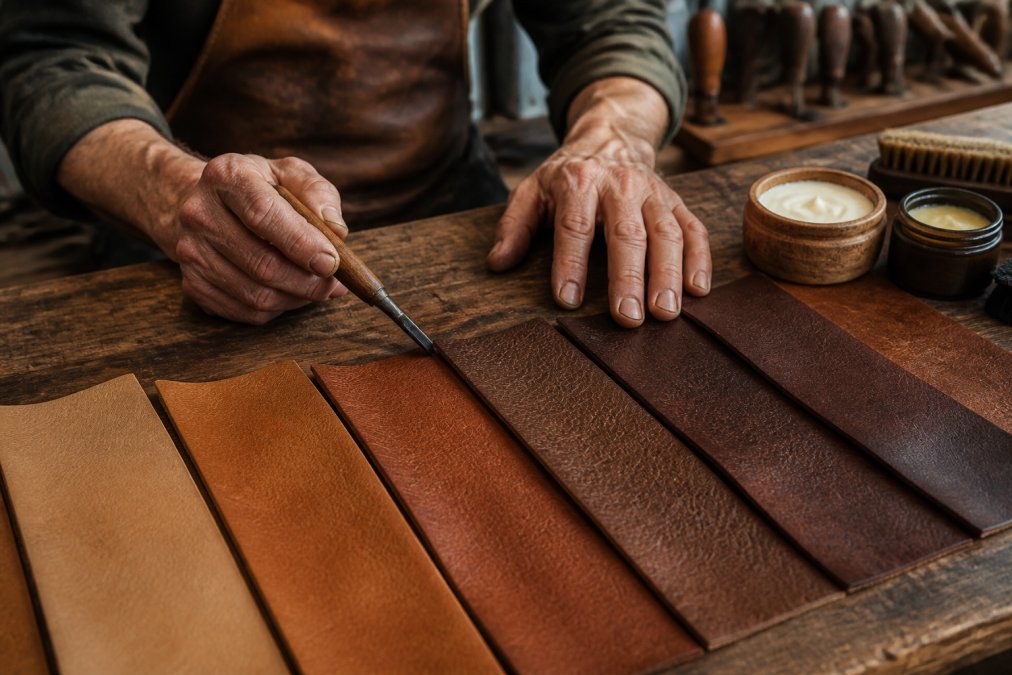
Vegetable tanning uses natural tannins from tree bark instead of chromium salts, creating leather that ages gracefully. When you condition a vegetable-tanned sheath regularly, the leather darkens and becomes more supple. This is the leather AnchorsAweighLeather uses for most custom orders because it rewards care and develops character. Hermann Oak and English Bridle leather are premium vegetable-tanned options that command higher prices, and deliver proportional durability.
The alternative is chrome-tanned leather, which is faster to produce and cheaper. It resists water better initially, but it doesn't develop patina the way vegetable-tanned leather does. For a custom leather knife sheath, you're making a long-term investment, so vegetable-tanned leather makes more sense. You're paying for material that improves with use.
Thickness matters too. Sheaths typically run 6-8 ounces, which provides rigidity for blade protection without excessive bulk. Thicker leather (up to 10 ounces) adds weight and stiffness but creates a more durable sheath for heavy-use knives. Thinner leather (4-5 ounces) reduces weight but sacrifices some protection and longevity.
Custom Leather Sheath Pricing: What to Expect
Custom leather knife sheath pricing depends on complexity, materials, and whether you're ordering from a mass producer or a dedicated craftsperson. A basic pancake sheath starts around $41-$46 for quality handcrafted work. Specialty sheaths, like the Custom Leather Folding Knife Sheath designed for specific knives such as the Buck 110, run $45. Horizontal carry sheaths and more complex designs land in the $49 range.
These prices reflect real handcrafted work. Every stitch is done by hand using saddle stitch technique, which creates a stronger, more durable seam than machine stitching. The leather is hand-selected, cut, and molded to your specifications. You're not paying for inventory, you're paying for time and skill.
| Sheath Type | Starting Price | Best For | Lead Time |
|---|---|---|---|
| Pancake sheath | $41-$46 | Pocket knives, folding blades | 2-3 weeks |
| Horizontal carry | $49 | Fixed blades, larger knives | 2-3 weeks |
| Specialty designs | $43-$45 | Filet knives, ULU knives | 3-4 weeks |
| Custom fit options | Starting at $33 | Budget-conscious buyers | 2-3 weeks |
Cheaper sheaths exist, but they're typically machine-made from lower-grade leather and won't last. A $15 sheath will fail within months. A $45 handcrafted sheath from AnchorsAweighLeather will still be protecting your blade a decade from now. The math favors quality.
Many custom makers charge extra for customization, laser engraving, custom dyes, or unusual carry configurations. AnchorsAweighLeather includes custom fitting as standard. You specify your knife dimensions, and the sheath is molded to accommodate your exact blade. No upsell required.
Pancake Sheaths vs. Vertical Carry: Finding Your Carry Configuration
Your carry configuration determines comfort, draw speed, and how accessible your knife is during the day. The two most popular options are pancake sheaths and vertical carry designs, and they serve different needs.
A pancake sheath positions your knife flat against your body, parallel to your belt. This configuration keeps your blade close and reduces printing, the visible outline of your knife through your shirt. Pancake carry works well for pocket knives, smaller fixed blades, and everyday carry in professional settings. The Custom Pancake Knife Sheath design keeps your knife slim and accessible without drawing attention. Draw speed is slightly slower than vertical carry, but comfort and concealment are superior.

Vertical carry positions your knife point-down on your belt, with the blade perpendicular to your body. This setup favors draw speed and works better for larger fixed blades. Scout carry, a variation where the blade hangs horizontally but at an angle, splits the difference between speed and concealment. Some users prefer forward cant, which angles the knife forward for an even faster draw.
Your choice depends on context. Hunting? Vertical carry wins. Professional environment where you need discretion? Pancake sheath. Fishing where you need speed and your blade size isn't a concern? Scout carry or forward cant. AnchorsAweighLeather offers custom configurations for all three, so you're not locked into one option.
The Custom Texas Pancake Knife Sheath represents the pancake design refined for everyday use, secure belt carry, clean draw, and the craftsmanship that comes from hand-stitched construction. For users who prioritize concealment and comfort, this is the go-to configuration.
Custom Fit and Sizing for Secure Retention
Secure retention means your knife stays put during movement but draws smoothly when you reach for it. A poorly fitted sheath either lets your blade rattle around or grips so tightly that drawing feels like wrestling your own gear.
Custom fit starts with knowing your knife's exact dimensions: blade length, blade width at the widest point, and handle length. AnchorsAweighLeather builds each sheath to accommodate your specific measurements. The leather is molded around your blade, creating a snug fit that's impossible with off-the-shelf options.
Retention is controlled through sheath thickness, leather stiffness, and welt construction, the reinforced edge where leather folds. A properly constructed welt provides structure without needing excessive leather thickness. The sheath holds your knife securely without crushing the handle or damaging your blade.
Belt loop width matters too. Most sheaths accommodate belts up to 1.5 inches wide, which covers standard carry. Larger belts require custom loop sizing. The Custom Leather Knife Sheath and pancake variations all specify their belt compatibility upfront, so you know before ordering whether it'll work with your setup.

How to Clean Leather Knife Sheath and Maintain Long-Term Quality
Leather maintenance is straightforward, but consistency matters. A sheath that receives regular care will outlast one that's neglected by years. Your custom leather knife sheath will develop character and patina naturally, but conditioning accelerates the process and protects against damage.
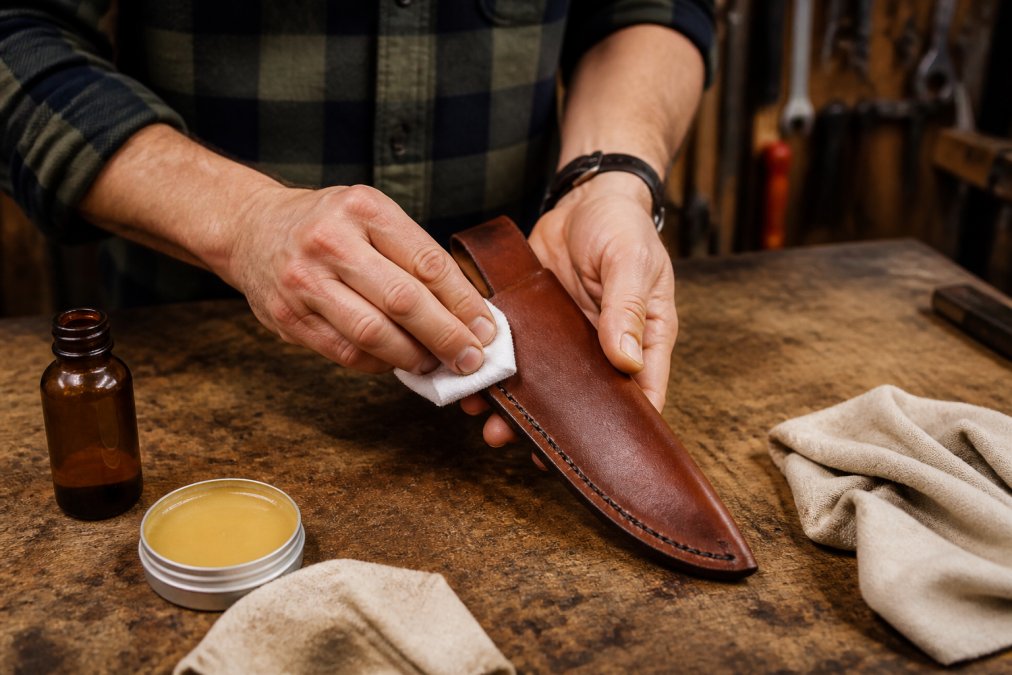
Start with basic cleaning. Wipe your sheath with a dry cloth after use, especially if it's been exposed to moisture or dirt. For stubborn dirt, use a slightly damp cloth, not soaking wet. Let it air dry naturally, away from direct heat or sunlight. Never use a heat source like a hair dryer; rapid drying can crack leather.
Conditioning should happen every 3-6 months, depending on climate and use. Neatsfoot oil is the traditional choice for vegetable-tanned leather. Apply a thin coat with a soft cloth, working it into the leather in circular motions. Let it absorb for 24 hours, then buff away excess with a clean cloth. The leather will darken slightly and become more supple.
For water resistance, some leatherworkers apply beeswax after conditioning. This adds a protective layer without changing the leather's feel. AnchorsAweighLeather applies neatsfoot oil and atoms wax during production, creating a durable waterproof finish. Your maintenance job is just keeping that protection topped up.
Avoid harsh cleaners, saddle soap (too heavy for knife sheaths), and anything silicone-based. These can clog leather pores and prevent it from breathing. Stick to neatsfoot oil and occasional light conditioning. The leather should remain supple, not plastic-like.
Storage matters. Keep your sheath in a cool, dry place. Excessive heat causes leather to dry out and crack. Excessive moisture promotes mold. A normal indoor environment is fine. If you store a sheath for extended periods, condition it before putting it away and again before using it.
Ordering Your Custom Leather Knife Sheath: Process and Lead Times
The ordering process for a custom leather knife sheath is straightforward but requires precision. You need to provide your knife's exact dimensions so the sheath is molded specifically for your blade.
Start by measuring your knife. Blade length (tip to guard), blade width at the widest point, and handle length are the essentials. If your knife has an unusual shape, a recurved edge, for example, mention it. Take photos from multiple angles if the knife has distinctive features. AnchorsAweighLeather will use this information to create a sheath that fits perfectly.
Next, specify your configuration. Pancake or vertical? Belt loop width? Any customization like laser engraving or specific leather color? The Custom Texas Pancake Knife Sheath comes in multiple color options, and most custom orders can be tailored to your preferences.
Lead times typically run 2-3 weeks for standard orders, sometimes longer for complex customization. This isn't delay, it's the reality of handcrafted work. Each sheath is made to order, not pulled from inventory. You're waiting for your specific sheath to be built, not for stock to arrive.
AnchorsAweighLeather offers free shipping on orders over $100, which covers most custom sheath orders. The Custom Leather Knife Sheath starts at $49, and specialty designs run up to $49 depending on complexity. You're getting American-made craftsmanship with no hidden fees.
Investing in a custom leather knife sheath from AnchorsAweighLeather means getting a sheath built specifically for your knife and your carry style. Handcrafted from vegetable-tanned full-grain leather using saddle stitch construction, each sheath is designed to protect your blade while delivering the secure retention and draw speed you need. With lead times of 2-3 weeks and prices starting at $41, you're getting American-made quality that lasts a decade or more. Get started with a custom order today and experience the difference that true craftsmanship makes.
Frequently Asked Questions
How much does a custom leather knife sheath cost?
Custom leather knife sheath pricing typically ranges from $33 to $49 depending on design complexity and materials. A basic pancake sheath for pocket knives starts around $41-$46, while specialized designs like filet sheaths or horizontal carry options run $43-$49. Full-grain vegetable-tanned leather and hand-stitching construction justify the investment over factory alternatives. AnchorsAweighLeather offers free shipping on orders over $100.
What is the best leather for making knife sheaths?
Vegetable-tanned full-grain leather is the industry standard for knife sheaths because it molds to your blade over time, develops a protective patina, and lasts decades with proper care. Full-grain construction preserves the hide's natural surface, making it stronger than corrected or split leather. Avoid bonded leather; it delaminates and fails within months.
How do I commission a custom leather knife sheath?
Contact a custom maker with your knife's blade length, width, and carry preference (pancake, vertical, scout, etc.). Provide measurements and any special requests like specific leather color. Most makers require a custom order form and lead times typically range from 2-4 weeks. Confirm retention requirements and belt loop width (usually up to 1.5 inches). A deposit or full payment upfront is standard practice for handcrafted work.
How do I clean and maintain a leather knife sheath?
Wipe down your sheath monthly with a dry cloth to remove dust and dirt. Apply neatsfoot oil or leather conditioner every 3-6 months to prevent cracking and maintain water resistance. For stubborn stains, use a damp cloth and mild soap, then dry immediately. Avoid prolonged moisture exposure and store in a cool, dry place. Proper conditioning extends sheath life by decades and deepens the natural patina that develops with use.
What's the difference between custom leather and Kydex sheaths?
Leather sheaths offer superior aesthetics, breathability, and a custom fit that improves over time through molding. Kydex is faster to produce, cheaper, and more rigid for maximum retention. Leather develops character with age and patina; Kydex remains static. Leather requires maintenance; Kydex does not. Many users prefer leather for its durability and timeless appeal.
This article was written using GrandRanker
0 comments