
Table of Contents
- Step 1: Gather Your Leather Scratch Repair Tools
- Step 2: How to Remove Scuffs From Leather
- Step 3: How to Remove Scratches From Leather Wallets With Heat and Pressure
- Step 4: Leather Conditioner for Scratches That Won't Budge
- Step 5: How to Repair Deep Scratches in Leather
- Common Mistakes That Make Leather Wallet Scratches Worse
- When to Replace Instead of Repair
- Frequently Asked Questions
Last Updated: October 12, 2026
Step 1: Gather Your Leather Scratch Repair Tools
Most scratches on a leather wallet never needed a repair kit. They needed ten minutes and the right technique. Learning how to remove scratches from leather wallets starts with understanding one thing: leather is skin, and surface marks often respond to the same things skin does.
Since 2017, we've seen every kind of scratch a pocket can produce. The good news? Most of them lift right out.
Leather scratch repair tools are the basic supplies used to lift, smooth, and seal surface damage on leather goods. You don't need a full cobbler's bench. You need five things.
What You'll Need Before You Start
- A soft microfiber cloth
- Leather conditioner or a neutral cream
- A hair dryer or your own hands
- Cotton swabs for tight spots
- A leather-safe dye pen for deep cuts
Skip harsh soaps, alcohol, and paper towels. They strip the oils that keep leather supple.
Step 2: How to Remove Scuffs From Leather
A scuff is not a scratch. That distinction matters, and it's where most people go wrong.
Scuffs are surface transfers. The leather isn't cut, it's just marked by whatever rubbed against it. A scuff usually sits on top of the finish. A scratch cuts into it.
So how to remove scuffs from leather without damaging the grain? Start gentle.
- Wipe the area with a dry microfiber cloth using light circular motions
- If the mark stays, dampen the cloth slightly and repeat
- For stubborn scuffs, add a pea-sized drop of conditioner
- Buff with a clean section of the cloth until the mark fades
- Let the leather rest for an hour before you judge the result
Most scuffs lift in under two minutes. If yours doesn't, you're probably dealing with a scratch, and that's the next step.
A common mistake is scrubbing hard right away. That pushes the mark deeper into the grain and can dull the finish permanently.
Step 3: How to Remove Scratches From Leather Wallets With Heat and Pressure
Heat and pressure are the two tools that fix most shallow scratches, and they cost nothing.
Leather fibers bend when something sharp drags across them. The scratch looks like a cut, but it's really just flattened fibers. Warmth relaxes them. Pressure coaxes them back into place.
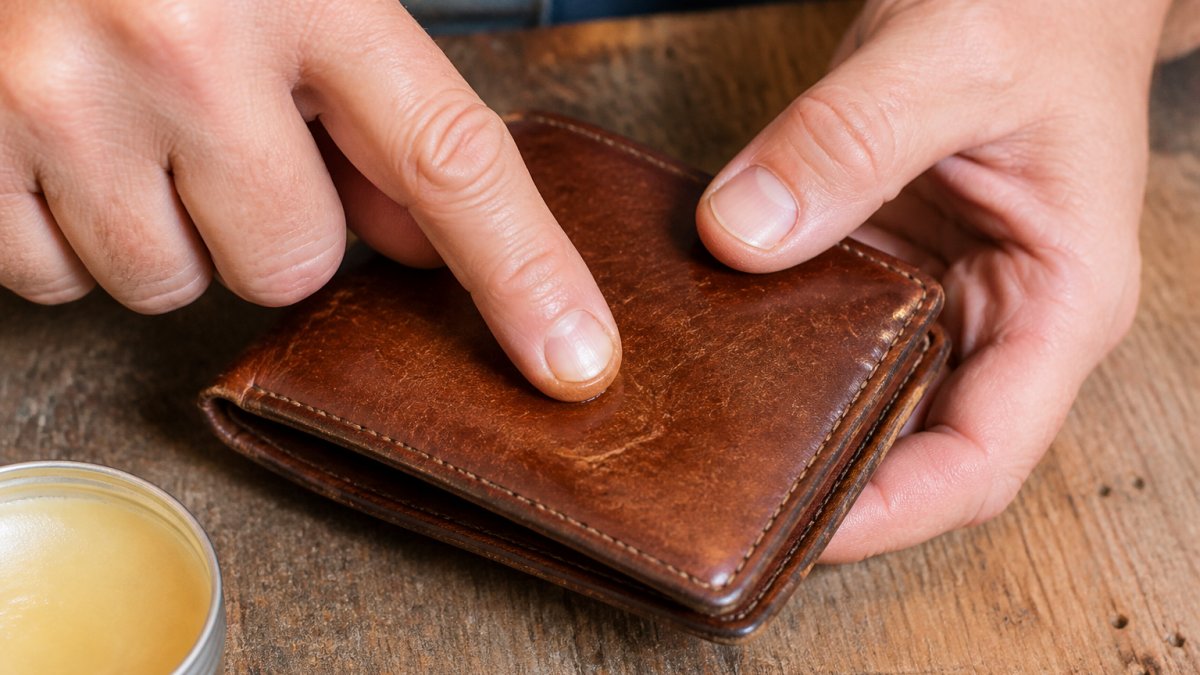
Here's the method:
- Warm the scratch with a hair dryer on low, holding it several inches away
- Stop when the leather feels warm, not hot
- Press the scratch with your thumb and rub in small circles
- Keep going for 30 to 60 seconds
- Check your progress in good light
The friction from your thumb adds heat as you work. That's why this method beats most tools.
The Finger-Rub Method for Shallow Marks
No hair dryer? No problem. Your hands carry natural oils that help here.
Rub the scratch firmly with your fingertip for a full minute. Then rub it again. The warmth and oil slowly lift the flattened fibers. This works best on light surface marks you can barely feel with a fingernail.
Step 4: Leather Conditioner for Scratches That Won't Budge
When heat and pressure stall out, leather conditioner for scratches does the heavy lifting. Conditioner replaces the oils that wear away with daily use, and hydrated leather hides marks far better than dry leather.
Apply a small amount with your fingertip. Work it into the scratch in circles. Let it sit for 15 minutes, then buff off the excess.
You may need two or three rounds. That's normal. Leather absorbs slowly, especially on a wallet that's been in a pocket for years.
A few things to keep in mind:
Mens leather wallet, leather wallet, leather billfold →
- Less is more. Too much conditioner leaves a greasy film that attracts dirt
- Match the product to the leather. Creams suit smooth finishes, oils suit rugged ones
- Condition every few months to prevent new scratches from settling in
Think of it this way. A well-conditioned wallet shrugs off marks that would scar a dry one.
Step 5: How to Repair Deep Scratches in Leather
Deep scratches need a different approach. If you can catch your fingernail in the groove, heat and conditioner alone won't close it.
Here's how to repair deep scratches in leather:
- Clean the area and let it dry completely
- Apply a leather filler or repair compound
- Press it into the cut with a small spatula or your fingertip
- Wipe away the excess before it sets
- Let it cure for the full time on the label
- Color-match with a leather dye pen if needed
- Seal with a thin coat of conditioner
The color match is the hard part. Test your dye on a hidden spot first, and build the color in thin layers rather than one heavy pass.
If the scratch goes all the way through the leather, stop. Repair compounds fix surface damage, not structural tears.
Common Mistakes That Make Leather Wallet Scratches Worse
Most damage we see comes from good intentions and the wrong method. Here are the mistakes that turn a small mark into a permanent one.
| Mistake | What Happens | The Fix |
|---|---|---|
| Scrubbing hard with a dry cloth | Pushes the mark deeper, dulls the finish | Use light pressure and a damp cloth |
| Using alcohol or harsh soap | Strips oils, dries the leather out | Stick to leather-safe cleaners |
| Overheating with a hair dryer | Shrinks fibers, leaves shiny patches | Warm only until the leather feels warm |
| Skipping the test spot | Conditioner darkens or stains the leather | Test on a hidden seam first |
| Over-conditioning | Greasy film that traps dirt | Apply thin coats, buff off the excess |
The pattern is simple. Fast and forceful breaks leather. Slow and gentle fixes it.
When to Replace Instead of Repair
Some wallets are past saving, and knowing when to stop is part of the skill.
Replace your wallet if the leather is cracked through, if stitching has pulled loose along a fold, or if a tear runs across a stress point. Repairs on structural damage rarely hold, and they can fail at the worst moment.
There's also the question of value. A wallet built from quality vegetable-tanned leather can take years of pocket wear and still look good. A thin, bonded-leather wallet often can't. If you're repairing the same spot every few months, the leather itself is the problem.
That's the real difference between a wallet that ages and one that just wears out. Good leather develops a patina. Cheap leather just falls apart.
When you're ready for something that holds up, our Mens leather wallet, leather wallet, leather billfold is built from supple vegetable-tanned leather with hand-stitched saddle seams. Personalization is free, up to four letters.

For a slimmer carry, the Alta Edition Minimalist Wallet holds up to four cards in a thin front-pocket design. And if you want maximum room, the Long Wallet, Mens Wallet, Roper Wallet offers five card slots and two cash compartments in genuine veg tan leather.


Frequently Asked Questions
Can scratches be removed from a leather wallet?
Yes, most surface scratches can be removed or significantly reduced. Shallow marks often disappear with just the warmth and oils from your fingers. Deeper scratches may need a leather conditioner or professional repair. Full-grain and vegetable-tanned leathers respond especially well because the fibers can be reworked. The key is acting before the scratch dries out and becomes permanent.
Can you use leather conditioner on a scratched wallet?
Yes, leather conditioner is one of the most effective tools for scratch removal. Apply a small amount to a soft cloth and work it into the scratch using circular motions. The conditioner replenishes oils and helps the leather fibers relax back into shape. Let it absorb for 15 to 20 minutes, then buff away any excess. Avoid over-conditioning, which can darken the leather unevenly.
What should you avoid putting on a leather wallet?
Skip petroleum jelly, olive oil, baby oil, and household cleaners. These can clog leather pores, cause discoloration, or break down the finish over time. Also avoid alcohol-based products and harsh soaps. Stick with purpose-made leather conditioners and balms. If you're unsure about a product, test it on a hidden area first, like the inside of a card slot.
Can deep scratches in leather be repaired at home?
Some deep scratches can be improved at home with conditioner and gentle heat, but cuts that expose the suede-like underside may be more challenging. If the scratch feels rough or catches your fingernail, a leather repair specialist may be able to assist. Vegetable-tanned leather develops a patina that often masks minor damage naturally over time.
A scratched wallet is a small problem, but it's a frustrating one, especially when the leather underneath is worth saving. AnchorsAweighLeather handcrafts American-made leather goods built to last, from vegetable-tanned wallets to custom orders, all backed by free shipping on orders over $100. When a repair isn't worth it, get started with AnchorsAweighLeather and carry something that only gets better with time.
0 comments