
Table of Contents
- Why a Leather Key Holder Beats a Loose Keyring
- Step 1: Measure Your Load and Match Key Organizer Capacity
- Step 2: Judge Leather Quality, Grade, and Tanning
- Step 3: Test the Retention Mechanism Before You Buy
- Step 4: Keep Pocket Bulk Down with a Compact Key Organizer for Everyday Carry
- Key Organizer vs Keychain: Which Carry Style Fits You
- Leather Key Holder Maintenance, Patina, and Repair
- Choosing Your Leather Key Holder: A Quick Comparison
- Frequently Asked Questions
Last Updated: October 20, 2026
Why a Leather Key Holder Beats a Loose Keyring
A leather key holder is a small case or fob that keeps your keys folded, covered, and quiet instead of jangling loose on a ring.

A loose keyring scratches your phone, pokes your leg, and announces every step you take. A leather key holder fixes all three problems at once.
- No noise. Keys sit flat against leather, not metal on metal.
- No pocket damage. Leather covers the teeth and sharp edges.
- Faster access. One motion gets the key you need.
Not every leather key holder is worth your money.
Below are four steps to pick the right one, plus how to care for it so it lasts for years.
Step 1: Measure Your Load and Match Key Organizer Capacity
Key organizer capacity is the number of keys, fobs, and cards a holder can carry without bulging or straining. Count your full load before you shop.
Counting Keys, Fobs, and Access Cards
Empty your pockets onto a table. Now sort everything into three piles:
- Flat keys: house keys, padlock keys, mailbox keys
- Thick keys: car keys, keys with plastic heads, keys with chips
- Everything else: fobs, access cards, bottle openers
Most leather key holders handle flat keys well. Thick car keys and access cards are where cheap designs fail. Leave room for one or two extra keys.

Fit Checks for Car Keys and Thick Heads
Car keys are the deal breaker. A key with a plastic head or built-in chip is wider and thicker than a house key. Measure the widest point of your thickest key and check it against the holder's stated dimensions.
If your car key head is wider than the leather panel, it will sit crooked and wear the stitching. Test the fit with your real keys, not a photo.
Step 2: Judge Leather Quality, Grade, and Tanning
Leather quality comes down to three things: the grade of the hide, how it was tanned, and where it came from. Most buying guides stop at the grade, which is like judging a car by its paint color.
Leather Grades: What the Labels Actually Mean
Full-grain leather is the top layer of the hide with the grain intact, the tight, dense surface that resists stretching and abrasion.
Top-grain leather has the top layer sanded smooth to remove imperfections.
Bonded leather is shredded leather fibers glued and pressed into a sheet. It is not a hide.
A practical test: ask the maker to name the grade and the tannery.
Veg Tan vs Chrome Tan: What Changes in Daily Use
Veg tan leather is tanned with plant-based tannins, usually from tree bark. It starts firm, breaks in with use, and darkens into a rich patina, and it takes dye and burnishing well.
Chrome tan leather is tanned with salts.
For everyday carry, veg tan is the better long-term bet. It is firmer, holds its shape, and rewards the break-in with a fit that is specific to your key load.
Hide Provenance and Thickness: The Questions Nobody Asks
Provenance matters because climate, diet, and husbandry affect hide density, a hide from a colder climate tends to have a tighter grain. It is a question worth asking a maker who sources carefully.
Thickness is measured in ounces, where 1 oz equals roughly 1/64 inch. For key holders, 4-5 oz is the sweet spot. Thicker leather is stiff and bulky in a pocket.

Step 3: Test the Retention Mechanism Before You Buy
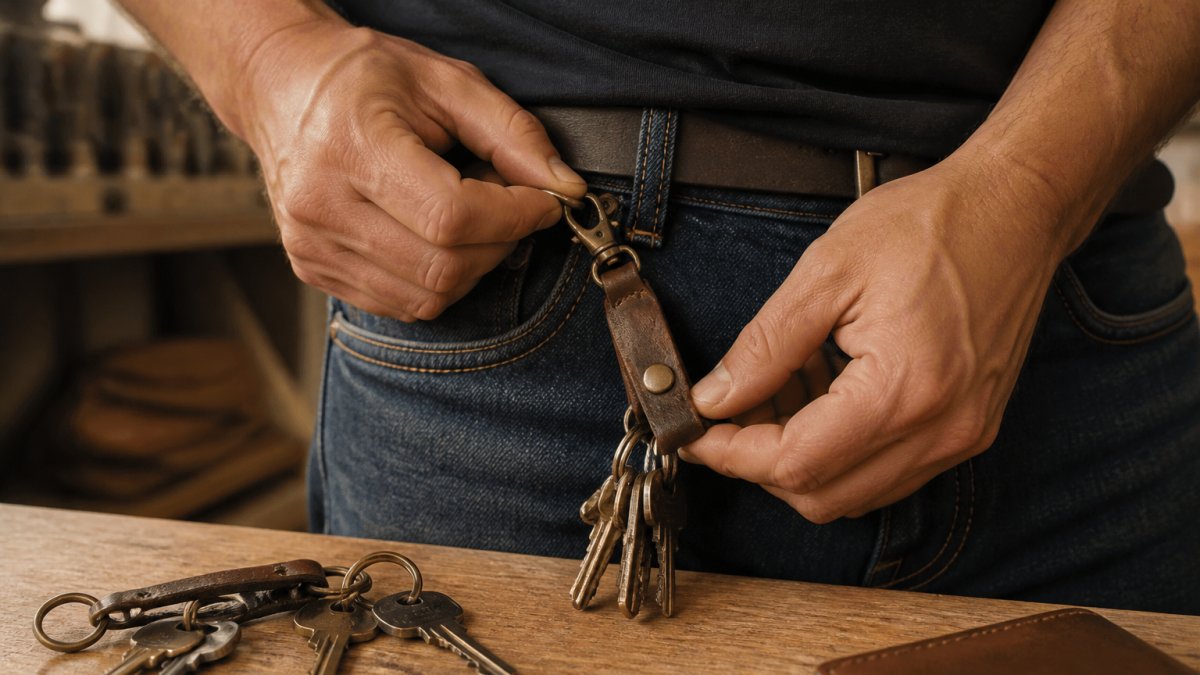
The retention mechanism is the hardware that keeps your keys attached: the screw post, snap closure, split ring, or swivel claw. This is where most holders fail first, and it is the hardest part to judge from a product photo.
Screw Posts: Metal Insert or Threaded Leather?
A screw post is a two-piece fastener that clamps the leather panels together. A post with a metal insert holds torque and resists stripping; a post that threads directly into leather will strip out as the fibers compress and wear.
Test criteria: ask the maker whether the post has a metal insert. If you have the holder in hand, back the screw out and look at the hole. A metal sleeve is visible.
Snaps: Pull Test and Wear Pattern
A snap closure should feel tight on the first open and close; a loose snap will pop open in your pocket when loaded with keys.
Wear pattern to watch: the female side of a snap can lose tension over hundreds of cycles. A maker who uses a branded snap, such as a common hardware brand, is usually signaling a higher duty cycle.
Split Rings: Gauge and Bend Test
A split ring is the simplest retention method and the easiest to get wrong. Thin wire rings bend open and lose keys; thick gauge rings hold their shape.
Leather Key Holder, Leather Key Chain, Leather Key Ring, Key Chain, EDC →
A common pattern is that cheap holders ship with thin rings that feel fine on day one and fail after a few months of pocket carry. Ask for the wire gauge if the maker lists it.
Swivel Claws: Rotation and Attachment Point
A swivel claw clips to a belt loop or bag and rotates 360 degrees. It should turn freely without binding; a stiff claw fights you every time and transfers stress to the leather at the attachment point.
Look at how the claw attaches to the leather. A rivet through a reinforced tab distributes load better than a single stitch line. If the attachment is only stitched, watch for fraying at that point over time.
Mechanism Durability and Maintenance
Once a month, tighten screw posts, test snap tension, and check the split ring for bending. A loose screw post is the most common failure and the easiest to prevent with a screwdriver and thirty seconds.
Replacement is usually simple. Screw posts, snaps, and split rings are standard hardware. Ask the maker whether they sell replacement parts or will service the holder.
Step 4: Keep Pocket Bulk Down with a Compact Key Organizer for Everyday Carry
A compact key organizer for everyday carry should disappear in your pocket. Bulk comes from three places: leather thickness, hardware size, and how the keys stack.
Keep these numbers in mind:
- Leather weight: 4-5 oz leather is the sweet spot for key holders. Thicker is stiff and bulky. Thinner stretches.
- Footprint: A holder around 2.6 inches long and 0.6 inches wide stays out of the way in a front pocket.
- Key stack: Keys should sit flat and layered, not bunched into a lump.
Pocket carry beats belt carry for most people, but if you wear dress pants or carry a bag, a clip-on fob keeps your pockets empty. Weigh your current keyring and compare it to the holder's listed weight; if the maker does not list weight, that is a red flag.
Key Organizer vs Keychain: Which Carry Style Fits You
Key organizer vs keychain is really a question about how you use your keys. A keychain is a ring.
| Feature | Loose Keychain | Leather Key Holder |
|---|---|---|
| Noise | Loud jingle | Quiet |
| Pocket wear | Scratches phone and lining | Leather protects |
| Key access | Grab and sort | One key at a time |
| Bulk | Thin but messy | Slightly thicker, tidy |
| Durability | Ring wears out | Leather ages well |
| Style | Utilitarian | Finished look |
Pick a keychain if you carry two keys and nothing else. Pick a leather key holder if you carry three or more keys, a fob, or anything that scratches.
The middle ground is a leather key fob with a swivel snap. It clips to your belt loop or bag and keeps keys off your pocket entirely.
Leather Key Holder Maintenance, Patina, and Repair
Leather key holder maintenance takes about five minutes a month and adds years to the life of the piece.
Here is the routine we recommend:
- Wipe the leather with a dry cloth to remove grit
- Apply a thin coat of neatsfoot oil once or twice a year
- Buff with a soft cloth after oiling
Patina is the dark, glossy finish leather develops as oils from your hands and the air work into the surface.
Veg tan leather patinas fastest. Expect a noticeable color shift within a few months of daily carry.
Repair is usually simple: loose stitching at the rivet or a stretched key hole can often be fixed by a leatherworker.
Choosing Your Leather Key Holder: A Quick Comparison
Use this table to match your carry style to the right holder, then check the maker's specs against your key load.
| Your Situation | What to Prioritize | What to Avoid |
|---|---|---|
| 3-5 flat keys, front pocket | 4-5 oz veg tan, compact size | Thick stacked leather |
| Car key plus house keys | Wide panel, strong screw post | Narrow fobs |
| Belt loop or bag carry | 360-degree swivel snap | Fixed clips |
| Dress pants or slacks | Clip-on fob, no pocket bulk | Bulky organizers |
| Access cards in the mix | Room for a card slot | Tight key stacks |
| Gift buyer | Personalization options | Generic sizing |
Want something with more character? Our alligator leather key holders in burnt orange and black run $40.00, each with the same 360-degree swivel snap and hand finish.
The right leather key holder is the one that fits your keys, your pocket, and your routine.
Frequently Asked Questions
What should you look for in a leather key holder?
Start with the leather itself. Full-grain or top-grain veg tan holds up to daily wear and develops patina instead of cracking. Then check the retention mechanism: a 360-degree swivel snap claw keeps keys secure and lets them rotate freely so they do not tangle. Confirm the size fits your key count, and look for hand-burnished edges and a rivet-secured build. A leather key holder from a maker who names the leather weight, such as 4-5 oz, gives you a clearer picture of how it will hold up.
How many keys can a key organizer hold?
It depends on the design. A simple leather key fob typically holds 3 to 6 keys on a split ring, while a folding key organizer with a screw post often handles 6 to 10. Car fobs and access cards take up more room than flat keys, so count those separately. If you carry more than 8 keys, look for a wider panel or a two-ring setup. Measure your key stack first, then pick a holder with a little slack so keys still swing freely.
Are leather key holders better than traditional keychains?
For everyday carry, usually yes. A leather key holder keeps keys contained so they do not jingle or scratch your phone and cards, and the leather adds a layer of protection in your pocket. Traditional keychains are cheaper and easier to add keys to, but they let keys splay out and wear faster. If you carry more than three keys daily, a leather key organizer vs keychain comparison almost always favors the organizer for quiet, organized carry.
How do you maintain a leather key holder?
Wipe it with a dry cloth when it gets dusty, and keep it away from soaking water. Every few months, apply a thin coat of neatsfoot oil or a leather conditioner, let it absorb, then buff with a soft cloth. If the snap or rivet loosens, stop using it and have it repaired before the leather tears. Regular leather key holder maintenance like this keeps the leather supple and slows wear at the belt loop.
Your keys deserve better than a scratched phone and a noisy pocket. At AnchorsAweighLeather, we handcraft every key holder from premium veg tan leather, finish it by hand, and back it with American-made construction from a veteran-owned shop. Browse our leather key holders and fobs, add free personalization, and carry something built to last.
0 comments