
Last Updated: November 5, 2026
Quick Summary
Machine stitching fails over time because a lock stitch interlocks two threads at a single point inside the material, so abrasion, tension drift and needle damage can each loosen that crossing. When one thread breaks, the neighboring loop can release and pull through the same hole, turning one broken stitch into a run of open holes.
- Exposed thread wears through from abrasion, shifting load onto the remaining strands.
- Loose top tension pulls the interlock toward the surface, where abrasion reaches it sooner.
- A dull or bent needle leaves uneven holes that weaken the seam before any thread breaks.
- A saddle stitch resists unraveling because a broken thread on one side leaves the other locked.
Table of Contents
- The Most Common Reasons Machine Stitching Fails Over Time
- Saddle Stitch vs Lock Stitch Durability: Why the Structure Matters
- Material-Specific Durability: Thread, Leather Weight and Load
- How to Identify Hand Stitched Leather Before You Buy
- Choosing a Leather Wallet or Holster Built to Outlast Machine Seams
- Frequently Asked Questions
Machine stitching rarely fails all at once. A seam on a wallet or holster usually holds for months, then a few threads loosen, a stitch skips, and the line starts to open. Understanding the mechanics behind this pattern is one of the fastest ways to judge whether a leather product will last.
A lock stitch is the most common stitch on consumer and industrial sewing machines. It works by interlocking two threads, a top thread from the needle and a bobbin thread from below, so that each stitch is secured at both faces of the material. That interlock is what makes it fast and affordable to produce. It is also what makes it vulnerable: if either thread weakens, the lock can release, and a single broken stitch can let the rest of the line unravel.
The trade-off is structural. A lock stitch depends on consistent tension, a sharp needle and thread that matches the material. When any of those drift, the stitch starts to loosen before the leather itself shows any wear.
The Most Common Reasons Machine Stitching Fails Over Time
Machine stitching fails over time because a lock stitch is a chain of interdependent loops, and every failure mode attacks one link in that chain. The causes below are not independent; in practice they compound, which is why a seam that looks fine at purchase can open months later.
Thread Wear, Abrasion and Unraveling
Thread takes the punishment that the leather does not. On a lock stitch, the top thread and bobbin thread interlock at the middle of the material, so the exposed thread on both faces carries the same load. Every time a wallet slides into a pocket or a holster rubs against a belt, the exposed thread abrades. Once the outer fibers wear through, the load shifts onto the remaining strands, and the stitch begins to pull out of the hole it made.
A frayed section of thread becomes the weakest point in a stitch, and once one loop slips, neighboring stitches carry more load. This is one reason machine seams can fail in a run rather than at a single point.
Tension Drift and Needle Damage
Tension that is slightly off at the start can hold for a while, then worsen as the machine vibrates and the thread settles. A lock stitch depends on the top and bobbin threads meeting at the same point inside the material; if the top tension is too loose, the bobbin thread is pulled toward the top face and the interlock sits near the surface, where abrasion reaches it sooner. If the top tension is too tight, the seam puckers and the thread is pre-stressed before it ever sees a load.
Needle damage compounds the problem. A dull or bent needle drags rather than penetrates cleanly, creating uneven holes that weaken the seam before any thread breaks. A needle that is too large for the thread punches a hole bigger than the thread can fill, so the stitch has room to migrate; a needle that is too small for the leather deflects and skips. A worn needle can also skip stitches, leaving gaps that a seam cannot afford, because each skipped stitch shifts load onto its neighbors.
Why the Lock Stitch Unravels When One Thread Breaks
The structural reason machine stitching fails over time is the interlock itself. In a lock stitch, the top thread and bobbin thread cross at a single point inside the material, and each stitch is secured only by that crossing. If either thread breaks at one stitch, the loop at that stitch can release, and the thread from the adjacent stitch can pull through the same hole. The result is a run: one broken stitch becomes two, then a line of open holes.
A saddle stitch does not share this failure mode. Two needles, each pulling a separate thread through the same hole from opposite sides, pass the threads through each other inside the material. There is no single crossing that can release both sides, so a broken thread on one side leaves the other side's thread locked in the hole.
The main causes of machine stitch failure, and how each one weakens a seam, are summarised below.
| Cause | How it fails | Why it matters |
|---|---|---|
| Thread wear and abrasion | Exposed thread wears through and load shifts to remaining strands | Each stitch loses holding strength |
| Tension drift | Loose top tension pulls interlock toward the surface | Abrasion reaches the interlock sooner |
| Needle damage | Dull or bent needle drags and leaves uneven holes | Seam weakens before any thread breaks |
| One broken thread | Adjacent loop releases and thread pulls through the same hole | One broken stitch can become a run of open holes |
Saddle Stitch vs Lock Stitch Durability: Why the Structure Matters
A saddle stitch uses two needles, each pulling a separate thread through the same hole from opposite sides, and the two threads pass each other inside the material. Because there is no single thread that can pull free from one side alone, a broken thread does not automatically release the seam. The stitch is far more resistant to unraveling, which is why hand-stitched leather goods tend to outlast machine seams under repeated load.
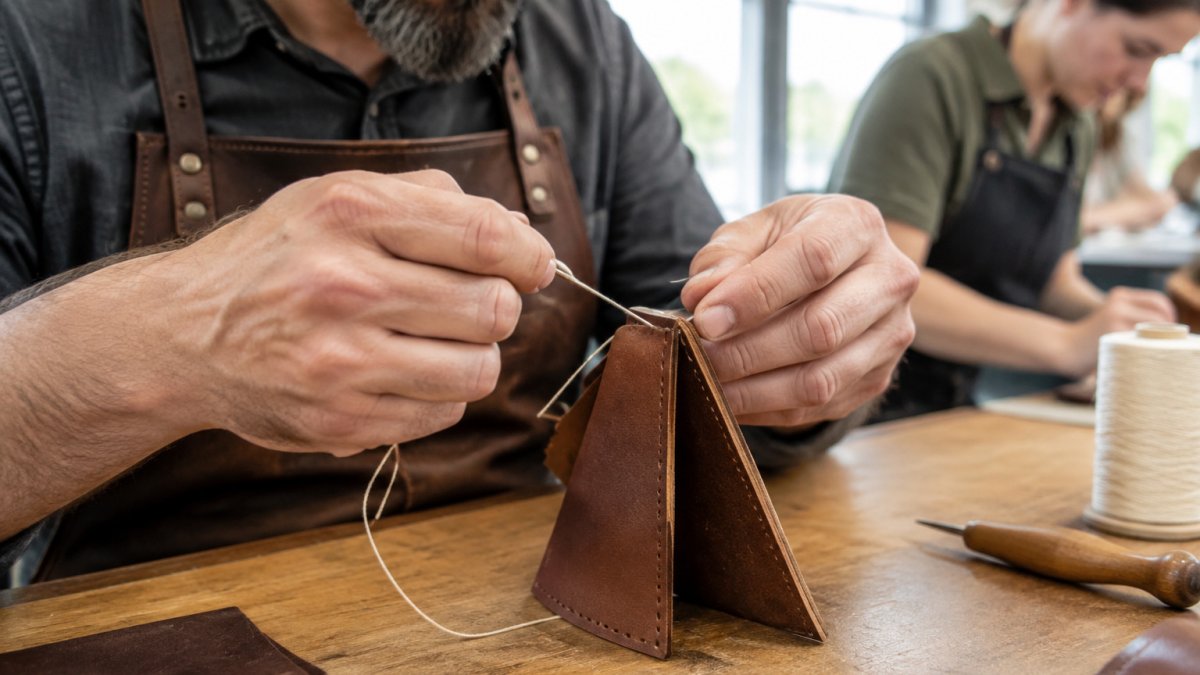
The difference comes down to redundancy. A lock stitch is only as strong as its weakest interlock point, while a saddle stitch distributes the load across every pass of the thread.
Crusader Leather Bi fold Wallet: Hand Stitched Slim Design →
Material-Specific Durability: Thread, Leather Weight and Load
Thread choice and leather weight determine how a seam behaves under stress, but the interaction between the two matters more than either variable alone. The same thread that performs well in a firm veg-tan holster can fail early in a soft chrome-tan wallet, because the leather's density and flex change how the stitch sits and how load reaches it.
Thread Type and How It Interacts with Stitch Structure
Waxed linen thread is the traditional pairing for a saddle stitch. The wax coating reduces friction as the thread passes through the hole, helps the thread lock into the leather, and slows moisture uptake. Linen has low stretch, so a saddle-stitched seam in waxed linen holds its tension rather than creeping loose under load. The trade-off is abrasion resistance: linen fibers wear faster than synthetic fibers when exposed to grit and repeated rubbing.
Synthetic thread, typically polyester or nylon, offers higher abrasion resistance and consistent diameter, which is why it dominates machine sewing. In a lock stitch, synthetic thread's low stretch is an advantage because the interlock depends on consistent tension. In a saddle stitch, synthetic thread can be too slippery to lock as firmly as waxed linen, so some makers prefer a lightly waxed synthetic or a blended thread.
A heavy, waxed thread sits securely in thick leather, while a thin thread can cut into softer hides and fail sooner. Thread diameter should match the hole the awl or needle makes: too thin and the stitch migrates, too thick and the leather around the hole is overstressed.
Leather Weight, Flex and Load Path
Leather weight also matters: thin leather flexes more, which increases the bending stress on each stitch. A wallet panel that bends every time it goes into a pocket works each stitch back and forth, and a lock stitch's interlock sits directly in that flex zone. Thicker leather distributes the same bend over a larger radius, so each stitch sees less movement.
Load is the final variable. A card holder sees light, frequent stress, while a holster bears sustained tension from the firearm and the belt. Sustained tension favors a stitch structure that distributes load across many passes, which is the saddle stitch's advantage; frequent light stress favors abrasion resistance, which is where thread type and edge finishing matter most.
Matching Thread, Leather and Stitch to the Load
Watch out: a maker who uses premium leather but undersized thread, or a heavy thread in a soft leather, can produce a seam that fails sooner than a well-matched seam in a less expensive material.
How to Identify Hand Stitched Leather Before You Buy
Hand-stitched work leaves visible clues. Look at the holes along the seam: saddle-stitched seams show a continuous line of matching stitches on both faces, and the stitches look consistent in length and spacing. A machine lock stitch often shows a slightly different pattern on the reverse side, with the bobbin thread visible as a series of loops. Check the edges too. Hand-stitched edges tend to be finished and slightly uneven in a way that reflects individual work, while machine edges are typically uniform and tightly trimmed.
Ask any seller how the seams were made before you buy. For more practical guidance on picking durable leather goods, read How to Choose a Durable Leather Wallet Gift. If the answer is vague, treat that as a signal to look more closely before you commit.
Choosing a Leather Wallet or Holster Built to Outlast Machine Seams
If longevity is your priority, look for a hand-stitched design and check the seam details before you buy. You can see a hand-stitched slim bifold built this way in the Crusader Leather Bifold Wallet. Our Crusader Leather Bifold Wallet is handcrafted in the USA from premium full-grain leather, with a slim bifold layout that fits a front or back pocket. For a more rugged option, the Longhorn Minimalist Wallet is hand-stitched from premium full-grain leather and finished in Saddle Tan with a hand-tooled longhorn design. If you need a holster, the HOSS IWB Leather Holster is handcrafted in the USA from premium full-grain leather with a universal IWB fit.


Machine stitching has its place, but if you want a piece that holds together for years of daily use, the structure of the seam is the first thing to examine. Browse our handcrafted leather goods to find a design built the way it should be.
Frequently Asked Questions
Is the saddle stitch stronger than a machine lock stitch?
A saddle stitch uses two needles that pass through the same hole from opposite sides, so each stitch is locked independently. If one stitch breaks, the rest of the seam holds, because the thread does not run in a single continuous loop that can unravel. A machine lock stitch joins top and bobbin threads at each point, so a single broken or loosened stitch can let the seam run. Saddle stitching is generally regarded as the more durable structure for leather, though the actual strength also depends on thread weight, stitch spacing and leather thickness.
Why does machine stitching unravel so easily?
Machine stitches rely on the tension balance between the needle thread and the bobbin thread. When tension drifts, the lock point shifts and loops can pull loose. Abrasion from daily wear, a dull or bent needle that damages thread fibers, and skipped stitches that leave gaps all weaken the seam. Once one section begins to fail, the remaining stitches carry extra load and tend to follow. Regular inspection and correct tension settings slow this process considerably.
What causes leather stitching to break over time?
Leather stitching most often breaks from abrasion where the seam rubs against pockets, belts or hardware, from thread that is too light for the load, and from stitch holes that are too close to the edge. Moisture and sweat can also weaken unwaxed thread. Hand-stitched seams resist these failures better than machine seams, and a stitch can be repaired by re-threading a single section.
How can you tell if a leather wallet is machine or hand stitched?
Look at the stitch line on both faces of the leather. Machine stitching produces identical stitches on each side with the same thread path, while a hand saddle stitch shows the same visible line on both faces, but the stitch looks slightly irregular in spacing and the thread ends are hidden inside the seam. Check the edges for uneven hole placement and inspect the back of the seam for a bobbin lock pattern. Listings from makers that describe hand stitching with waxed thread and two needles are a useful starting point.

0 comments