
Table of Contents
- Start With How You Travel, Not the Cover
- Leather Quality: Why a Full-Grain Leather Notebook Cover Wins
- Travel Journal Cover Sizes and Insert Compatibility
- Stitching, Binding, and Closure Security
- Why a Leather Notebook Cover With Pen Loop Belongs in Your Bag
- Weather, Scuffs, and How Leather Ages on the Road
- How to Care for a Leather Journal Cover While Traveling
- A Travel-Ready Selection Checklist and Total Cost of Ownership
- Frequently Asked Questions
Last Updated: October 17, 2026
Start With How You Travel, Not the Cover
The best leather journal cover for travel is the one that matches how you actually move, not how you imagine you'll move.
Ask three questions first: Where will it ride? How much writing will you do? What weather will it meet? A pocket notebook cover for quick notes on a train platform has different demands than a traveler-style notebook that holds months of entries.
Leather Quality: Why a Full-Grain Leather Notebook Cover Wins
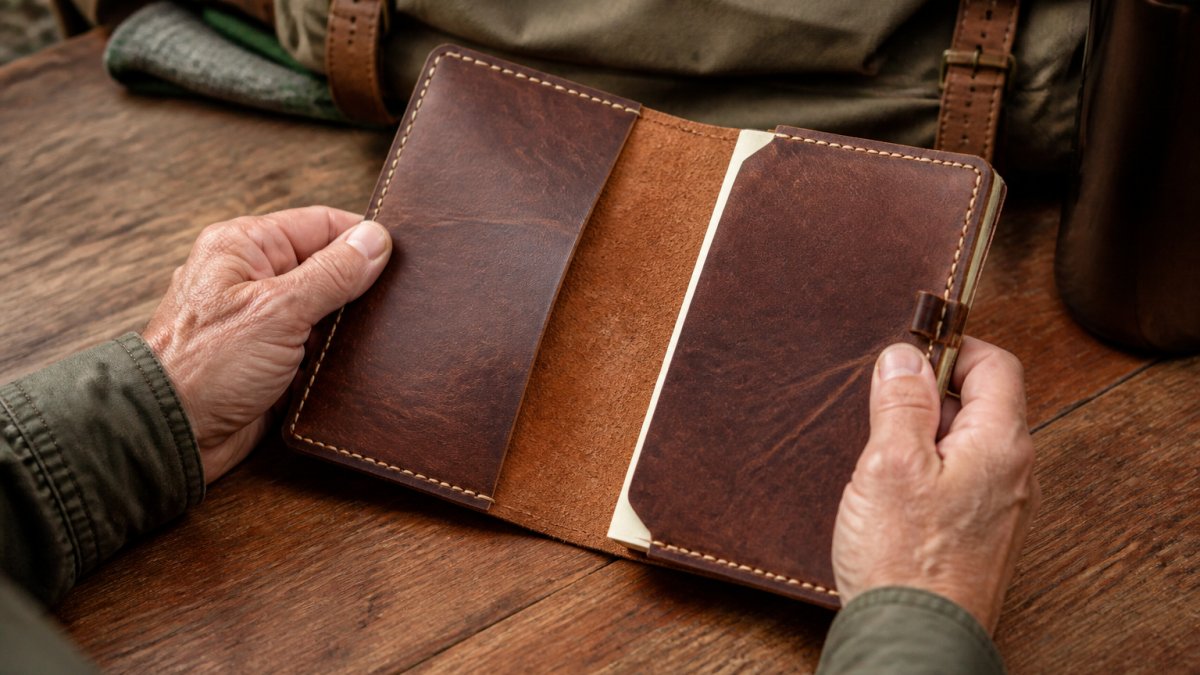
A full-grain leather notebook cover is cut from the outermost layer of the hide, where the fibers are densest and most intact. Lower grades get sanded or corrected to hide flaws, which removes the toughest fibers along with them.
Full-Grain vs. Pebbled and Top-Grain Leather
Top-grain leather is the layer just below the surface, sanded smooth and often treated for a uniform look. It's decent, but it's thinner on character. Pebbled leather gets its bumpy texture from pressing or tumbling, which can hide natural marks. That's fine for a dress wallet. For a travel journal cover, full-grain is often preferred.
The trade-off is honesty: full-grain shows every scuff. Many travelers learn to love that. If you want a cover that looks factory-new forever, full-grain will frustrate you.
Travel Journal Cover Sizes and Insert Compatibility
Travel journal cover sizes are usually described by the insert they hold, not the cover itself. That's the number that matters. A cover built for a 3.5 by 5.5 inch pocket notebook won't accept a standard 5 by 8 inch journal, no matter how the listing phrases it.
Standard Sizes, Outside Dimensions, and Refills
Check two measurements before buying: the insert size and the outside dimensions. A cover adds bulk at the spine and edges, so a pocket insert might yield a cover closer to 4 by 6 inches folded. Confirm refill availability too.
Our Leather Journal, Field Notes Wallet fits a 3 1/4 by 5 1/2 inch notebook and measures about 6 by 4 inches folded, with a card pocket, a stash pocket, and a notebook slot. It's the size most travelers actually carry.

Stitching, Binding, and Closure Security
Closure security is important. An elastic band stretched around a flimsy cover can lose tension. A snap that wasn't set properly can pop open. A wraparound strap that felt snug can loosen. Test the closure yourself before you commit.
Compare Closure Types by How They Fail
Each closure design has a characteristic failure mode. Knowing it helps you inspect a cover in person or ask the right question online.
- Elastic band (vertical or horizontal): Fails by losing tension. The elastic stretches, the cover no longer grips the insert, and pages shift. Look for elastic that's anchored through reinforced channels or stitched pockets, not glued. A glued channel softens in heat and pulls free.
- Snap closure: Fails at the set point. A poorly set snap, one that wasn't pressed with the right die, works loose and eventually tears through the leather. Check that the snap has a backing washer or a leather reinforcement patch behind it. Snap a cover shut and open it ten times in the store; a quality snap seats with a firm, consistent click.
- Wraparound strap or cord: Fails by stretching or slipping. Leather straps stretch with use; cord wraps can loosen if the notch or slot wears. Look for a strap with multiple adjustment holes or a cord with a positive lock, not a friction fit alone.
- Magnetic closure: Fails by weakening. Magnets lose strength with heat and repeated opening, and a strong magnet can interfere with a compass or a hotel key card. Test by closing the cover and shaking it gently, if it opens, the magnet is too weak for travel.
The Shake Test and the Stuff Test
Two quick checks tell you more than any product description.
The shake test: Load the cover with your actual notebook and pen, close it, and shake it firmly for five seconds over a bed or table.
The stuff test: Overfill the cover slightly, add a folded map, a boarding pass, a couple of cards, and close it. A good closure still engages with a little extra bulk.
Stitching That Holds Under Closure Stress
Closure stress concentrates at the spine and at the closure attachment points. Saddle stitching, done by hand with two needles and waxed thread, can hold even if one stitch breaks because the remaining stitches are independent. Machine lockstitch is fine for flat seams but can unravel from a single broken thread at a stress point. Look for hand-saddle-stitched spines and edges, and check that the closure is anchored with stitching or rivets rather than glue alone.
Why a Leather Notebook Cover With Pen Loop Belongs in Your Bag
A leather notebook cover with pen loop helps ensure you have a pen when you need one. A loop keeps your pen attached to the journal, so the two stay together.
Beyond the pen, look for a card pocket and a stash pocket. Our Leather Passport Holder is built for exactly this: two card slots, two document pockets, and a 6 by 3.8 inch footprint that handles a passport and a field notebook together.
Leather Passport Holder, Travel Wallet, Passport Wallet, field note cover →

Weather, Scuffs, and How Leather Ages on the Road
Leather ages well if you let it. Full-grain develops a patina, a darkening sheen that comes from oils in your hands and sunlight. Scuffs on the surface often buff out with a thumb and a little conditioner. Full-grain can evolve instead of degrading. Travel can expose a cover to conditions like rain, humidity, heat, abrasion, and the pressure of being packed against other gear. Here's how each one can behave.
Rain and Humidity
Rain is the real test. Vegetable-tanned leather, which we use, absorbs water and darkens when wet. It can recover if you let it dry at room temperature, away from direct heat.
Humidity is a slower problem.
Paper inserts can be more vulnerable than the leather. Most notebook paper can cockle and wrinkle when it absorbs moisture, and ink can feather or smudge.
Heat
Heat can affect travel gear. A leather cover left on a car dashboard or in direct sun can dry out, stiffen, and crack at the fold. Elastic closures can lose tension faster in heat, and glued components can soften. The practical rule: don't store a leather cover anywhere you wouldn't leave a chocolate bar. A hot car, a sunny windowsill, or the top of a backpack in direct sun all qualify.
Abrasion and Scuffs
Scuffs come from friction, the cover rubbing against a bag's interior, a zipper, keys, or a camera. Full-grain leather can take these in stride; the surface fibers can compress and darken rather than tearing. Light scuffs often buff out with a thumb and a little conditioner. Deeper gouges can become part of the cover's story. If you want a cover that looks factory-new forever, full-grain may frustrate you; if you want one that records where you've been, it can be a suitable material.
What Actually Protects the Cover on the Road
- A dedicated pocket or pouch. The single best protection is keeping the cover away from loose metal and abrasive gear.
- A simple sleeve. A cloth or felt sleeve adds a layer against scuffs and moisture without much bulk.
- Air-dry discipline. Empty the pockets and let the cover air out after a wet or humid day.
- Sparing conditioner. A pea-sized amount every few months is plenty; more clogs the pores and attracts grit.
How to Care for a Leather Journal Cover While Traveling
How to care for a leather journal cover on the road comes down to three habits: keep it dry, condition it sparingly, and store it flat. Wipe off dust and grit with a dry cloth before it works into the stitching.
Pack it flat against a notebook or a folded shirt, not crushed at the bottom of a duffel. If it gets soaked, empty the pockets, blot the surface, and let it air dry away from sun and heat.
A Travel-Ready Selection Checklist and Total Cost of Ownership
Run this checklist before you commit. It covers the gaps most buying guides skip: weight, closure testing, and long-term cost.
| Check | What to Look For | Why It Matters |
|---|---|---|
| Leather grade | Full-grain, vegetable-tanned | Survives abuse, develops patina |
| Insert size | Matches your notebook (e.g. 3.5 x 5.5 in) | Refills stay easy to find |
| Outside dimensions | Fits your bag pocket | One-hand access in transit |
| Closure | Hand-set snap or taut elastic | Pages stay put in a bag |
| Stitching | Saddle-stitched spine and edges | Holds up to daily opening |
| Pen loop | Fits your pen snugly | No lost pens mid-trip |
| Weight | Light enough for daily carry | Heavy covers get left behind |
| Care needs | Simple conditioning, air dry | Low maintenance on the road |
Total cost of ownership can favor full-grain. A cover replaced every year or two can cost more than one handcrafted cover that lasts longer. Buy once, condition it occasionally, and let it age.
Frequently Asked Questions
What size leather journal cover is best for travel?
Match the cover to the notebook you actually write in. Pocket field notes run about 3 1/4 by 5 1/2 inches and slip into a jacket pocket, while larger A5-style covers suit longer entries but add bulk to a daypack. Check the outside dimensions of the cover, not just the insert size, since a leather journal cover adds thickness at the spine and edges. A cover around 6 by 4 inches folded, like the field notes wallet style, is a practical middle ground for most travelers.
Is a full-grain leather notebook cover worth the extra cost?
Full-grain leather keeps the strongest part of the hide intact, so it can resist cracking and take on a patina instead of peeling. Cheaper corrected-grain or bonded leather can split at flex points. For a travel journal that gets stuffed into bags and handled constantly, a full-grain leather notebook cover can offer long-term value, which can make the upfront price easier to justify over time.
How do you keep a leather journal cover from getting scratched while traveling?
Scuffs are part of how leather ages, but you can limit damage by keeping the cover in its own pocket or sleeve rather than loose with keys and tools. Avoid overstuffing card slots, since pressure stretches the leather and dulls the finish. A light application of leather conditioner before a trip adds a protective layer. If a scratch appears, rub it with a fingertip; natural oils often blend minor marks back into the grain.
How do you care for a leather notebook cover on a trip?
Wipe off dust and grit with a dry cloth at the end of each day, and keep the cover away from direct heat and prolonged sun, which dries out the leather. If it gets wet, blot it and let it air dry at room temperature rather than using a hair dryer. Pack a small tin of conditioner for longer trips and apply a thin coat every few weeks. Store the cover with the notebook inside so it holds its shape between uses.
The hard part of travel gear is trusting it will hold up trip after trip. We build our leather journal covers by hand from full-grain, vegetable-tanned leather, saddle-stitched for durability, and sized for real pocket notebooks. Every order ships free over $100, and we take custom requests if you need a specific fit. Get started with AnchorsAweighLeather and carry a cover that gets better with every mile.
0 comments