
Table of Contents
- Why Custom Left-Handed Leather Holsters Matter
- IWB vs OWB Carry: Which Style Works Best for Left-Handed Shooters
- Best Appendix Carry Leather Holster Features for Southpaws
- Material Quality and Leather Selection
- The Leather Holster Break-In Process
- How to Care for Leather Gun Holsters
- Customization Options for Your Specific Firearm and Carry Style
- Conclusion
Last Updated: August 29, 2026
Why Custom Left-Handed Leather Holsters Matter
Left-handed shooters face a fundamental problem: most holsters are designed for right-handed carriers. A custom left-handed leather holster solves this directly. At AnchorsAweighLeather, we understand that carrying a firearm shouldn't require compromise or uncomfortable adjustments to your natural draw stroke.

Left-handed shooters need retention systems, cant angles, and trigger guard coverage that match their biomechanics. Off-the-shelf options force you to adapt your body to the holster instead of having a holster built for how you actually move. A properly fitted custom left-handed leather holster eliminates this friction entirely.
Leather remains the gold standard for concealed carry because it molds to your body, breathes during all-day wear, and improves with use. Unlike synthetic materials that stay rigid or degrade unpredictably, quality leather develops character over time. For left-handed carriers, customization becomes non-negotiable. You're commissioning a tool built specifically for your firearm model, carry position, and dominant hand.
IWB vs OWB Carry: Which Style Works Best for Left-Handed Shooters
Inside-the-waistband and outside-the-waistband carries each present distinct advantages for left-handed shooters. Your choice depends on your lifestyle, clothing options, and how much concealment you prioritize.
Inside-the-Waistband (IWB) Carry
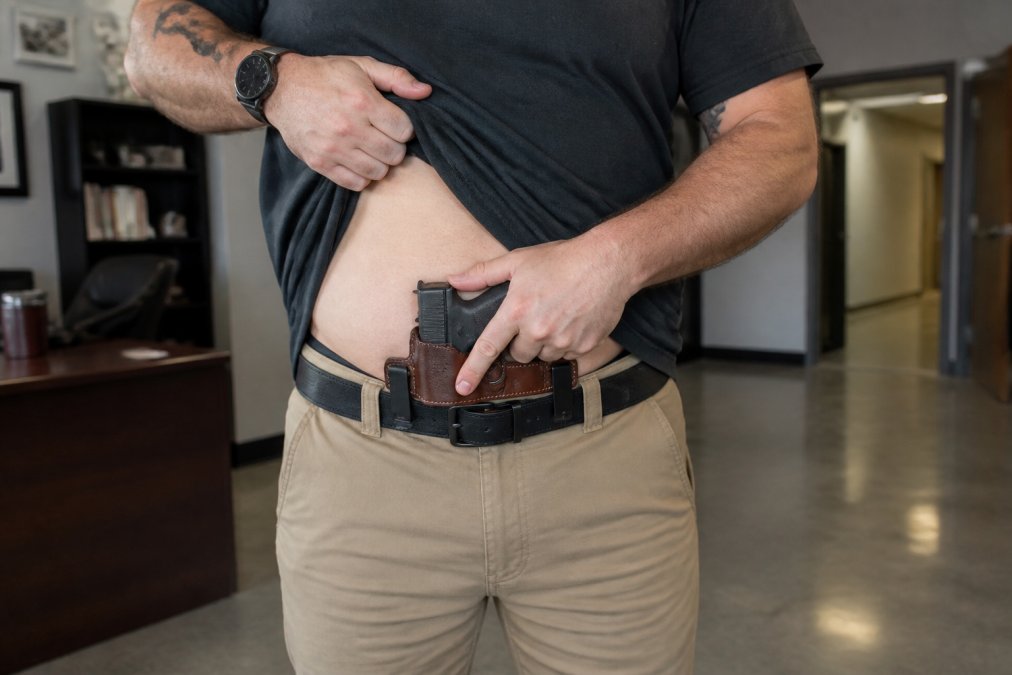
Inside-the-waistband carry positions your firearm inside your pants, against your body, with the holster's belt loop anchoring to your waistband. For left-handed shooters, this means your draw hand approaches the gun from inside your clothing, a direct, efficient motion that minimizes exposure.
The concealment advantage is substantial. Your shirt, jacket, or sweater covers the entire holster and firearm, preventing printing in professional environments. IWB also positions the gun closer to your body, reducing the likelihood of someone accessing it in a physical altercation.
The trade-off is comfort during extended wear. IWB holsters sit against your body with minimal barrier between the leather and your skin. A quality custom left-handed leather holster with proper molded fit and a sweat guard minimizes these issues, though some discomfort during the break-in period is normal.
For left-handed appendix carry (gun positioned forward of the hip), IWB is the dominant choice. The position allows a fast, natural draw while keeping the firearm completely concealed. AnchorsAweighLeather's Custom Leather IWB Holster ($43.00) is hand-molded to your specific firearm, delivering the secure fit that makes IWB carry reliable for daily use.

Outside-the-Waistband (OWB) Carry
Outside-the-waistband carry positions your holster outside your pants, on your belt. For left-handed shooters, your draw hand accesses the gun from the outside with nothing between your hand and the holster except air.
OWB carry excels in accessibility and speed. Your draw stroke encounters zero fabric or additional layers. The holster sits higher on your belt, often making the draw more ergonomic for certain body types and carry positions.
Comfort during extended wear is generally superior to IWB. Your firearm sits outside your body, so there's no direct contact with your skin, no sweat accumulation, and better air circulation. For outdoor activities or climates where heat and humidity are factors, OWB often feels more comfortable.
The concealment trade-off is real. An OWB holster requires cover garments to stay hidden. For left-handed shooters who prioritize open carry or work in environments where a visible holster is acceptable, OWB is a strong choice. The Freedom OWB Avenger Leather Holster ($66.00) from AnchorsAweighLeather delivers the functional design that works for left-handed carriers who want speed and durability.
Appendix Carry for Left-Handed Shooters
Appendix carry positions your firearm at the front of your waistband, to the left of your centerline, angled forward. This position offers several biomechanical advantages. Your natural hand position when relaxed places your left hand near the appendix area, making the draw stroke intuitive and fast. You can access your firearm while seated in a vehicle, at a desk, or in crowded spaces where traditional hip carry would be awkward. The gun stays completely concealed under a normal shirt or jacket.
The learning curve exists. Appendix carry requires practice to develop a safe, consistent draw. Your holster must have excellent retention and a trigger guard that completely covers the trigger during re-holstering. A custom left-handed leather holster molded for appendix carry ensures the cant angle and retention level match your specific firearm and body geometry.
Many left-handed shooters find appendix carry becomes their primary position after a short adjustment period. The combination of speed, concealment, and accessibility makes it the default choice for everyday carry.
Best Appendix Carry Leather Holster Features for Southpaws
The best appendix carry leather holster for left-handed shooters includes specific design elements that maximize both safety and performance.
Molded fit is non-negotiable. Your holster should be hand-molded to your exact firearm model, not a universal design. A molded fit ensures consistent retention, predictable draw, and secure re-holstering.
Cant adjustment allows you to dial in the forward angle of your holster. Left-handed appendix carry works best with a 15-30 degree forward cant, depending on your body type and draw preferences.
Trigger guard coverage is a safety requirement. Your trigger guard must be completely enclosed by leather so that nothing can contact the trigger during draw or re-holster. This prevents accidental discharge.
Sweat guard is a leather panel that sits between your firearm and your body, protecting the gun from sweat and moisture while protecting your skin from the gun's hard surfaces.
Hand-stitched construction matters for longevity. Hand-stitched holsters use waxed thread and stitching patterns that distribute stress across multiple anchor points, creating seams that last years of daily carry without failure.
The HOSS IWB Leather Holster ($60.50) incorporates these features with a universal design, while AnchorsAweighLeather's custom options allow you to specify exact cant angles, retention levels, and molded fit for your particular firearm.

Material Quality and Leather Selection
Not all leather is created equal. Understanding the differences helps you make an informed choice about what goes against your body and holds your firearm.
Full-Grain vs Vegetable-Tanned Leather
Full-grain leather includes the entire thickness of the hide, from the top grain through to the bottom. This leather retains natural oils and develops a patina over time. Your holster will darken and develop creases that show the history of your carry.
Vegetable-tanned leather is tanned using tannins from tree bark rather than chemical processes. This leather ages beautifully and accepts hand-tooling better than chrome-tanned alternatives. The trade-off is that it requires more maintenance and is more susceptible to moisture.
For a custom left-handed leather holster, full-grain leather offers the best balance of durability, minimal maintenance, and long-term value. AnchorsAweighLeather uses premium full-grain leather that holds its shape, resists sweat damage, and improves with age.
Hand-Stitched Construction and Durability
Hand-stitched construction is the defining characteristic of quality leather work. Each stitch is placed individually using waxed thread that resists moisture and UV damage.
The durability advantage is measurable. Hand-stitched seams regularly last 10+ years because the stitching pattern distributes stress across multiple anchor points.
Hand-stitching also allows for reinforcement at high-stress areas like the belt loop attachment and trigger guard seam. When you invest in a custom left-handed leather holster, hand-stitched construction is the foundation of a holster that will outlast your firearm.
The Leather Holster Break-In Process
New leather holsters require a break-in period. During the first 50-100 draws, your leather holster will feel stiff. The leather hasn't yet molded to your specific firearm and body geometry. This is normal and expected.
The stiffness decreases noticeably after the first 50 draws. Your body heat begins warming the leather, and the repeated friction of your draw stroke starts breaking down the stiffness. By 100 draws, most shooters report that their holster feels significantly more natural.
After 200-300 draws, your holster reaches the "sweet spot." The leather has molded to your firearm, your body heat has warmed the material, and your muscle memory has adapted to the specific draw angle and retention level. At this point, your holster feels like an extension of your body.
The break-in process continues for 1,000+ draws. Your holster will become progressively more supple, the leather will darken from body oils and sweat, and the fit will become increasingly personalized. Many shooters report that their holsters feel better after two years of daily carry than they did after two weeks.
How to Care for Leather Gun Holsters
Leather is a natural material that requires maintenance to stay supple, resist moisture damage, and maintain its structural integrity.
Regular Cleaning and Conditioning
Clean your holster monthly with a soft, dry cloth. Wipe away dust, sweat residue, and any debris that accumulates during carry. This prevents moisture from being trapped against the leather.
Condition your holster every 3-6 months, depending on your climate and how much you carry. Use a leather conditioner specifically formulated for gun holsters. Apply conditioner sparingly with a soft cloth, working it into the leather in circular motions. Allow the conditioner to absorb for 24 hours before carrying your holster again.
Over-conditioning is a real risk. Excessive conditioner can soften the leather too much, reducing retention and causing your holster to lose its shape. The goal is to maintain the leather's natural oils and flexibility.
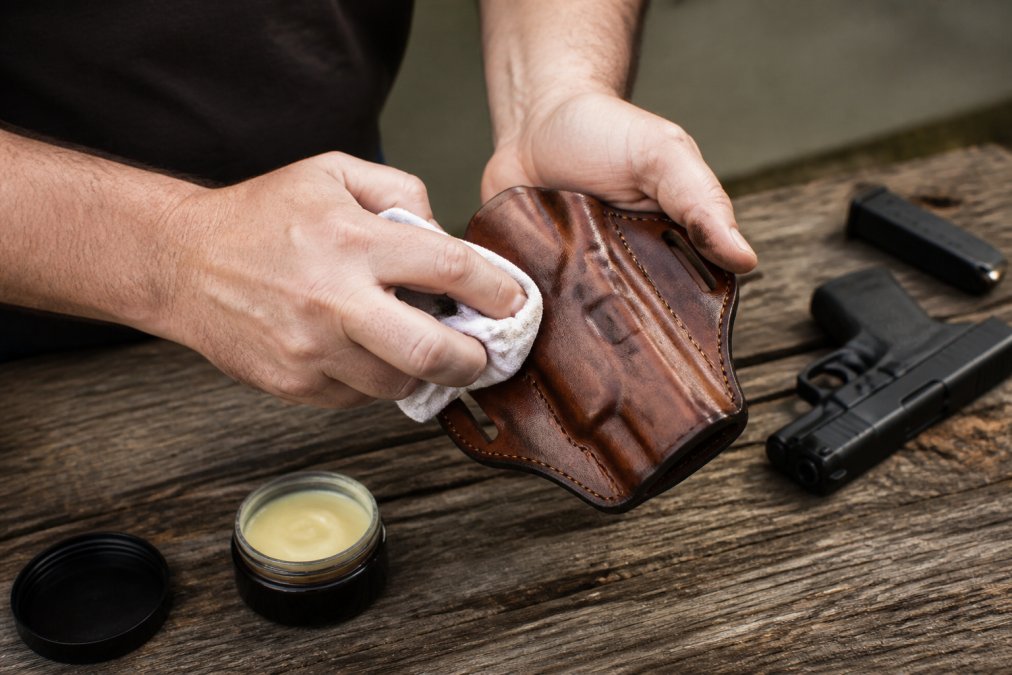
For appendix carry holsters, pay special attention to the sweat guard and trigger guard areas, which accumulate the most sweat and moisture.
Storage and Climate Considerations
Store your holster in a cool, dry location away from direct sunlight. UV light degrades leather over time, causing it to fade and become brittle. A closet, drawer, or gun safe is ideal.
In humid climates, consider using silica gel packets in your storage location to absorb excess moisture. In dry climates, increase your conditioning frequency to every 2-3 months if you notice the leather becoming stiff or developing cracks.
Avoid storing your holster near heat sources like radiators or vents. A stable, cool environment preserves your holster's shape and structural integrity.
Customization Options for Your Specific Firearm and Carry Style
The true advantage of a custom left-handed leather holster is the ability to specify exactly how it's built.
Molded Fit and Retention Adjustments
Request a molded fit for your exact firearm model. Provide your holster maker with the specific gun you'll be carrying, including the exact variant, as different barrel lengths and slide profiles affect how the holster molds.
Retention adjustment is typically handled through leather thickness and friction fit. A tighter molded fit creates more friction, requiring more force to draw. A looser fit allows a faster, easier draw but provides less security. Most custom holster makers can adjust retention by modifying the leather thickness in key areas.
For left-handed shooters, specify your hand size and grip preference. A custom holster maker can adjust the grip angle and position to match your natural hand position, making your draw faster and more intuitive.
Cant Adjustment and Draw Speed
Cant angle, the forward tilt of your holster, directly impacts your draw speed and comfort. Appendix carry typically uses a 15-30 degree cant. Specify your preferred cant angle when commissioning your custom holster.
Some custom holster makers build adjustable cant systems; others build the cant angle into the holster itself. Adjustable systems offer flexibility; fixed cant angles offer simplicity and potentially better retention.
| Customization Option | Impact on Performance | Best For |
|---|---|---|
| Molded fit to exact firearm | Optimized retention, faster draw | All carry styles |
| Cant angle adjustment | Improved comfort, customized draw stroke | Appendix and hip carry |
| Sweat guard thickness | Better moisture management | High-sweat environments |
| Hand-stitched reinforcement | Extended durability, stress distribution | Daily carry over 2+ years |
| Leather thickness variation | Adjusted retention level, personalized fit | Specific firearm models |
A custom left-handed leather holster from AnchorsAweighLeather solves the fundamental problem that right-handed holster designs create for left-handed shooters. The combination of hand-molded fit, quality full-grain leather, and hand-stitched construction delivers a holster that improves with age and outlasts cheaper alternatives by years. Whether you choose inside-the-waistband appendix carry or outside-the-waistband hip carry, a properly fitted custom holster transforms your carry experience from compromise to confidence. Start with a specific firearm model in mind, communicate your carry position and body type clearly, and commit to the break-in process. The result is a holster built specifically for how you carry, a tool that becomes more personalized and comfortable with every draw.
Frequently Asked Questions
Why do left-handed shooters need custom leather holsters instead of standard models?
Standard holsters are typically designed for right-handed carry, placing the draw angle, retention strap, and thumb break on the wrong side for left-handed shooters. A custom left-handed leather holster positions the firearm and all controls for your dominant hand, improving draw speed, comfort, and safety. The molded fit also accounts for left-side appendix or strong-side carry positions, preventing the awkward reach that comes with reversed right-handed designs.
How long does the leather holster break-in process typically take?
Most quality leather holsters require 2-4 weeks of regular carry to fully break in. During this period, the leather molds to your firearm's shape and your body's contours, improving retention and comfort. The friction fit becomes smoother, and the leather softens slightly without losing structural integrity. Handcrafted full-grain leather may feel stiff initially, but this initial firmness ensures long-term durability and security.
What's the difference between IWB and OWB carry for left-handed shooters?
IWB (inside-the-waistband) holsters sit inside your pants for maximum concealment, ideal for everyday carry where discretion matters. OWB (outside-the-waistband) holsters sit on your belt outside your pants, offering faster draw speed and better comfort during extended wear. Left-handed IWB holsters position the gun on your left side with the thumb break on the left, while left-handed OWB options like the avenger style provide a bold, open carry presentation with full accessibility.
How do I maintain my custom leather gun holster to ensure it lasts?
Clean your holster monthly with a soft cloth to remove dust and sweat buildup. Condition the leather every 3-6 months using quality leather conditioner to prevent cracking and maintain flexibility. Store it in a cool, dry place away from direct sunlight and extreme humidity. Avoid over-conditioning, which can soften the leather too much and reduce retention. Hand-stitched seams should be inspected annually for any separation, though quality craftsmanship means they'll hold for years with proper care.
This article was written using GrandRanker
0 comments