
Table of Contents
- Why Handmade Leather Holsters Retain Better Than Factory Options
- Your Leather Holster Break-In Guide for Proper Retention
- Leather Holster Molding Techniques for a Custom Fit
- How to Tighten a Loose Leather Holster Safely
- Adjusting Retention Straps and Thumb Breaks
- Retention Testing Protocols and Troubleshooting Loose Holsters
- Leather Thickness, Grain, and Quality: What Affects Retention
- Conclusion
- Frequently Asked Questions
Last Updated: September 13, 2026
Why Handmade Leather Holsters Retain Better Than Factory Options
Handmade leather holsters deliver better holster retention than factory options because each one is molded to a specific firearm, not stamped from a generic pattern. That hand-fitting creates consistent contact across the frame, which is what secure holster retention actually depends on. At AnchorsAweighLeather, we build every holster this way in our San Antonio shop, and the difference shows up the first time you holster your gun. A mass-produced pouch grips in a few spots and stays loose everywhere else. Hand-fitting spreads that pressure evenly, so the leather holds the firearm without grabbing it.

Friction Fit vs. Active Retention Explained
Friction fit, or passive retention, holds a firearm through contact pressure between the leather and the gun's frame, trigger guard, and slide. Active retention adds a mechanical device, such as a thumb break or retention strap, that you must deliberately release before the draw.
Most concealed carry setups rely on friction fit alone. It's faster, quieter, and nothing snags on your clothing during the draw stroke. Active retention makes more sense for open carry, duty use, or rough terrain where the gun could get knocked loose. The NRA guide to holster selection and carry methods covers how these systems differ in practice.
Your Leather Holster Break-In Guide for Proper Retention
A new leather holster needs a break-in period before retention settles into its final fit. Expect a stiff draw for the first week, noticeable loosening in weeks two and three, and a stable, consistent hold by week four. Most people quit during week one because the draw feels like wrestling a boot out of mud. Push through it.
The Break-In Period: What to Expect Week by Week
- Week 1: Tight draw, stiff leather, some resistance at the mouth of the holster.
- Week 2: Leather starts contouring to the frame; draw resistance drops noticeably.
- Week 3: The holster takes the shape of your firearm; retention becomes predictable.
- Week 4: Fit stabilizes. Adjust the tension screw or strap only after this point.
Leather Holster Molding Techniques for a Custom Fit
Molding is what turns a flat piece of veg-tan leather into a holster that grips a specific firearm. Wet forming is the standard method: you dampen the leather, press the gun into it, and work the material around the trigger guard, slide, and frame until it holds that shape as it dries.
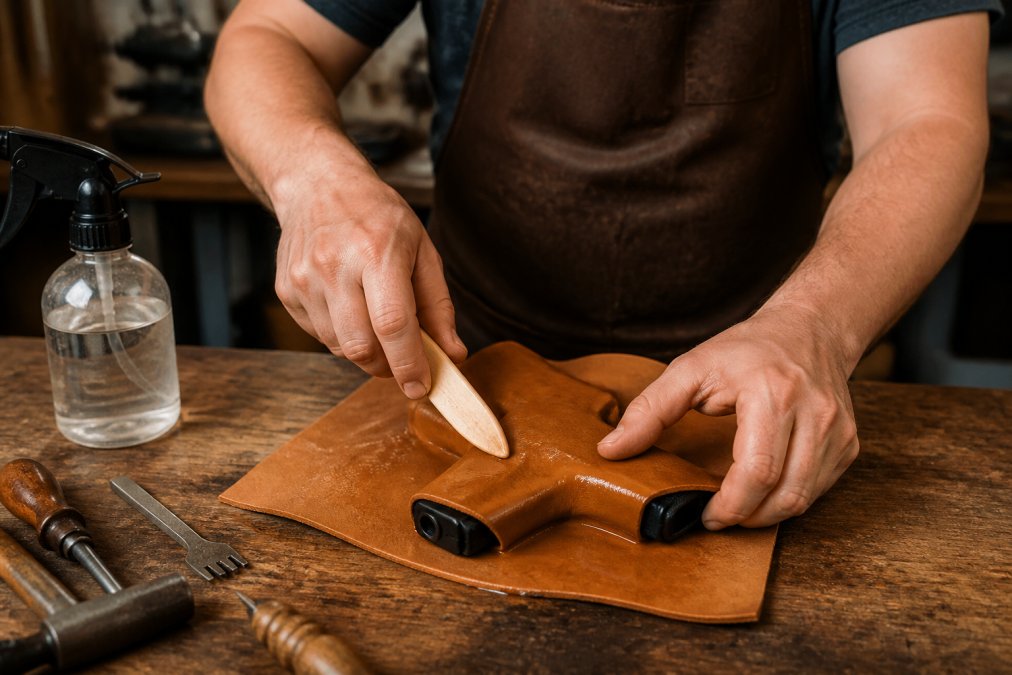
Wet Forming with Denatured Alcohol vs. Water
Water is the traditional choice. It's cheap, safe, and gives you plenty of working time, but the leather stays pliable longer and can take a full day to dry. Denatured alcohol speeds drying and produces a harder, more defined mold, which matters when you want crisp lines around a trigger guard.
The trade-off is forgiveness. Alcohol dries fast, so you get one shot at the shape. Water lets you rework a contour that isn't sitting right. For a first attempt, use water. For a production holster where the pattern is already dialed in, alcohol gives you a tighter final fit.
How to Tighten a Loose Leather Holster Safely
The safe way to tighten a loose leather holster is to adjust the tension screw first, then spot-treat the leather with moisture if more grip is needed. Never soak the whole holster, and never apply heat. Both dry out the leather and shorten its life.
Here's the order that works:
- Tighten the tension screw a quarter turn and test the draw.
- If there's no screw, dampen only the area around the trigger guard with a barely wet cloth.
- Let it dry overnight with the firearm (unloaded) or a dummy gun inserted.
- Re-test. Repeat once if needed, never more.
If the holster still won't hold after two rounds, the leather has likely stretched past recovery and it's time for a replacement.
Adjusting Retention Straps and Thumb Breaks
Retention straps and thumb breaks work on a different principle than friction: they physically block the draw until you release them. Adjust the strap so it snaps closed with light pressure but requires a deliberate motion to open. Too tight and you'll fumble under stress. Too loose and it pops open on its own.
Check the snap placement against your draw angle. A strap that sits under your thumb at rest is faster than one you have to hunt for. If you carry appendix, a thumb break positioned for a strong-side draw will fight you every time. Match the hardware to the position.
Retention Testing Protocols and Troubleshooting Loose Holsters
Retention testing is the step most people skip, and it's the one that tells you whether your holster is actually safe to carry. Test it before you trust it. The problem with most advice is that it's subjective, "shake it and see" doesn't tell you whether your holster passes or fails. What follows is a repeatable protocol with defined thresholds so you can quantify retention instead of guessing.
The Standardized Retention Test Protocol
Run these in order on an unloaded firearm, in a safe direction, with no live ammunition in the room.
- Inversion test (baseline): Holster the unloaded firearm and turn the holster completely upside down for a full 5 seconds. The firearm should not shift more than roughly 1/8 inch and must not fall free. Any drop is an automatic fail.
- Shake test (quantified): With the firearm holstered, hold the holster by the belt loops and shake firmly 10 times at roughly 2 shakes per second. Measure movement at the muzzle end. Under 1/4 inch of travel is acceptable for a friction-fit carry holster. Over 1/2 inch means the mouth has stretched and retention is degrading.
- Draw resistance (the metric most guides skip): Using a trigger-pull gauge or a luggage scale hooked to the grip, measure the force required to draw the firearm straight up out of the holster. A common working range for concealed carry friction fit is roughly 3 to 8 pounds of initial resistance. Below 3 pounds, the holster is too loose for reliable retention. Above 8 pounds, you're likely to fumble under stress. Record the number, then re-measure after 100 draws, a drop of more than 1 pound signals the leather is stretching past recovery.
- Draw consistency: Perform 20 draws. Retention should feel the same on draw one and draw twenty. If draw 20 is noticeably easier than draw 1, the leather is fatiguing.
- Re-holstering check: The holster mouth should stay open so you can re-holster one-handed without looking. A collapsed mouth is a retention and safety failure.
Troubleshooting by Failure Mode
Match the symptom to the fix:
- Fails inversion, passes shake: The whole holster is too loose. Tighten the tension screw first; if there's no screw, spot-treat around the trigger guard and dry with the firearm inserted.
- Passes inversion, fails shake: Mouth-only stretch. This is the most common failure and the hardest to fix. A light spot treatment at the mouth, dried with the firearm inserted, can buy time, but if it recurs within a month, the leather has lost its memory and replacement is the honest answer.
- Passes both, but draw resistance is under 3 pounds: The holster is technically secure but marginal for daily carry. Re-measure after a week; if it keeps dropping, treat it as a failing holster.
- Draw resistance over 8 pounds: Not a retention problem, a break-in problem. Continue the draw-and-re-holster cycle from the break-in section before adjusting anything.
When to Retire a Holster
Leather has a finite number of stretch-and-recover cycles. If a holster fails the shake test twice after two separate correction attempts, or if draw resistance has dropped more than 1 pound from its post-break-in baseline, the fiber structure has fatigued. No amount of spot treatment brings that back. Retire it.

Leather Thickness, Grain, and Quality: What Affects Retention
Leather thickness and grain determine how well a holster holds its shape over years of use. Thicker veg-tan leather, generally in the 7 to 9 ounce range, resists stretching and holds a molded contour far longer than thin, chrome-tanned material. Full-grain leather keeps the tight fiber structure that gives a holster its memory. But thickness alone is a crude metric. What actually governs long-term retention is the tannage, the chemistry used to convert hide into leather, because that chemistry determines how the fibers respond to heat, moisture, and repeated stress.
Veg-Tan vs. Chrome-Tan: How Each Reacts to Heat and Moisture
Vegetable-tanned leather is processed with plant-derived tannins (typically from tree bark). Those tannins bond with the collagen fibers and leave the leather porous and thermally responsive. When you wet-form veg-tan and let it dry, the fibers lock into the shape you pressed them into, that's the mechanism behind a molded holster. The same property means veg-tan is re-formable: apply controlled moisture and moderate heat (most makers stay under 120°F) and the fibers will relax and re-set. That's why a stretched veg-tan holster can sometimes be rescued with a spot treatment, and why overheating it permanently collapses the fiber structure and kills retention for good.
Chrome-tanned leather is processed with chromium salts. The fibers become more tightly bound and less porous, which makes the leather softer, more uniform, and far more resistant to moisture and heat. That sounds like an upgrade until you try to mold it. Chrome-tan doesn't hold a wet-formed contour the way veg-tan does, it springs back. It also doesn't re-form predictably, so once a chrome-tan holster stretches, there's no reliable way to bring retention back. This is the single biggest reason handmade holster makers default to veg-tan for anything that needs to grip a specific firearm.
Why Grain Structure Matters More Than Ounce Weight
A 9-ounce hide with loose, open grain will sag at the mouth within months, while a well-structured 7-ounce hide can outlast it. Grain is the dense outer layer of the hide where the fibers are tightest. When that layer is intact (full-grain), it acts as a structural skin that resists the mouth of the holster from flaring outward, and mouth flare is where most retention failures begin. Corrected-grain or split leather has that layer sanded or removed, which is why it feels smoother but loses the memory that keeps a holster gripping.
Stitching Tension and Panel Flex
Stitching tension plays a role too. Uneven hand-stitching lets the leather panel flex where it shouldn't, and that flex is where retention dies. A holster stitched with consistent tension along the trigger guard and mouth holds its geometry under draw stress; one with loose or uneven stitches develops a soft spot that widens with every draw. This is the part of the build that separates a holster you replace every year from one that outlasts the gun.
Conclusion
Getting retention right comes down to fit, break-in, and honest testing, and skipping any of those steps is how good holsters end up in a drawer. If you'd rather start with leather that's already molded to your firearm, AnchorsAweighLeather handcrafts every holster in the USA from full-grain leather, with custom orders available and free shipping on orders over $100. Our IWB designs, including the HOSS and the TEXAS REBEL, are built for daily carry that holds its shape. Get started with AnchorsAweighLeather and carry a holster made to last.

Frequently Asked Questions
How tight should holster retention be on a handmade leather holster?
A properly fitted leather holster should hold your firearm securely when turned upside down with a moderate shake, but still allow a smooth draw without excessive force. You want enough holster retention that the gun does not shift during daily movement, yet not so tight that you struggle to draw. A good rule: if you can draw with one hand using deliberate effort, the tension is right. Too loose means the gun could fall out; too tight slows your draw stroke and creates safety risks.
Should you oil the inside of a leather holster to improve draw?
No. Oiling the inside of a leather holster softens the leather and reduces the friction fit that provides passive retention. This can make the holster too loose over time. Instead, use a break-in period with repeated draws to smooth the interior naturally. If the holster feels stiff, work the leather with your hands or place your firearm in a thin plastic bag and holster it overnight. Proper leather conditioning should target the exterior only, using a small amount of quality conditioner.
What are the signs that a leather holster has lost its retention?
Watch for these warning signs: your firearm shifts or rattles when you move, the holster no longer holds the gun when inverted, the draw stroke feels loose or inconsistent, or the leather around the trigger guard has stretched and no longer snaps into place. If you notice any of these, it is time to tighten the holster using a tension screw adjustment, spot wet forming, or reshaping the leather. Ignoring these signs compromises holster safety and concealed carry security.
Can you adjust the retention on a handmade leather holster?
Yes, most handmade leather holsters allow retention adjustment. If your holster has a tension screw, tighten it gradually until you reach the desired draw resistance. For holsters without hardware, you can spot-treat the leather with a small amount of water or denatured alcohol and reshape the area around the trigger guard and slide. Let it dry with the firearm (or a dummy gun) inserted. Custom holsters from makers like AnchorsAweighLeather are molded for your specific firearm, which reduces the need for frequent adjustments.
0 comments