
Table of Contents
- What Everyday Carry Gear for Self Defense Actually Means
- The 5 Core Categories of Everyday Carry Gear
- The Best Non-Lethal Self Defense Tools Compared
- Legal Everyday Carry Weapons: Know Your Limits
- Choosing a Concealment Holster That Works
- How to Clean Leather Knife Sheath and Holsters
- Building Your Carry System: A Step-by-Step Approach
- Common Mistakes and Bad Advice to Ignore
- Frequently Asked Questions
Last Updated: September 8, 2026
What Everyday Carry Gear for Self Defense Actually Means
Everyday carry gear for self defense is the collection of tools you keep on your person daily, selected to help you respond to a threat or emergency without relying on a dedicated bag or vehicle. It is a practical insurance policy, not a fashion statement. The gear only works if you actually carry it, which means comfort, concealability, and reliability matter more than size or intimidation factor.
This guide breaks down the core categories of defensive carry, the legal realities, and how to build a system that holds up to daily use.
The goal is straightforward: build a carry setup that disappears on your belt, deploys instantly, and keeps you legally and ethically in the clear. Below, we will show you exactly how to choose each piece, maintain it, and train with it so it becomes an extension of your hand rather than dead weight.
The 5 Core Categories of Everyday Carry Gear
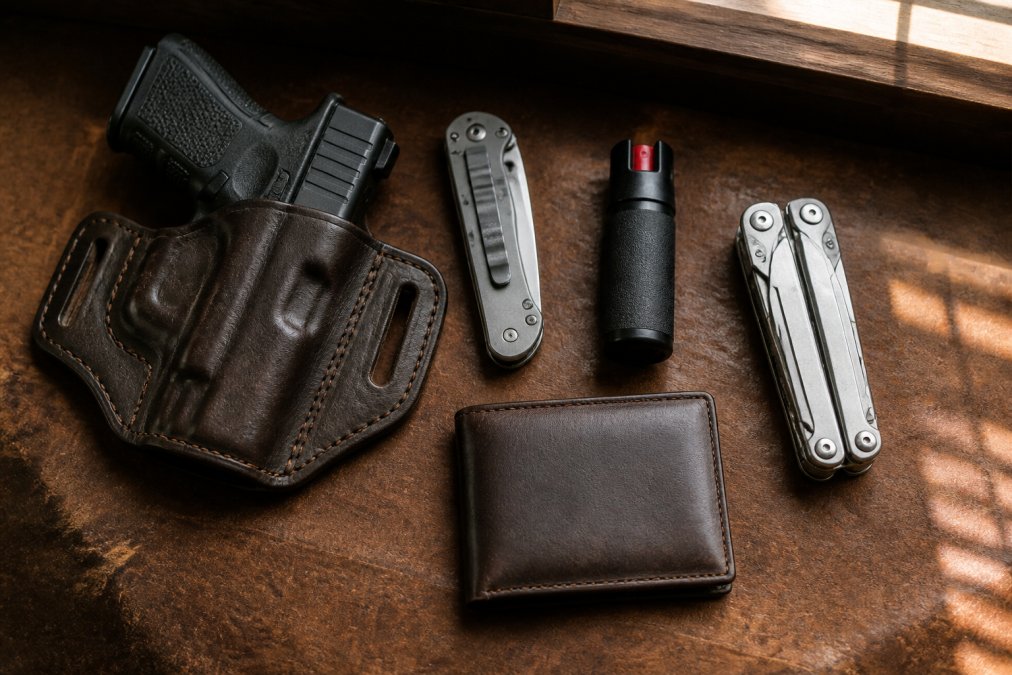
A complete defensive carry system covers five distinct jobs: creating distance, stopping an attack, cutting or utility work, illumination, and communication. Most people overbuy on one category and ignore the others entirely. A balanced setup addresses each role with a single, high-quality item rather than a pocket full of redundant tools.
The five categories are impact tools like kubotans, chemical agents like pepper spray, edged tools like knives and multitools, and the carry platform itself, which includes holsters and sheaths. Illumination rounds out the list because low-light encounters are statistically common, and a bright light is both a targeting tool and a temporary disorienting device.
Impact Tools and Kubotans
Impact tools are the quietest option in the defensive lineup. A kubotan is a short, often key-shaped rod of hard material that concentrates force into a small striking surface. It requires no training to carry legally in most jurisdictions, but it does require training to use effectively, since you must close distance with an attacker to deploy it.
The strength of an impact tool is its discretion. It looks like a keychain fob or a pen, draws no attention, and passes through metal detectors where a knife or firearm would not. Its weakness is that it demands gross motor skills under stress and puts you within arm's reach of a determined attacker.
Pepper Spray and Chemical Agents
Pepper spray remains the most accessible non-lethal option for civilians because it works at a distance and does not require physical strength to deploy. The active ingredient, oleoresin capsicum, causes immediate eye closure, coughing, and pain, which buys you the seconds needed to escape.
What most guides miss is that pepper spray has an expiration date and a temperature range. A canister left in a hot car degrades faster than the label suggests, and a frozen canister may not pressurize correctly. Replace your spray on a set schedule, and test a fresh unit once to confirm the stream pattern matches your expectations.
Knives and Multitools
A knife serves two roles in a carry system: utility and last-resort defense. For most people, the utility role dominates, which is why a folding knife with a locking blade and a pocket clip outperforms a fixed blade for daily carry. Blade steel matters; look for something that holds an edge and resists corrosion, since a rusty blade is a failed tool.
A multitool adds pliers, drivers, and cutters that solve dozens of non-defensive problems each week. Carrying one builds the habit of having tools on you, which reinforces the mindset that you are prepared. The defensive value of a multitool is minimal, but its utility value keeps it in your pocket, and a tool you carry beats a purpose-built weapon you leave at home.
The Best Non-Lethal Self Defense Tools Compared
Choosing the best non-lethal self defense tools comes down to matching the tool to your environment, your physical abilities, and your willingness to train. No single option wins every scenario, so the comparison below focuses on practical trade-offs rather than marketing claims.
| Tool | Effective Range | Training Required | Legal Risk | Best For |
|---|---|---|---|---|
| Pepper spray | 6-10 feet | Low | Low | Multiple attackers, distance |
| Kubotan | Contact only | High | Low | Discreet carry, keychain |
| Tactical flashlight | 10-50 feet | Medium | None | Disorientation, illumination |
| Stun gun | Contact | Medium | High in some states | Close-quarters deterrence |
| Knife | Contact | Very high | High | Last-resort only |
The tactical flashlight deserves more attention than it gets. A quality light with a strobe function can disorient an attacker at night while simultaneously identifying the threat and illuminating your escape route. It is the only tool on this list that is legal everywhere, requires no special permit, and doubles as a utility item.
Pepper spray is the best all-around choice for most civilians because it creates distance and works under adrenaline. The limitation is environmental; wind can blow the spray back into your face, and some individuals, particularly those under the influence of certain substances, may not react as expected.
Legal Everyday Carry Weapons: Know Your Limits
Legal everyday carry weapons vary dramatically by state, and the rules change frequently enough that carrying outdated advice is a real risk. What is legal in Texas may be a felony in California or New York, and local ordinances can impose additional restrictions beyond state law.
Before purchasing any defensive tool, check the current statutes in your state and municipality. The U.S. Concealed Carry Reciprocity resource tracks state-by-state laws, but the authoritative source is your state attorney general's office or legislature. Knife laws are especially tricky; blade length limits, automatic opening mechanisms, and carry position all fall under different rules depending on where you live.
The legal reality extends beyond what you can carry to how you use it. The use-of-force continuum governs your response, and a tool that is legal to carry can still land you in prison if you deploy it disproportionately to the threat. Your first and best legal protection is avoiding the encounter altogether, which brings us to the mindset that makes every tool more effective.
Choosing a Concealment Holster That Works
A concealment holster is the foundation of your entire carry system because if the holster fails, the firearm stays home. The two non-negotiable requirements are positive retention and a clean draw path. Leather holsters that are molded to a specific firearm model offer the best of both, since the leather forms a friction fit that holds the weapon securely while allowing a smooth presentation.
Inside-the-waistband carry, commonly called IWB, offers the best concealment for most body types and clothing choices. The holster rides between your pants and your body, with only the clip or loops visible. The trade-off is comfort, which is why holster material and construction matter so much. Full-grain leather conforms to your body over time, distributing pressure and making all-day carry practical.
For a universal fit that works across multiple firearms, the HOSS IWB Leather Holster from AnchorsAweighLeather is handcrafted from rugged full-grain leather and built for daily reliability. If you carry a specific model and want a molded fit, the Custom Leather IWB Holster is shaped by hand to your exact firearm.


How to Clean Leather Knife Sheath and Holsters
Leather conditioning is the maintenance task most people skip, and it is the difference between gear that lasts a decade and gear that cracks within a year. Knowing how to clean leather knife sheath and holster surfaces keeps them supple, prevents moisture damage, and preserves the molded fit that makes them safe for carry.
Start by wiping the leather with a dry, soft cloth to remove surface dirt and dust. For deeper cleaning, use a saddle soap applied with a damp cloth in circular motions, then wipe away the residue with a clean, dry cloth. Avoid soaking the leather; water breaks down the fibers and can distort the molded shape that holds your knife or firearm securely.
After cleaning, apply a thin layer of leather conditioner and let it absorb overnight. The conditioner replaces natural oils lost through use and exposure. Frequency depends on use; a holster worn daily in a humid climate needs conditioning monthly, while a knife sheath used occasionally may only need it quarterly. A well-maintained leather holster from AnchorsAweighLeather is built to last.

Building Your Carry System: A Step-by-Step Approach
Building a carry system is a process, not a single purchase. The steps below sequence your decisions so each piece complements the others rather than conflicting with them.
- Start with the legal layer. Confirm what you can carry in your state, and secure any required permits before buying gear.
- Choose your primary defensive tool. For most people, this is either a firearm or pepper spray, based on your training and comfort level.
- Select the carry platform. Match a holster or pouch to your primary tool, prioritizing retention and concealment.
- Add illumination. A tactical flashlight covers the low-light gap and serves as a non-lethal option.
- Include a utility tool. A knife or multitool solves daily problems and keeps you in the habit of carrying.
- Train with the complete setup. Wear everything for a full day to confirm comfort, then practice deployment drills weekly.
- Establish a maintenance schedule. Clean and condition leather monthly, replace pepper spray annually, and test your light's batteries regularly.
The order matters because your carry platform dictates what you can actually wear. A firearm you cannot conceal comfortably will end up in a drawer, making every other decision irrelevant.
Common Mistakes and Bad Advice to Ignore
The internet is full of carry advice that sounds authoritative and falls apart under scrutiny. One persistent myth is that a larger caliber or bigger knife automatically means better protection. In practice, the tool you can deploy accurately and legally under stress is the only one that counts, and that points toward smaller, more concealable options for most people.
Another common mistake is neglecting the psychological side of carrying. The gear is only half the equation; situational awareness is the other half. Threat assessment and de-escalation techniques prevent most encounters before a weapon ever leaves its holster. According to guidance on personal safety and situational awareness, being aware of your surroundings and having an exit plan are the first lines of defense in any emergency.
A third error is skipping maintenance entirely. A leather holster that has dried out can collapse and fail to retain your firearm, and a knife sheath that has lost its shape can let the blade rattle and dull against its own edge. The leather care guidance from the U.S. General Services Administration emphasizes regular conditioning to extend the life of leather goods, a principle that applies directly to your carry gear.
Finally, ignore the advice that tells you to carry a weapon you are unwilling to train with. A kubotan in the hands of someone who has never practiced striking is less useful than a loud whistle. Choose tools that match your commitment level, and build your skills before you build your collection.
Building a reliable self defense carry system comes down to honest assessment of your legal landscape, your physical abilities, and your willingness to maintain your gear. Cheap equipment fails when you need it most, which is why investing in handcrafted, American-made leather goods from a veteran-owned business makes practical sense. AnchorsAweighLeather offers full-grain leather holsters and sheaths that mold to your gear, hold up under daily wear, and carry the confidence of quality construction, with free shipping on orders over $100. Get started with AnchorsAweighLeather and build a carry system that lasts as long as your commitment to preparedness.
Frequently Asked Questions
What are the best non-lethal self defense tools to carry every day?
Pepper spray and a kubotan are two of the most practical non-lethal options. Pepper spray lets you create distance and stop a threat from several feet away. A kubotan, often a small metal or polymer rod, is a force multiplier for strikes and joint manipulation if someone gets close. A sturdy tactical flashlight also works well, doubling as an impact tool while improving visibility in low-light situations.
What are the legal everyday carry weapons I can have on me?
Legal everyday carry weapons depend on your state and local laws. Most states allow non-lethal tools like pepper spray and kubotans without a permit. Knives and firearms require you to check blade length limits and concealed carry licensing rules. Always verify your local statutes before carrying anything, since a tool that is legal in one county may be restricted in another.
How do I build a balanced everyday carry kit without overloading my pockets?
Start with the essentials: a reliable folding knife, a small pepper spray, and a quality holster if you carry a firearm. Add a slim multitool and a compact light. Test each item in your normal clothing to confirm it stays put and does not print. Adjust the placement until everything is accessible with either hand. A balanced kit is one you actually wear daily, not one that sits in a drawer.
How should I clean a leather knife sheath to keep it in good shape?
Wipe the sheath with a dry cloth after each use to remove dirt and moisture. For a deeper clean, use a damp cloth with mild saddle soap, then let it air dry away from heat. Once dry, apply a conditioner like neatsfoot oil to keep the leather supple. Avoid soaking the leather, which can cause warping and damage the fit around your blade.
What do police recommend for everyday self-defense?
Many law enforcement trainers recommend starting with situational awareness as your primary defense. For gear, they often suggest OC pepper spray as a reliable non-lethal option and a quality flashlight to identify threats at distance. If you carry a firearm, they stress the importance of a secure holster with good retention and consistent training.
What are the four D's of self-defense?
The four D's are a framework for responding to a threat: Defuse, Deflect, De-escalate, and Defend. Defuse means avoiding the situation when possible. Deflect involves creating distance or using an object as a barrier. De-escalate uses words and body language to calm a conflict. Defend is the last resort, using physical force or your everyday carry gear to stop an attack.
0 comments