
Table of Contents
- Why Custom Leather Holsters Are Worth the Investment
- The Best Appendix Carry Leather Holster for Concealed Carry
- How to Break In a Leather Holster
- Leather Holster Maintenance Tips for Longevity
- Custom vs. Factory-Made: What You Actually Get
- The Hidden Costs of Cheap Holsters
- Frequently Asked Questions
Last Updated: September 17, 2026
Why Custom Leather Holsters Are Worth the Investment
Custom leather holsters are handcrafted carry systems molded to a specific firearm, made from full-grain leather, and built to outlast the gun they hold. We've watched too many shooters cycle through three or four cheap nylon rigs in the time one properly made leather holster lasts. That's the core argument here: the upfront cost stings less than the replacement cycle.

The Best Appendix Carry Leather Holster for Concealed Carry
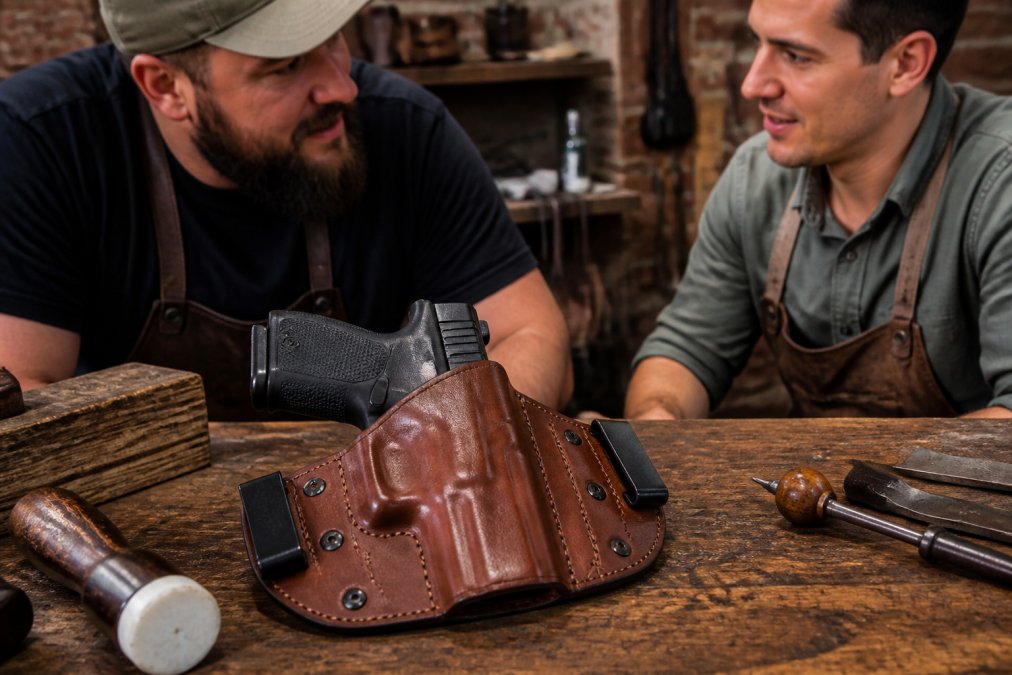
The best appendix carry leather holster is one molded to your specific firearm with a reinforced mouth, adjustable ride height, and full trigger guard coverage, because appendix carry points the muzzle at your body and leaves zero margin for a holster that collapses or shifts.
Why appendix is the hardest carry position to build for
Appendix (roughly the 12:30 to 1:30 position on the belt) is the only common carry position where the muzzle sweeps the femoral artery and the holster mouth sits against soft tissue rather than the hip bone. That geometry is why the leather has to do more work here than in any other position:
- Mouth reinforcement: A steel or kydex-reinforced band sewn into the top edge keeps the holster open when the gun is out. Without it, the leather collapses and you're reholstering blind into a folded pocket.
- Body thickness: 8-9 oz full-grain leather holds shape on its own; 4-5 oz garment leather does not. Thickness is the single biggest predictor of whether an appendix holster survives a year of daily carry.
- Trigger guard coverage: Full wrap, not a strap that can ride up. This is non-negotiable for appendix.
- Sweat shield: A tall shield keeps the grip and the slide off your skin, which matters more in appendix than in any other position because the gun sits against your stomach all day.
- Cant: A neutral or 0-5 degree cant works for most body types; a 15+ degree FBI cant is an OWB geometry that fights the appendix draw.
Appendix vs. strong-side vs. OWB: the same holster is not the answer
A holster that works at 4 o'clock on the hip is not automatically a good appendix holster, and vice versa. The differences are mechanical, not cosmetic:
| Carry position | Typical cant | Mouth reinforcement | Retention priority |
|---|---|---|---|
| Appendix (IWB) | 0-5 degrees | Critical | Trigger guard + mouth |
| Strong-side hip (IWB) | 10-15 degrees | Important | Trigger guard |
| Outside waistband (OWB) | 10-20 degrees | Moderate | Trigger guard + thumb break |
| N/A | N/A | Full coverage |
What to check before you buy
- Confirm the mold is your exact model. "Fits Glock 19 and similar" is not a mold; it's a guess.
- Ask about leather weight. A maker who can't tell you the ounce weight of the leather is not a maker you want building an appendix rig.
- Check the ride height range. You want at least an inch of adjustment so you can tune it to your torso length.
- Look at the stitch pattern. Double stitching at stress points (mouth, belt loops, trigger guard) is the difference between a holster that lasts years and one that separates at the seam.
How to Break In a Leather Holster
Breaking in a leather holster means drawing and reholstering your unloaded firearm repeatedly, letting the leather gradually conform to the gun's shape over one to two weeks of regular handling, never soaking or forcing the leather.
Here's the process that actually works:
- Confirm the firearm is unloaded and cleared.
- Insert the gun into the holster and leave it overnight to start the molding.
- Draw and reholster 20-30 times a day, slowly, focusing on a smooth motion.
- Wear the holster on your belt for a few hours daily so body heat and movement soften the leather.
- Repeat for one to two weeks until the draw feels consistent.
Leather Holster Maintenance Tips for Longevity
Leather holster maintenance tips boil down to three habits: keep it dry, condition it sparingly, and never store a gun in it long-term. Do those and a quality holster can serve you for years.
- Wipe it down after sweaty carry days with a dry cloth.
- Condition lightly once or twice a year with a leather-specific product, not saddle soap.
- Let it dry naturally if it gets wet, away from direct heat.
- Rotate carry if you have multiple holsters so no single one takes all the wear.
Custom vs. Factory-Made: What You Actually Get
Custom holsters are molded to a specific firearm model, while factory-made holsters are built to a loose "fits many" standard that trades fit for volume. That single difference drives everything else: retention, comfort, draw speed, and lifespan.
| Factor | Custom Leather | Factory-Made |
|---|---|---|
| Fit | Molded to your firearm | Universal, approximate |
| Retention | Consistent, tunable | Varies by gun |
| Break-in | 1-2 weeks | Immediate |
| Lifespan | Many years with care | Often replaced yearly |
| Cost | Higher upfront | Lower upfront |
The material science behind the price difference
Most factory holsters are built from one of three materials: nylon, molded polymer (kydex), or a leather-look laminate. Each has a specific weakness that shows up under daily carry:
- Nylon: Soft, collapses over time, and holds moisture against the gun. Retention depends on a strap, not on fit.
- Kydex: Rigid and moisture-resistant, but it doesn't conform to your body, it can crack at stress points in cold weather, and it's noisy against a belt.
- Laminate "leather": A thin leather skin bonded to a synthetic backing. It looks like leather but lacks the fiber structure that gives real leather its memory and moldability.
Why carry style changes the answer
Whether a custom holster is "worth it" depends on how you carry:
- Appendix (IWB): Custom is close to mandatory. The mouth has to stay open, the cant has to match your draw, and the sweat shield has to be sized to your body. A universal IWB rig is a compromise you feel every time you sit down.
- Strong-side hip (IWB): Custom still wins, but the margin is smaller. A quality factory IWB can work here if the retention is consistent.
- Outside waistband (OWB): This is where factory holsters are most defensible. OWB geometry is more forgiving, the gun isn't against your body, and a thumb break can supplement retention. If you only carry OWB, a factory holster is a reasonable starting point, but a custom OWB still fits better and lasts longer.
- Pocket and ankle: Custom matters less; the holster is mostly a cover, not a retention system.
What you're actually paying for
Strip away the marketing and the price difference comes down to four things:
- Labor. A custom holster is cut, stitched, wet-molded, and finished by hand. That's hours of skilled work per holster, not minutes on a press.
- Leather grade. Full-grain hides cost more than split or bonded leather, and they're the only grade that molds and holds shape.
- The mold. A maker has to own or make a mold for your specific firearm. That's a fixed cost spread across a small number of holsters, not millions of units.
- Fit and finish. Edges are burnished, stitching is doubled at stress points, and the retention is tuned to your gun before it ships.
The Hidden Costs of Cheap Holsters
Cheap holsters cost more over time than they save at checkout. A holster that wears out in months means repeat purchases, plus the risk of a compromised draw when you need it most.
Frequently Asked Questions
Are leather holsters worth the extra cost compared to Kydex?
Leather holsters from makers like AnchorsAweighLeather cost between $43 and $60.50, while Kydex options often run $40 to $80. The difference is longevity and comfort. Full-grain leather molds to your body over time, reducing pressure points during all-day carry. Kydex offers faster draw speed and easier cleaning, but leather provides quieter draws and better concealment against the body. For everyday carry, leather's break-in period pays off in comfort and retention that improves with use.
How long does a well-maintained custom leather holster last?
A handcrafted full-grain leather holster can last for many years with proper care. The key is regular conditioning with a leather-safe product and avoiding prolonged moisture exposure. Vegetable-tanned leather, like the type used in quality custom holsters, develops a patina and improves its molded fit over time.
What should you look for in a high-quality handcrafted holster?
Check four things: material, stitching, retention, and trigger guard coverage. Full-grain or vegetable-tanned leather is the gold standard. Hand-sewn stitching with heavy waxed thread outlasts machine stitching. Retention should hold the firearm securely when inverted but allow a smooth draw. The holster must fully cover the trigger guard. A custom molded fit for your specific firearm prevents shifting. AnchorsAweighLeather's holsters, for example, are handcrafted in the USA from premium full-grain leather with these features.
Do leather holsters provide better retention than synthetic options?
Leather holsters rely on friction and a molded fit for retention. Synthetic holsters use mechanical retention like screws or clips. Leather retention is passive and silent, which benefits concealed carry. However, leather requires a break-in period of 1 to 2 weeks of regular use before retention feels ideal. A well-made leather holster like the HOSS IWB or TEXAS REBEL offers secure retention with a smooth draw once broken in.
Cheap gear is a false economy, and nowhere is that truer than in concealed carry. AnchorsAweighLeather handcrafts American-made leather holsters built to last, with full-grain construction, secure retention, and free shipping on orders over $100. Get started with AnchorsAweighLeather and carry gear that outlasts the trend cycle.
0 comments