
Last Updated: October 22, 2026
Quick Summary
How to choose a gun belt for leather holsters starts with matching your belt width to your holster's belt loops, typically 1.5 or 1.75 inches. Select a quality leather belt with a reinforced core and 7-9 ounce vegetable-tanned leather that resists bending, then measure your pants waistband and add one inch for proper fit and support.
- Standard gun belt widths are 1.5 inches and 1.75 inches, and your belt must match your holster's loop width exactly.
- Measure your carry pants waistband and add one inch to determine your gun belt size.
- Quality gun belts use 7-9 ounce vegetable-tanned leather with reinforced centers and hand-stitched construction.
- Test your belt and holster together for 30 minutes while moving to verify the holster stays stable and doesn't shift or sag.
- Leather belts are the better choice for leather holsters because both materials age similarly and work seamlessly together.
Table of Contents
- What Makes a Belt Suitable for Concealed Carry with Leather Holsters
- Gun Belt Width for Holster Compatibility
- How to Measure for a Gun Belt
- Leather Belt vs Nylon Gun Belt: Which Material Suits Your Holster
- Belt Stiffness, Rigidity, and Support for All-Day Carry
- Testing Fit and Preventing Sagging, Shifting, and Holster Cant
- Leather Construction Quality and Break-In Care
- Choosing Your Gun Belt: A Practical Selection Framework
- Frequently Asked Questions
What Makes a Belt Suitable for Concealed Carry with Leather Holsters
Understanding how to choose a gun belt for leather holsters means you need more than just any belt. A proper concealed carry belt must support your firearm's weight without sagging, shifting, or exposing your holster. The difference comes down to construction, materials, and how well it works with your leather holster.
A gun belt performs three critical jobs: it holds your holster in a fixed position, prevents tilting or rotating, and distributes your firearm's weight evenly across your waistline. Most everyday belts fail at all three, they flex too much, let your holster drift, and sag under the load.
A quality gun belt solves this with rigid support exactly where you need it.
The best gun belts for leather holsters share key features:
- Reinforced core that resists bending and flexing
- Thick, durable leather (typically 7-9 ounces) that maintains its shape
- Proper width to fit your holster's belt loops securely
- Minimal stretch after break-in to keep everything stable
Gun Belt Width for Holster Compatibility
Your gun belt's width directly affects how well your leather holster fits and functions. Most leather holsters are designed for specific belt widths, and getting this wrong means poor retention, discomfort, or a holster that won't stay in place.
Standard gun belt widths come in two main sizes: 1.5 inches and 1.75 inches. Your holster loops are sized for one or the other, and mixing them creates problems.
A belt that's too narrow slides through oversized loops, letting your holster rotate and shift. A belt that's too wide won't fit through the loops at all. Either way, you've wasted money on equipment that doesn't work together.
Check your leather holster's specifications first. Most quality holsters list the belt width they're designed for. AnchorsAweighLeather's holsters, including the Cattleman Pancake Holster and Rancher Saddle Holster, are designed to accommodate belts up to 1.5 inches wide for secure, stable carry.


If you're building a new carry setup, start with your holster choice. Let that dictate your belt width, not the other way around.
How to Measure for a Gun Belt
Getting the right belt size requires accurate measurement. Too tight restricts movement and causes discomfort; too loose won't support your holster properly. Here's how to measure correctly.
Step 1: Measure your current pants waistband
Find pants that fit comfortably for all-day wear. Lay them flat and measure the waistband from the inside edge of one belt loop to the inside edge of the opposite belt loop.
Step 2: Add one inch for the gun belt
Gun belts are typically thicker and stiffer than regular belts. They sit differently on your body. Add one inch to your pants waistband measurement to get your gun belt size.
Step 3: Account for holster position
Your carry position affects how the belt sits.
Step 4: Test with your holster
Once your gun belt arrives, thread it through your holster's belt loops while wearing the pants you'll carry in.
A common mistake is ordering based on your regular pants size. Gun belts fit differently because of their rigidity and thickness. Following these steps ensures your new belt works properly with your leather holster.
Leather Belt vs Nylon Gun Belt: Which Material Suits Your Holster
Your gun belt's material affects how it works with leather holsters and how long it lasts. Leather and nylon each have different strengths, and your choice should match your carry style and holster type.
Leather belts are the traditional choice for leather holsters. Quality leather (especially vegetable-tanned) develops character over time, molds slightly to your body, and breathes. It works seamlessly with leather holsters because both materials age similarly.
Leather belts require occasional conditioning and watching for cracking in dry climates, and they're heavier than nylon.
Nylon belts are lighter, need no conditioning, and resist moisture and weather better than leather. But they don't age well with leather holsters, a nylon belt and leather holster create a mismatch in materials and aesthetics.
For leather holsters specifically, leather belts are the better choice. If you're carrying with a handcrafted leather holster like those from AnchorsAweighLeather, a quality leather belt ensures your entire carry system works as intended.
Belt Stiffness, Rigidity, and Support for All-Day Carry
Stiffness is what separates a gun belt from a regular belt. Rigidity is non-negotiable for concealed carry, a floppy belt can't support your holster, while a rigid belt keeps everything stable all day.
When you're carrying a loaded firearm, your holster needs constant support. Every time you bend, sit, or move, your belt must resist flexing. If it bends too much, your holster rotates. Your firearm's position changes.
A quality gun belt maintains its shape under load, it doesn't sag after hours of wear or crease where your holster sits. This rigidity comes from the belt's core construction and leather thickness.
The surrounding leather (typically 7-9 ounces thick) adds durability and comfort against your body.
OWB Leather Holster, Avenger Holster, Leather Holster →
Expect a break-in period with a new leather gun belt. The leather softens slightly as it molds to your body but won't lose its rigidity.
Test your belt's stiffness before committing to a carry setup. Hold the belt horizontally and try to bend it. It should resist bending strongly.
Testing Fit and Preventing Sagging, Shifting, and Holster Cant
Before carrying daily with your new belt and holster, test the fit thoroughly. A proper fit prevents sagging, keeps your holster in a consistent position, and ensures your firearm stays concealed.
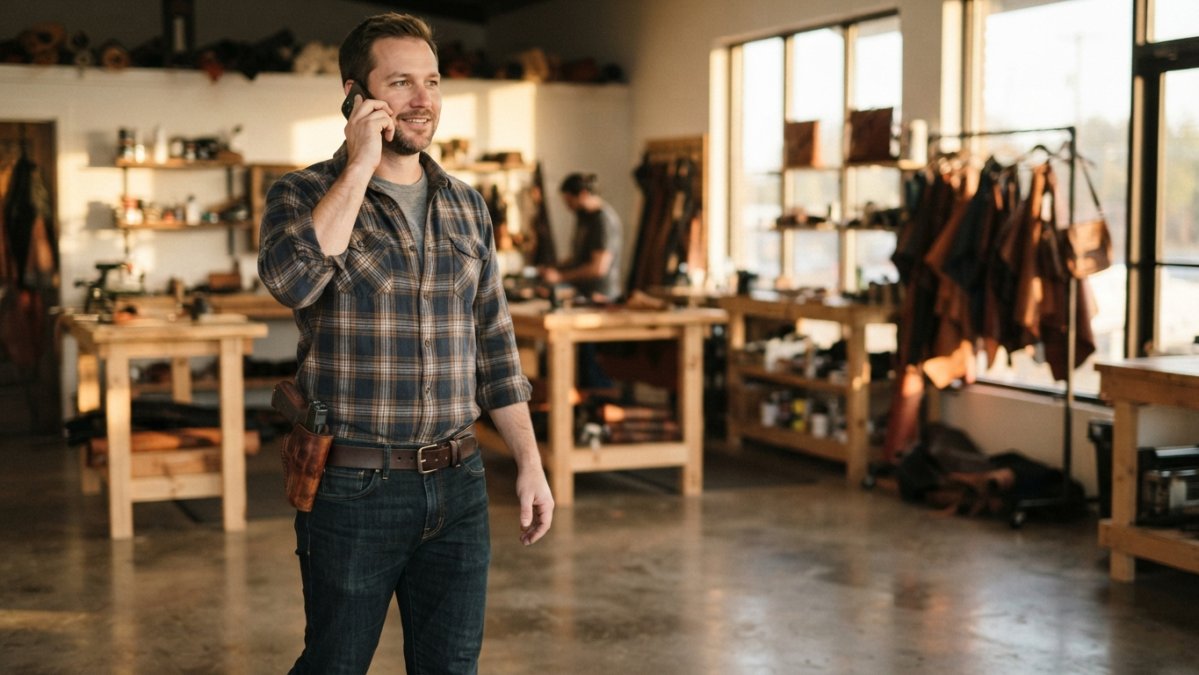
Sagging happens when your belt can't support the weight of your holster and firearm. Your waistband drops. Your holster moves lower. Your shirt rises, exposing your carry position. A rigid gun belt prevents this.
Shifting occurs when your holster rotates or slides along your belt throughout the day, changing your draw angle and making concealment unreliable.
Holster cant is the angle at which your holster sits on your waistline. A neutral cant works best for most carry positions, though some prefer a slight forward or rearward cant.
To test your setup:
- Put on your belt with your unloaded holster attached
- Wear it for 30 minutes while moving normally
- Sit, stand, bend, and walk to simulate daily activity
- Check if your holster stays in the same position
- Feel if your belt sags or shifts
- Verify that your holster doesn't rotate
If everything stays stable and comfortable, your belt and holster work together well. If you notice problems, adjust your belt size or holster position before carrying your firearm.
Leather Construction Quality and Break-In Care
Your leather belt's construction quality determines how long it lasts and how well it performs. Understanding leather construction helps you choose a belt that serves you for years.
Quality leather gun belts use full-grain or vegetable-tanned leather, thicker and more durable than split or bonded leather.
Look for belts with reinforced centers and consistent stitching. Each stitch should be tight and even. Gaps or loose stitches indicate poor craftsmanship and shorter lifespan.
AnchorsAweighLeather's leather holsters are handcrafted from 7-9 ounce vegetable-tanned leather with hand-stitched construction. Apply the same standard to your gun belt, when it matches your holster's construction quality, your entire carry system performs better.
Break-in expectations: A new leather gun belt will feel stiff, which is normal.
During break-in, condition your belt occasionally with leather conditioner to speed the process and keep the leather healthy. After break-in, condition every few months or as needed in dry climates.
With proper care, a quality leather gun belt becomes more comfortable with age and develops a patina that tells the story of your carry.
Choosing Your Gun Belt: A Practical Selection Framework
Now that you understand what makes a gun belt work with leather holsters, here's how to choose a gun belt for leather holsters for your specific needs.
| Selection Criteria | What to Evaluate | How It Affects Your Carry |
|---|---|---|
| Belt Width | Match your holster's belt loop width (1.5" or 1.75") | Wrong width = holster won't fit or will shift |
| Material | Leather (vegetable-tanned preferred) vs. nylon | Leather complements leather holsters; nylon doesn't age well with them |
| Stiffness | Resist bending when held horizontally | Floppy belt = sagging, shifting, unreliable holster position |
| Thickness | 7-9 ounce leather for gun belts | Thinner belts can't support firearm weight properly |
| Construction | Hand-stitched with reinforced center | Poor stitching = premature failure and safety issues |
| Size | Pants waistband + 1 inch | Incorrect size = discomfort and poor holster support |
Step 1: Start with your holster
Choose your leather holster first and let that choice dictate your belt specifications.
Step 2: Measure accurately
Use the measurement steps outlined earlier. Order the size that matches your carry pants plus one inch. When your belt arrives, test it with your holster before committing to daily carry.
Step 3: Prioritize quality construction
Look for full-grain or vegetable-tanned leather, hand-stitching, and a reinforced center.
Step 4: Test everything together
Once you have your belt and holster, wear them together for an hour before carrying your firearm. Verify your holster stays in position, your belt doesn't sag, and everything feels secure and comfortable.
The right gun belt for leather holsters isn't complicated. It does one job well: keeping your holster stable, secure, and accessible all day. When it matches your holster's quality and specifications, your entire carry system works as intended.
Choosing the right gun belt for your leather holster is an investment in reliability and comfort. At AnchorsAweighLeather, we build holsters designed to work with premium gun belts, our Avenger Holster, Patriot Saddle Holster, and other models are handcrafted from 7-9 ounce vegetable-tanned leather with reinforced construction that demands a belt matching that quality.

Frequently Asked Questions
What makes a belt suitable for carrying a leather holster?
A gun belt for leather holsters must provide rigid support without sagging under firearm weight, maintain a secure holster attachment through reinforced belt loops, and resist movement during draw and re-holster. The belt should be stiff enough to distribute weight evenly, preventing the holster from shifting or canting. Quality leather construction ensures reliable service for everyday carry.
How do I measure for a gun belt?
Measure your waistline where you actually carry the holster, not at your natural waist. Wear the pants you'll carry in and measure snug but comfortable around your midsection with a soft measuring tape. Add one inch to this measurement for your belt size. For example, if your carry waistline measures 34 inches, order a 35-inch belt. This accounts for the thickness of the belt material itself and ensures proper fit through all belt loops without excessive bunching or gaps.
Should a gun belt be the same size as my regular belt?
No. A gun belt should typically be one size larger than your everyday belt because it's thicker and more rigid. Your regular belt may be 1.25 inches thick, while a quality gun belt is often 0.25 to 0.5 inches thicker. Measure specifically for carry position rather than relying on your dress belt size. A properly sized gun belt will fit snugly through all belt loops and support your holster without rotating or sliding during movement.
Can I use a regular leather belt with a holster?
Regular leather belts lack the stiffness and reinforcement needed for safe holster carry. They sag under firearm weight, allowing the holster to shift, rotate, or cant. Gun belts are specifically constructed with reinforced centers, thicker leather, and sometimes internal stiffening to maintain their shape. For everyday carry with a leather holster, a dedicated gun belt ensures your holster stays in place and your firearm remains secure throughout the day.

0 comments