
Table of Contents
- The Core Difference: Handmade vs Mass Produced Leather Goods
- Material Quality and Selection
- Full Grain vs Top Grain Leather: What Actually Matters
- Stitching Techniques: Durability of Saddle Stitching vs Machine Stitching
- How to Identify High Quality Leather Goods
- Cost, Longevity, and Real-World Value
- Maintenance, Repairability, and Sustainability
- Frequently Asked Questions
Last Updated: August 30, 2026
The Core Difference: Handmade vs Mass Produced Leather Goods
When you're comparing handmade vs mass produced leather goods, you're really comparing two fundamentally different manufacturing philosophies. One prioritizes speed and volume; the other prioritizes durability and individuality. At AnchorsAweighLeather, we've built our entire business on the handmade approach, and the difference shows up in how products age, perform, and hold their value over years of daily use.
The core distinction isn't just romantic nostalgia. Handmade leather goods are constructed by individual craftspeople using traditional techniques, often with hand-selected materials and methods like saddle stitching. Mass-produced items are manufactured in factories using standardized processes, machine stitching, and materials chosen primarily for cost efficiency. These aren't minor variations in approach, they produce fundamentally different products with different lifespans, maintenance needs, and long-term value propositions.
Here's what matters most: handmade goods typically cost more upfront but improve with age and use. Mass-produced items are cheaper initially but often degrade quickly or require replacement. Understanding this tradeoff is essential before you commit to either category. According to research on leather durability and material science, the construction method and material quality are the strongest predictors of how long a leather item will last and how well it will age.
Material Quality and Selection
The first place handmade and mass produced leather goods diverge is in material sourcing. Handmade producers typically select hides individually, looking for specific grain patterns, thickness consistency, and overall quality markers. A craftsperson making wallets or holsters will often reject hides that don't meet their standards, even if those hides could technically be used.
Mass producers, by contrast, work with whatever volume of hides they can source at the lowest cost. They optimize for yield: how many usable pieces can be cut from each hide, not how beautiful or durable each piece will be. This economic pressure pushes mass producers toward lower-grade leather, thinner hides, or blended materials that reduce costs.
Full-grain leather, the highest quality option, includes the entire thickness of the hide with the natural grain pattern intact. It's more expensive to work with because it's less forgiving during production, but it ages beautifully and develops character over time. Top-grain leather has the outer layer sanded smooth and often receives a protective coating. It's cheaper and more consistent, but it doesn't age the same way and can peel or crack as the coating wears.
Most handmade producers use full-grain or high-quality top-grain leather. Most mass producers use lower grades of top-grain or bonded leather (scraps glued together). The difference in longevity is dramatic. A full-grain leather wallet from a handmade producer can last 10-20 years with basic care. A mass-produced wallet often shows significant wear within 2-3 years.
AnchorsAweighLeather sources vegetable-tanned leather for most of our wallets and accessories. Vegetable tanning is a slower, more expensive process than chrome tanning (the mass-production standard), but it produces leather that develops a richer patina and ages more gracefully. Our Roper Wallet uses 1-2mm thickness veg tan leather specifically chosen for durability and character development.

Full Grain vs Top Grain Leather: What Actually Matters
The distinction between full-grain and top-grain leather is one of the most misunderstood quality markers in the industry. Full-grain leather retains the natural surface of the hide, including all the grain patterns and minor imperfections. Top-grain leather has that outer layer sanded away and often receives a polyurethane or acrylic coating for consistency and stain resistance.
Here's the practical difference: full-grain leather is more durable and develops a richer patina over time. It's also less uniform, you'll see variations in color and grain from one wallet to another, and even from one side of the wallet to the other. Top-grain leather is more consistent and easier to clean, but it doesn't age as well and the coating can eventually peel or crack.
Handmade producers almost always use full-grain leather because it rewards craftsmanship. The natural variations become part of the product's character. Mass producers often prefer top-grain because it's easier to standardize and reduces visible defects that customers might perceive as flaws.
Neither is objectively "better", it depends on what you value. If you want a wallet that looks identical to itself in five years, top-grain is fine. If you want something that develops personality and improves with use, full-grain is the right choice. The research on leather aging and patina development confirms that full-grain leather develops a protective patina that actually improves water resistance over time, while top-grain coatings gradually degrade with exposure.
For everyday carry items like wallets and holsters, full-grain leather is worth the premium. You'll notice the difference after six months of use.
Stitching Techniques: Durability of Saddle Stitching vs Machine Stitching
This is where construction method creates the most obvious performance difference. Saddle stitching is a hand-sewing technique where two needles work from opposite sides of the leather, creating an interlocking pattern that's nearly impossible to unravel if a single stitch breaks. Machine stitching uses a single thread that runs continuously, if that thread breaks anywhere, the entire seam can unravel.
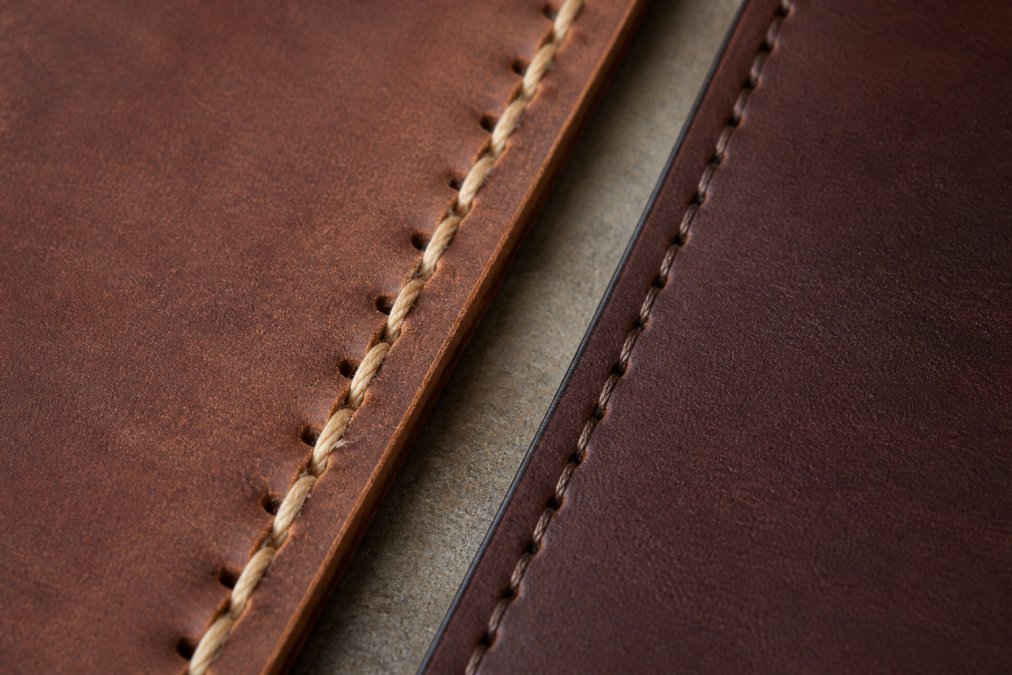
Handmade producers use saddle stitching almost exclusively. It's slower, a craftsperson might spend 30 minutes stitching a single wallet seam, but the result is dramatically more durable. Every stitch is visible, and if one breaks, you can replace just that stitch without the entire seam failing.
Mass producers use machine stitching because it's fast and cheap. A machine can stitch a wallet seam in under a minute. But if that thread breaks (which happens more often with lower-quality thread), you've got a real problem. The entire seam can separate, and repair is often impossible without cutting the piece apart.
The durability difference is measurable. Saddle-stitched leather goods can handle years of heavy use without seam failure. Machine-stitched items often show seam separation within 12-18 months of regular use. According to durability studies on leather stitching methods, saddle-stitched seams withstand 3-5 times more stress cycles than machine stitching before failure.
All AnchorsAweighLeather wallets use saddle stitching. Our San Antone Roper Wallet is hand-sewn with individual stitches visible throughout. It's one of the first things customers notice, and it's one of the reasons these wallets last decades instead of years.
How to Identify High Quality Leather Goods
Before you buy, you need to know what to look for. Here are the concrete markers that separate quality handmade goods from mass-produced alternatives.
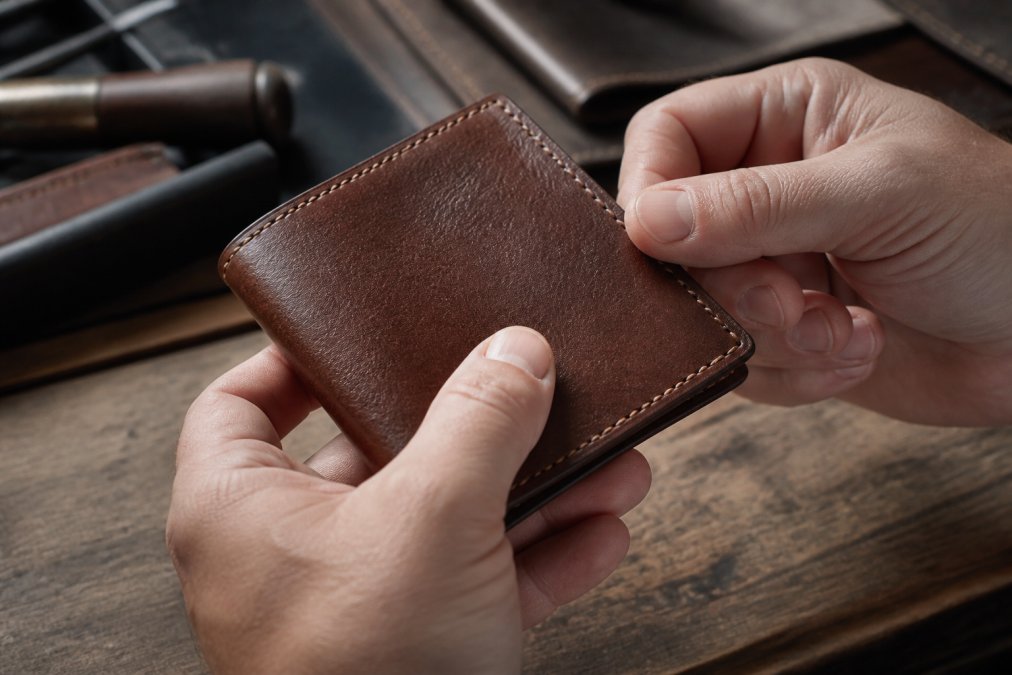
Check the grain pattern. Run your fingers across the leather surface. Full-grain leather has a natural, irregular grain pattern. If the surface feels completely uniform and smooth, it's likely top-grain or bonded leather. Natural variation is a sign of quality.
Inspect the edges. High-quality leather goods have finished edges, either burnished smooth or sealed with edge paint. Mass-produced items often have raw, unfinished edges that fray quickly. Look at the wallet or holster edges closely. Rough, unfinished edges are a red flag.
Examine the stitching. Look for individual, visible stitches. Saddle stitching creates a distinctive pattern where stitches are visible on both sides of the leather. Machine stitching looks like a continuous line. If you can't see individual stitches clearly, it's machine-stitched. Count the stitches per inch, quality work typically has 8-10 stitches per inch. Fewer stitches means the seam will fail sooner.
Feel the thickness. Leather thickness matters for durability. Quality wallets use 1.5-2mm leather. If a wallet feels thin and flimsy, it won't last. Pick it up and flex it slightly, quality leather feels substantial and doesn't crease easily.
Look for hardware quality. Snaps, rivets, and D-rings should feel solid and be securely attached. Poor-quality hardware often corrodes or breaks within months. Quality hardware is usually brass or stainless steel and feels heavy.
Check for patina potential. Ask the maker what type of leather they use. If they mention vegetable-tanned leather, that's a good sign. If they're vague about it, move on. Quality producers are proud of their materials and will tell you exactly what they use.
Cost, Longevity, and Real-World Value
The price difference between handmade and mass-produced leather goods can be significant. A handmade wallet might cost $45-$225. A mass-produced alternative might be $15-$30. On the surface, that looks like a bad deal for the handmade option.
But cost-per-wear tells a different story. If a mass-produced wallet lasts two years with regular use, and you use it daily, that's roughly 730 days of wear. A $20 wallet works out to about 2.7 cents per day. If a handmade wallet lasts 15 years, that's roughly 5,475 days of wear. A $75 wallet works out to about 1.4 cents per day.
The handmade option is actually cheaper over time, and it improves rather than degrades.
There's another factor: replacement cost and inconvenience. When a mass-produced wallet fails (and it will), you have to buy another one. That's not just the cost of the new wallet, it's the time to find a replacement, the risk of losing cards or cash during the transition, and the frustration of dealing with a failed product. Handmade goods rarely fail, and when they do, many makers will repair them for free or at minimal cost.
AnchorsAweighLeather offers free shipping on orders over $100, which means our bi-fold wallet at $45 qualifies. That $45 investment will outlast multiple mass-produced alternatives, develop character as it ages, and likely never need replacement. Compare that to buying a new cheap wallet every two years.

Maintenance, Repairability, and Sustainability
Handmade leather goods actually require less maintenance than mass-produced alternatives, a counterintuitive fact that surprises most people. High-quality leather develops a protective patina that improves water resistance over time. You don't need special conditioners or treatments. Basic care, occasional wiping with a damp cloth and periodic conditioning with mink oil or leather balm, is all that's needed.
Mass-produced leather, especially top-grain with synthetic coatings, requires more active maintenance. The coating can crack or peel, requiring repair products or replacement. Bonded leather can delaminate, which is usually irreversible.
Repairability is where handmade goods shine. A handmade wallet with a broken stitched seam can be re-stitched. A broken snap can be replaced. A scuffed surface can be conditioned and will often improve. Most handmade producers offer repair services, and the cost is minimal compared to buying a new wallet.
Mass-produced items are often designed to be disposable. If a seam fails, repair isn't economical. If the coating peels, you can't fix it. You throw it away and buy another one.
From a sustainability perspective, handmade leather goods are dramatically better. They last longer, which means fewer resources consumed over time. They're repairable, which extends their lifespan further. And they're often made from vegetable-tanned leather, which uses natural tannins instead of toxic chemicals. Mass production optimizes for volume and cost, which usually means more waste, more chemical use, and more frequent replacement cycles.
The environmental impact of buying one handmade wallet that lasts 15 years is substantially lower than buying eight mass-produced wallets over the same period.
The choice between handmade vs mass produced leather goods comes down to what you actually value. If you want the cheapest option today, mass production wins. If you want something that improves with age, lasts decades, and actually saves money over time, handmade is the clear choice.
AnchorsAweighLeather builds every wallet, holster, and sheath with the intention that it will outlast you. Our handcrafted leather goods use vegetable-tanned full-grain leather, saddle stitching, and individual craftsmanship. Whether you choose our Roper Wallet, bi-fold wallet, or one of our specialty options like the genuine alligator wallet, you're investing in something built to last. With free shipping on orders over $100, there's no better time to experience the difference that American-made handcrafted quality actually delivers.

Frequently Asked Questions
What's the real difference between handmade and mass-produced leather goods?
Handmade leather goods are crafted by individual artisans using hand-cut pieces and hand-stitching techniques like saddle stitching, which creates stronger seams. Mass-produced items use automated cutting and machine stitching to maximize efficiency. Handmade pieces typically use higher-grade materials like full-grain vegetable-tanned leather, while mass production often relies on lower-cost alternatives. The result: handmade goods develop unique patina over time and last decades, while mass-produced items may wear out in months.
Why do handmade leather goods cost more than mass-produced items?
Handmade leather goods cost more because of labor, material quality, and production time. Artisans spend hours on each piece using premium full-grain leather and hand-stitching techniques that require skill and precision. Mass production uses cheaper synthetic materials and automated machinery that produces hundreds of items daily. A handmade wallet might cost $45-$225, while mass-produced alternatives start at $10-$20, but the handmade version will outlast the cheaper option by years or decades, making the cost-per-wear far lower over time.
How can you tell if a leather product is truly handmade?
Look for these signs of genuine handmade leather goods: irregular but consistent stitching patterns (saddle stitching shows individual hand-made passes), visible edge finishing that's hand-burnished rather than machine-uniform, and full-grain leather that shows natural imperfections and grain variation. Check for hardware quality, thick construction (1-2 mm leather thickness), and personalization options. Ask the maker directly about their process, materials, and stitching method. Handmade items often come with maker accountability and transparency about their supply chain and tanning methods.
Will a handmade leather wallet break in, or does it feel good immediately?
Handmade leather goods, especially those made from vegetable-tanned leather, do have a break-in period. New leather feels stiff and structured, but it softens and molds to your body within days or weeks of regular use. This break-in is actually a sign of quality, the leather is becoming more supple while maintaining structural integrity. Mass-produced leather often feels soft immediately because it's been chemically treated or is lower-quality material that doesn't improve with age. After break-in, handmade leather develops a unique patina and becomes more comfortable and personalized to your use.
This article was written using GrandRanker
0 comments