
Table of Contents
- What Full Grain Leather Actually Is
- Full Grain vs Genuine Leather: What the Labels Hide
- How to Identify Full Grain Leather by Touch and Sight
- How to Spot Fake Leather Before You Buy
- The Leather Patina Process and What It Tells You
- Tanning Methods and Hide Integrity: Veg-Tan vs Chrome-Tan
- Counterfeit Detection in Luxury Goods and Retail Settings
- Conclusion
- Frequently Asked Questions
Last Updated: September 16, 2026
What Full Grain Leather Actually Is
Full grain leather is the outermost layer of a hide with the grain surface left intact, nothing sanded, buffed, or corrected away. That single fact separates it from nearly everything else sold as "leather" today, and the difference shows the moment you compare a finished piece side by side with a corrected one.
Full Grain vs Genuine Leather: What the Labels Hide
The word "genuine" on a leather label signals almost nothing about quality. It is a legal marketing term that can describe split leather, corrected grain, or bonded scraps pressed together with adhesive, real leather, technically, but rarely the top layer of anything.
The Five Leather Grades in Plain Terms
- Full grain: Intact outermost layer, natural imperfections visible, ages into patina.
- Top grain: Surface lightly sanded to remove flaws, still durable but less breathable.
- Corrected grain: Heavily sanded and embossed with a fake grain pattern.
- Split leather: The fibrous underlayer, no grain surface at all, often coated.
- Bonded leather: Scraps and fibers glued and rolled into sheets, the weakest option.
| Grade | Grain Surface | Durability | Ages Into Patina |
|---|---|---|---|
| Full grain | Intact | Highest | Yes |
| Top grain | Sanded | High | Partially |
| Corrected grain | Embossed | Moderate | No |
| Split leather | None | Low | No |
| Bonded leather | None | Lowest | No |
Understanding this hierarchy is the first real step in how to identify full grain leather before money changes hands.
How to Identify Full Grain Leather by Touch and Sight
Touch and sight are where most buyers stop, which is exactly why so many walk out with corrected grain. Your fingertips can confirm a suspicion, but they cannot tell an intact grain surface from an embossed pattern stamped onto a sanded or split hide. For that, you need magnification and a repeatable sequence.
The Loupe Test: Reading Pore Patterns Under Magnification
This is the closest thing to a definitive field test. A 10x jeweler's loupe costs a few dollars and fits in a wallet. Under magnification, the difference between real grain and a stamped pattern becomes obvious.
Here is what to look for:
- Pore density and spacing. Full grain pores are densely packed and vary in size and distance, following the animal's irregular follicle pattern. An embossed pattern repeats at a near-constant interval because it was pressed from a roller or plate.
- Pore depth. Real pores sit in the surface as small openings with visible depth and shadow. Stamped pores are shallow dimples with flat bottoms and no interior structure.
- Grain continuity across seams. On a genuine piece, the grain pattern flows continuously across a panel and only breaks at the seam. On a coated or split hide, it often stops abruptly at panel edges or restarts at a slightly different angle.
- Hair follicle clusters. Cowhide shows follicles grouped in clusters of two or three, with finer grain near the backbone and looser grain near the belly. If every square inch looks identical, it is a manufactured surface.
Grain Pattern, Pores, and Natural Imperfections
Real hides are not uniform. Look for pores that vary in size and spacing, a grain pattern that shifts across the piece, and markings no two sections share. A perfectly even, repeating pattern usually means an embossed synthetic coating. If the surface feels cold and slick, or reflects light like vinyl, walk away.
What Touch Alone Cannot Tell You
A corrected grain hide can be finished to feel almost identical to full grain. Silicone and polymer topcoats mimic the slight drag of real grain, and a light emboss can fool a thumb every time. If a piece passes the touch test but fails the loupe test, trust the loupe.
How to Spot Fake Leather Before You Buy
Faux leather and synthetic coatings fail the same tests every time: the surface is too regular, the edges too clean, and the material does not absorb oil the way a hide does. Rub a drop of water or oil on an inconspicuous spot, full grain absorbs it and darkens slightly, while synthetic coating repels it and beads up.
The Leather Patina Process and What It Tells You
Patina is the visible darkening and softening that full grain leather develops as oils from your hands, sunlight, and use work into the surface. It is proof of hide integrity, not damage. Corrected and bonded leather cannot develop real patina because there is no open grain to absorb anything.
Tanning Methods and Hide Integrity: Veg-Tan vs Chrome-Tan
Vegetable tanning uses natural tannins, takes weeks, and leaves the grain open enough to absorb oils and develop patina. Chrome tanning uses chemical salts, finishes in days, and produces a softer, more uniform hide that resists water but seals the surface. Both can be full grain. The tanning method changes how the leather behaves, not whether it is genuine.
Counterfeit Detection in Luxury Goods and Retail Settings
Counterfeiters target full grain because the name commands a higher price, and the modern counterfeit problem is not just fake handbags. It is mass-produced goods carrying a "full grain" label that no one verifies. Two tells separate real from fake in a retail setting: weight and smell. Full grain has noticeable heft for its size and a distinct earthy, leathery scent. Synthetics feel light and smell like plastic or glue.
The In-Store Verification Sequence
Work through these steps in order; each takes under a minute and none damages the item.
- Read the label for grade language, not material language. "Genuine leather," "100% leather," and "real leather" say nothing about which layer of the hide you are holding. Look specifically for "full grain," "full-grain," or "top grain." If the label uses only vague terms, verify by hand.
- Ask the grade question directly. Ask the seller: "Is this full grain or top grain, and which tannery produced the hide?" A knowledgeable seller answers without hesitation. A seller who says "it's all leather" or "it's premium leather" has not answered the question.
- Examine the cut edge. On a genuine full grain piece, the cut edge shows a dense, fibrous cross-section that transitions from a tight grain surface into a looser fiber structure beneath. Bonded leather looks like a pressed composite with visible glue lines or a fabric core; split leather is uniformly fuzzy with no grain layer at all.
- Check the underside. Flip the piece over or look inside a lined bag. Full grain typically shows a rough, fibrous back with visible fiber direction. A smooth, fabric-like backing glued to the underside is a strong sign of split or bonded leather.
- Inspect stitching and hardware. Genuine handcrafted goods show consistent, tight stitching and solid metal hardware that does not flex. Counterfeits cut corners on both. Loose, uneven stitching and hardware that bends under light finger pressure are red flags.
- Compare grain across panels. On a real full grain bag or jacket, the grain pattern shifts from panel to panel because each panel was cut from a different part of the hide. On a mass-produced counterfeit, the grain pattern repeats identically across panels because it was embossed from the same plate.
The Mass-Produced "Full Grain" Label Problem
The hardest counterfeit to catch is not a fake luxury logo. It is a legitimate-looking product from a mass-market brand that prints "full grain leather" on the box while using a corrected or split hide finished to look like grain. This is common in the mid-price range, where the label is technically defensible under loose marketing language but the material does not match what a buyer expects.
Three patterns show up repeatedly:
- The "full grain" claim with no tannery named. Artisanal makers usually name their tannery because the hide is a point of pride. Mass producers rarely do, because the hide is a commodity input.
- The "full grain" claim on a product priced far below the hide cost. Full grain hides cost significantly more per square foot than corrected or split leather. If the price does not reflect that gap, the label deserves scrutiny.
- The "full grain" claim paired with a heavy pigment coating. A thick, opaque finish hides the grain surface. Full grain is usually finished lightly, with aniline or semi-aniline dyes, precisely so the natural grain remains visible.
What Artisanal Goods Show That Factories Cannot
When buying in person, ask to see the underside and the cut edge. A legitimate seller will show you without hesitation. For custom work, a maker who stamps, initials, or tools the leather by hand leaves marks a factory line cannot replicate: tooling compresses the grain in a way that follows the hide's natural surface, and hand-stamped initials sit in the grain rather than on top of a coating.
Conclusion
Spotting real full grain comes down to a few repeatable checks: look for natural grain and pores, test how the surface absorbs oil, inspect the cut edge and underside, and trust weight and smell over labels. Get those habits in place and counterfeit or coated leather becomes obvious fast.
Frequently Asked Questions
How can I tell what type of leather I have?
Press your thumb into the surface. Full grain leather shows fine, irregular pores and springs back slowly, leaving temporary creasing. Genuine or corrected grain leather feels uniform and plastic-like with no visible pores. Check the edge: full grain shows a solid fibrous structure, while bonded leather reveals a glued, layered edge. Look for natural imperfections like scars and insect marks, which corrected grain hides through sanding and buffing.
Is there a difference between full grain leather and genuine leather?
Yes, and the gap is wide. Full grain leather uses the outermost layer of the hide, keeping the fiber density and tensile strength intact. Genuine leather is a legal marketing term that can describe split leather, corrected grain, or bonded leather made from scraps. Genuine leather often carries a synthetic coating to hide flaws, which blocks breathability and oil absorption. Full grain develops a patina over years; genuine leather typically peels or cracks.
Does full grain leather develop a patina over time?
It does, and that is one of its clearest advantages. The leather patina process happens as oils from your hands, sunlight, and air interact with the aniline dye and natural fibers. Over months, the surface darkens and gains a rich sheen unique to how you use the item. A holster or knife sheath carried daily will show distinct wear patterns. Corrected grain and faux leather cannot develop a real patina because the synthetic coating blocks oil absorption.
How does full grain leather compare to top grain leather?
Top grain leather is sanded to remove the outermost layer, which eliminates natural imperfections but also removes the strongest fibers. Full grain keeps that outermost layer, so it holds up better under abrasion and stress. Top grain feels smoother and more uniform out of the box. Full grain starts firmer and breaks in over weeks. For everyday carry gear like holsters and sheaths, full grain outlasts top grain by years.
Can you give me an example of full grain leather?
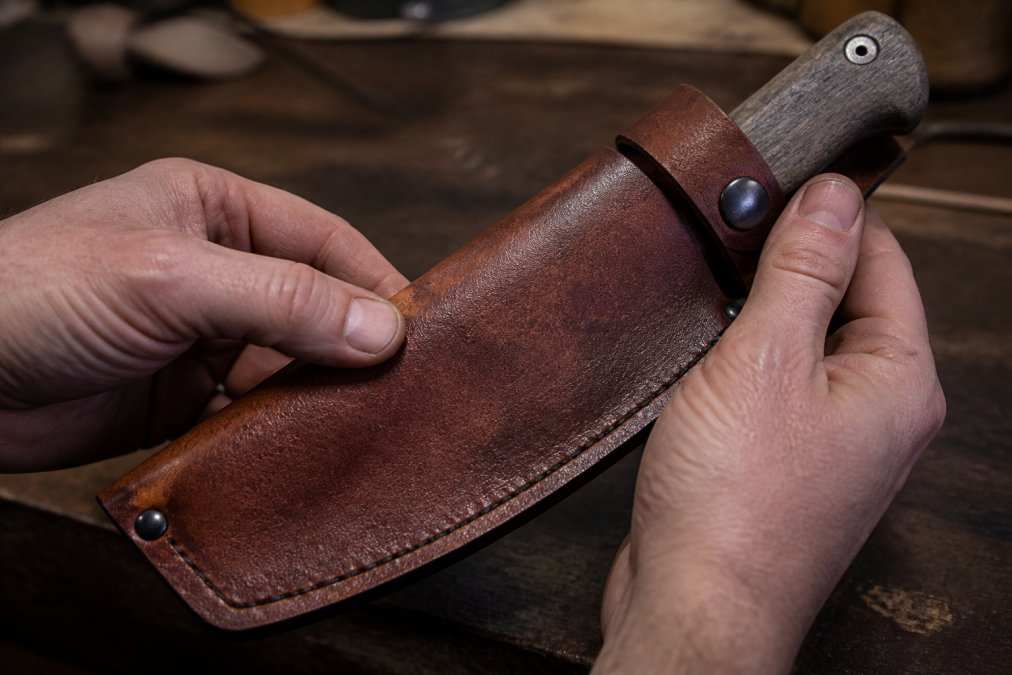
A leather hatchet sheath made from full-grain, veg-tan leather is a solid example. You can see the grain pattern, the natural markings, and the way the leather darkens with use. Vegetable-tanned full grain is common in American-made holsters, knife sheaths, and belts because it holds shape and resists stretching. When you handle it, the surface feels dry and firm at first, then softens with handling.
What are the five grades of leather?
From highest to lowest: full grain, top grain, corrected grain, split leather, and bonded leather. Full grain keeps the outermost layer intact. Top grain is sanded smooth. Corrected grain is heavily buffed and coated to hide flaws. Split leather comes from the lower fibrous layers. Bonded leather is ground-up scraps glued together and embossed with a fake grain pattern. Only the top two grades come from the original hide surface.
How can I spot fake leather in a store without damaging it?
Check the edge first. Real leather shows a fibrous, uneven cross-section. Faux leather shows a fabric backing or a uniform plastic edge. Next, look at the grain pattern: real leather has irregular pores that never repeat, while synthetic coating shows a stamped, repeating pattern. Smell it. Real leather smells earthy; faux leather smells like chemicals or plastic. Finally, press a fingernail into the surface. Real leather creases and recovers; faux leather stays flat or shows a permanent dent.
0 comments