
Quick Summary
Concealed carry tips for business casual attire come down to three things: a shirt cut full enough to drape over the holster, a stiff carry belt that keeps the holster high and tight, and a holster that sits snugly against the body. Test printing and movement in a mirror before your first workday.
- Choose a shirt cut full enough to drape over the holster rather than a slim or athletic fit.
- Use a heavier fabric or a mid-tone solid, since thin cotton and very light solids show holster outlines.
- Wear a stiff carry belt, because a thin dress belt sags and rotates the holster outward.
- Run a movement check at home: sit, lean, reach up, and bend, then recheck for printing.
Table of Contents
- How to Choose Concealed Carry Clothing for Business Casual Attire
- Concealed Carry With a Tucked-In Shirt: Belt, Holster and Placement
- Best Concealed Carry Holster for Business Attire
- How to Prevent Printing When Carrying Concealed
- Women's Concealed Carry Business Casual Outfits
- Testing Your Concealment Before Work: A Movement Check
- Booking Your Custom Holster for Your Next Work Week
- Frequently Asked Questions
Are Concealed Carry Tips for Business Casual Attire Worth It?
Last Updated: October 29, 2026
How to Choose Concealed Carry Clothing for Business Casual Attire
Carrying concealed at work is less about the gun and more about the clothes. How do you keep a firearm hidden in a button-up shirt and slacks without looking like you're hiding something?
Business casual is tricky. It looks clean and polished, which means less bulk to hide behind. A hoodie can cover almost anything. A crisp shirt cannot. So the job is to choose clothes that give you room without giving away your carry.
A common mistake is buying a shirt that looks sharp on the hanger but pulls tight across the waist when you sit down. Try the shirt on, then sit, bend, and reach up.
Shirt fit, fabric weight and patterns that reduce printing
Printing is what happens when the outline of your holster or gun shows through your clothes. It is the single biggest giveaway, and it is mostly a fit and fabric problem.
Fit matters most. A shirt that is too tight hugs the holster and shows its shape. A shirt cut a little fuller lets the fabric fall away from your body. Many people who carry find that a traditional or relaxed cut works better than an athletic or slim fit.
Fabric weight matters too:
- Heavier fabrics like twill and oxford cloth hide outlines better than thin cotton.
- Thin, light fabrics tend to show the shape of a holster clearly.
- Patterns such as small checks, stripes, or subtle prints can break up a silhouette.
Solid colors in a mid-tone often work well. Very dark or very light solids can make a printed outline stand out more.
Untucked shirts and other ways to cover the firearm
An untucked shirt is the simplest cover. A longer shirt worn untucked drops over the waistband and hides the holster completely. It still looks professional when the hem is clean and the shirt is cut to the right length.
Other options include:
- A lightweight vest or open-front layer worn over the shirt
- A cardigan or unstructured blazer for cooler offices
- Dress pants with a slightly higher rise, which keep the waistband covered
Each choice changes how quickly you can access your firearm, so test your setup before relying on it.
Concealed Carry With a Tucked-In Shirt: Belt, Holster and Placement
A tucked-in shirt is the hardest business-casual look to carry under, because the shirt goes inside the waistband and the holster sits outside it. Get the order of operations wrong and you either print badly or can't reach the grip. The fix is a system: a stiff belt, a tuckable holster with a concealment wing, and a shirt long enough to stay put when you move.
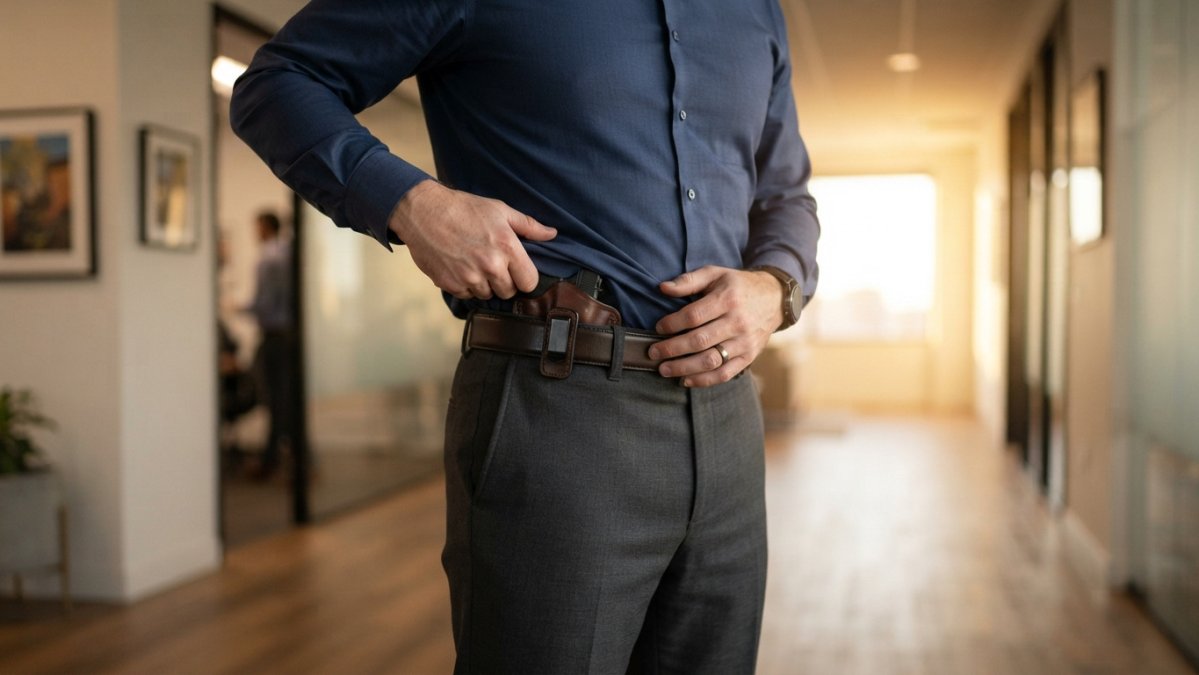
The tuck mechanics, step by step
The sequence matters:
- Put the holstered firearm in place at your chosen position.
- Tuck the shirt tail down between the holster and your body, smoothing it flat against the holster's outer face.
- Blouse the fabric slightly above the belt line so it drapes rather than pulls tight across the grip.
- Fasten the belt and check that the clip is gripping fabric and belt, not just fabric.
Why the belt does most of the work
A thin dress belt sags under a loaded firearm, and that sag rotates the holster outward, the exact motion that creates printing. A carry belt with a stiff core holds the holster vertical and keeps the grip tucked against your side. You can compare gun belts that work with leather holsters in this guide to choosing a gun belt. Look for a belt stiff enough that it does not fold when you bend it in half, and wide enough to fill the belt loops on your dress trousers. Many practitioners run a 1.5-inch belt for this reason; narrower fashion belts flex too much.
Placement tradeoffs for a tucked shirt
- Appendix (front, inside the hip bone): The grip sits where the shirt drapes most naturally, and the draw is fast while standing. The tradeoff is discomfort when seated for long stretches and more printing when you bend forward.
- Strong-side hip (3 to 4 o'clock): Comfortable for desk work and driving, and the grip stays behind your arm line. The tradeoff is that the draw is slower from a seated position and the holster can peek out when you reach overhead.
- Behind the hip (4 to 5 o'clock): Hides well under a drapey shirt, but access is awkward while seated and the holster tends to shift when you stand up.
Test each position through a full workday simulation, sit at a desk, stand, walk, reach for a shelf, before committing. Use this guide to holster ride height for concealment to dial in where the holster should sit. The position that hides best standing still is often not the one that hides best in motion.
Watch out: Do not tighten the belt so hard that the holster can't move with you. A cramped setup shifts and prints more, not less.
Choosing the holster for a tuckable setup
Our [IMAGE placement] Custom Leather IWB Holster is handcrafted in the USA from premium full-grain leather and molded by hand to fit your firearm. You can explore it here: custom leather IWB holster.
Best Concealed Carry Holster for Business Attire
The holster you choose matters as much as the clothes you wear over it. For business attire, an inside-the-waistband holster is usually the strongest option because it sits against the body under the shirt.
Custom Leather IWB holster, Leather Holster, Conceal Carry Holster →
Our TEXAS REBEL IWB Conceal Carry Holster is handcrafted from premium full-grain leather in the USA, custom molded for a snug fit, and designed for all-day comfort. If you want something made specifically for your firearm, a custom leather IWB holster is handcrafted to fit your specific firearm.
Here is a quick look at what to weigh:
| Option | Best For | Key Consideration |
|---|---|---|
| Standard IWB holster | Everyday office wear | Easy to conceal, quick access |
| Custom molded IWB | Specific firearm models | Snug fit, reduced movement |
| Leather holster | Long-term durability | Breaks in to fit your body |
How to Prevent Printing When Carrying Concealed
Printing is the number one thing people want to avoid. A few simple habits make a big difference:
- Choose a shirt that is cut full enough to drape over the holster
- Pick a mid-tone solid or a subtle pattern in heavier fabric
- Use a sturdy belt so the holster stays high and tight
- Keep the grip closer to your body by selecting a snug IWB design
Print checks should happen before you leave the house. Stand in front of a mirror, turn to each side, and look for outlines. Then bend and raise your arms. The shape that shows when you move is the shape everyone will notice.
Women's Concealed Carry Business Casual Outfits
Most carry advice is written around men's clothing, and it shows. Women's business casual involves fitted blouses, pencil skirts, wrap dresses, and trousers cut close to the hip, garments with less structure and less room than a button-up and slacks. The result is that the standard inside-the-waistband advice often fails, and the fix is to match the carry method to the garment rather than forcing the garment to accommodate the holster.
Match the method to the garment
| Garment type | Workable carry approach | Main tradeoff |
|---|---|---|
| Tailored trousers with a real waistband | Inside-the-waistband holster on a stiff belt | Needs a belt the trousers can support; low-rise cuts expose the holster when seated |
| Pencil or A-line skirt | Inside-the-waistband at the appendix or hip, or a thigh holster under the skirt | Draw access is slower; thigh carry requires practice to access discreetly |
| Wrap or sheath dress | Appendix carry with a concealment garment, or an off-body option | Dresses have no waistband to anchor a holster; a light jacket or cardigan becomes mandatory |
| Fitted blouse and slacks | Inside-the-waistband with a concealment wing, plus a structured layer | The blouse must drape, not cling; a thin blouse prints the grip outline |
The garment features that actually matter
- Waistband height and stiffness. Higher-rise trousers and skirts cover the holster line and give the clip something to grip. Low-rise styles expose the holster when you sit or bend.
- Fabric drape. A blouse that falls away from the body hides a holster; a clingy knit traces its outline. Look for woven fabrics with some body rather than thin jersey.
- Structured layers. An unstructured blazer or a cardigan with some weight breaks up the waistline silhouette in a way a soft wrap cannot.
- Prints and texture. Small-scale prints, subtle texture, and mid-tone colors disrupt the eye's read of a hard outline better than flat, light solids.
Body-type considerations
A petite frame often has less horizontal room between the hip bone and the waistband, so a smaller holster and a slightly longer top help. A curvier frame may find that a fuller cut drapes more easily, but the waist-to-hip curve can push a holster outward at the hip, appendix or behind-the-hip placement often hides better than strong-side hip. These are starting points, not rules; the only reliable test is trying the full outfit through a day of movement.
Access and safety tradeoffs
Every method that hides better tends to slow access. Thigh and off-body carry can be very discreet but require dedicated practice to draw safely and consistently. Whatever method you choose, confirm that the trigger guard is fully covered, that the holster retains the firearm when you move, and that you can reholster without looking. Consider a certified training course that covers the specific carry method you plan to use, since most range instruction assumes belt carry.
Testing Your Concealment Before Work: A Movement Check
Before your first full day at the office, run a simple test at home.
-
Put on the full outfit, including the belt, holster, and firearm.
-
Stand in front of a mirror and check for printing from every angle.
-
Sit down, lean forward, and reach up as if reaching a high shelf.
-
Bend at the waist and crouch.
-
Check again for printing and shifting.
Booking Your Custom Holster for Your Next Work Week
If you want a holster molded to fit your firearm, our Custom Leather IWB Holster is handcrafted in the USA from premium full-grain leather.
Frequently Asked Questions
What is the 3-3-3 rule for business casual fashion?
The 3-3-3 rule is a simple way to build a business casual outfit: pick three pieces, such as a shirt, pants and shoes, and keep them coordinated. For concealed carry, the same logic helps. Choose a shirt with enough length and fabric weight to cover your holster, and slacks with a secure waistband. Keep the silhouette clean so the outfit looks professional.
Can you conceal carry with a tucked-in shirt?
Yes, but it takes more planning. A tucked-in shirt shows your belt line. Test your outfit by bending, sitting and reaching before you leave home. If the shirt pulls up, consider an untucked shirt for that outfit.
How can women conceal carry in business casual attire?
Women can choose a slightly longer top or a fuller cut, and pair it with pants that have a higher rise. Layering with a lightweight cardigan or unstructured blazer can add coverage.
How can you reduce printing in business casual attire?
Printing happens when the outline of the firearm shows through clothing. Choose heavier fabric or a darker, patterned shirt, and select a fuller or untucked cut where appropriate. Avoid tight shirts that stretch over the gun. Check your reflection from multiple angles and in different lighting before you head out.

0 comments