
Table of Contents
- What Makes a Leather Knife Sheath for Belt Carry Actually Durable
- Best Leather for Knife Sheaths: Full-Grain vs. Top-Grain vs. Genuine
- Vertical vs. Horizontal Knife Sheath: Which Belt Carry Style Fits You
- Belt Width Compatibility and Sizing: How to Get the Right Fit
- Handmade vs. Mass-Produced Leather Knife Sheaths for Belt
- How to Clean a Leather Knife Sheath and Keep It Field-Ready
- Frequently Asked Questions
Last Updated: August 27, 2026
What Makes a Leather Knife Sheath for Belt Carry Actually Durable
A durable leather knife sheath for belt carry depends on three things: construction quality, leather selection, and hardware integrity. At AnchorsAweighLeather, we've built sheaths since 2017, and the difference between one that lasts a decade and one that fails in a season comes down to these fundamentals.

Sheath Construction: Stitching, Hardware, and Snap Closures
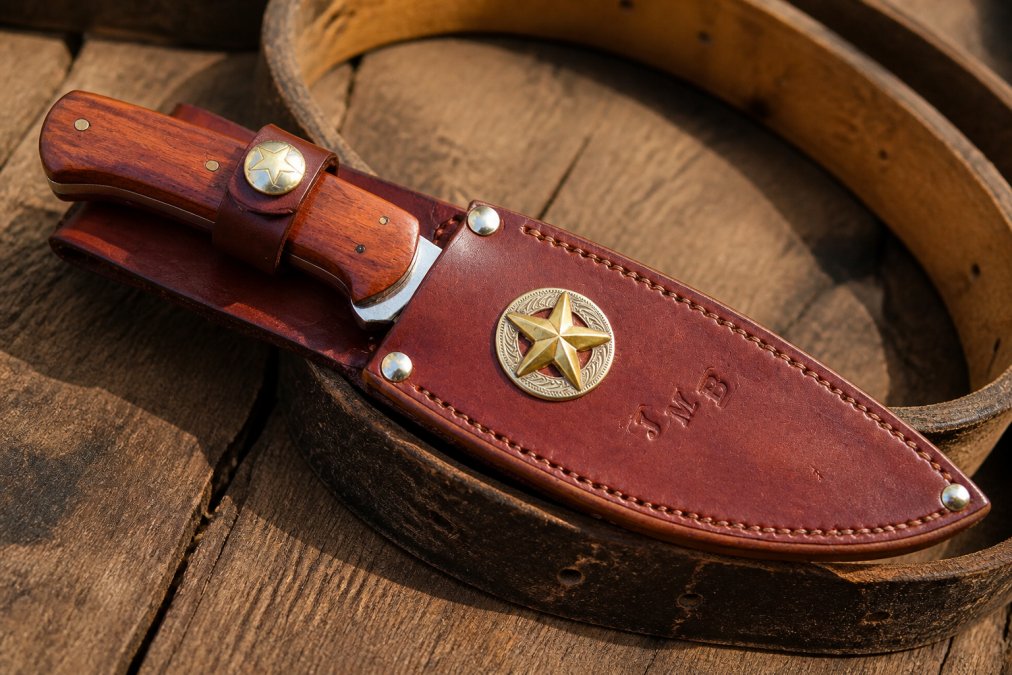
Cheap leather sheaths fail first at the stitching. Mass-produced versions use thin synthetic thread that cuts through leather channels under moisture, heat, and repeated draw cycles. Quality sheaths use heavy-duty hand-stitching with waxed linen or nylon thread in a saddle stitch pattern. The saddle stitch uses two needles and locks each stitch independently, so if one breaks, the seam doesn't unravel, a structural advantage that's kept this technique standard in leatherwork for centuries.
Hardware matters equally. Snap closures should be solid brass or nickel-plated steel, not pot metal, which corrodes and weakens. A quality snap should click firmly and release cleanly with no wobble.
Friction fit designs skip the snap and rely on precise molding to the blade profile. This works well for fixed blades when the fit is tight, but requires careful break-in and can loosen if the leather isn't thick enough.
Leather Thickness and Temper Guide
Leather thickness is measured in ounces per square foot:
- 4-5 oz leather (roughly 1.6-2mm): Too thin for belt sheaths; flexes and loses shape.
- 7-8 oz leather (roughly 2.8-3.2mm): The sweet spot for most belt knife sheaths, stiff enough to hold molded shape, flexible enough to form around the blade.
- 9-10 oz leather (roughly 3.6-4mm): Heavy-duty territory for large fixed blades and hunting knives.
Temper refers to how the leather has been tanned to achieve stiffness. A well-tempered sheath holds its shape through heat, cold, and moisture without cracking or warping.
Best Leather for Knife Sheaths: Full-Grain vs. Top-Grain vs. Genuine
Full-grain leather is the only serious choice for knife sheaths. It's the top layer of the hide with the natural grain intact, meaning the fiber structure is densest where you need it most. Top-grain leather has been sanded or buffed to remove imperfections, which weakens those outer fibers. Genuine leather is a marketing term for lower-grade splits that degrade quickly under field conditions.
Full-grain develops a patina over time that actually strengthens the outer layer, and its dense fiber structure resists cuts, abrasion, and moisture far better than processed alternatives. According to the Leather Research Laboratory at the University of Cincinnati, structural integrity is directly tied to how much of the original grain layer is preserved during tanning.
Vegetable-Tanned vs. Oil-Tanned Leather
Vegetable-tanned leather is tanned using natural plant-based tannins in a slow process that can take weeks. The result is firm, dense leather that molds well, holds tooled designs sharply, and develops a rich patina with age. It's the traditional choice for knife sheaths because it can be wet-molded to a blade's exact profile, then dried to hold that shape permanently.
Oil-tanned leather is processed with oils and waxes that leave the fibers soft, supple, and naturally water-resistant. It doesn't mold as precisely as vegetable-tanned leather, but it's more forgiving in wet conditions. Some makers use oil-tanned leather for the outer layer while using vegetable-tanned leather for the inner welt.
For EDC and outdoor carry, vegetable-tanned leather edges out oil-tanned for superior moldability and long-term shape retention.
Sustainability and Tanning Processes
Vegetable tanning is also the more sustainable option. It uses natural, biodegradable tannins rather than the chromium salts used in chrome tanning. As documented by the Leather Working Group's environmental standards, chrome tanning produces chemical waste streams requiring careful management, while vegetable tanning has a significantly lower environmental footprint.
Vertical vs. Horizontal Knife Sheath: Which Belt Carry Style Fits You
Carry orientation depends on your body type, activity level, and blade size.
Vertical carry positions the blade point-down along your hip. It's the most common orientation for fixed blades and works well for longer knives. Draw motion is upward and natural. The downside: on a long blade, the sheath tip can dig into the thigh when seated.
Horizontal carry, also called scout carry, positions the sheath horizontally across the small of the back or front of the belt. This works well for folding knives and shorter fixed blades, keeping the handle accessible from either hand and staying out of the way when seated. The draw is a cross-body pull that becomes intuitive with practice.
Neither is universally better. A hunter covering rough terrain often prefers vertical carry for a large fixed blade. An EDC user with a compact folder often prefers horizontal carry for comfort during long seated periods.
Belt Loop Orientation and Cant
Cant refers to the angle at which the sheath sits relative to vertical. A forward cant angles the handle toward the front of the body, making the draw faster and more ergonomic for strong-side hip carry. A reverse cant angles the handle toward the rear, preferred by some for cross-draw or appendix carry.
Most quality leather knife sheaths have a fixed belt loop, so cant is determined at purchase. Some makers offer adjustable cant loops or multiple loop positions. If you have a specific carry preference, particularly if you're left-handed or carry in a non-standard position, discuss this before ordering.
Folding Knife vs. Fixed Blade Compatibility
Fixed blade sheaths are wet-molded to the blade's shape and often include a welt, a strip of leather sewn between the front and back panels that keeps the blade centered and prevents the edge from cutting through the stitching. This is a critical safety and durability feature.
Folding knife sheaths are typically pouches or pocket-style designs. The knife is protected in its closed position, so there's no exposed edge to manage. The fit needs to be snug enough to prevent rattling but loose enough for a clean draw.
Belt Width Compatibility and Sizing: How to Get the Right Fit
Belt width compatibility is one of the most overlooked specs when buying a leather knife sheath, and it causes more fit problems than almost anything else.

Most belt sheaths are designed for either 1.5-inch or 1.75-inch belts, the two most common widths for work and EDC belts. A sheath loop sized for a 1.75-inch belt will slide and rotate on a 1.5-inch belt. A loop sized for 1.5 inches won't accept a 1.75-inch belt at all.
Before you buy, measure your belt width.
| Sheath Loop Width | Compatible Belt Width | Common Use |
|---|---|---|
| 1.5 inch | 1.25 - 1.5 inch | Dress belts, lighter EDC |
| 1.75 inch | 1.5 - 1.75 inch | Work belts, tactical belts |
| 2 inch | 1.75 - 2 inch | Heavy-duty, duty belts |
For blade sizing, measure your knife's blade length from tip to guard (not the handle), then add half an inch for clearance. That's the minimum interior depth your sheath needs. Measure the blade's widest point and compare it to the sheath's stated opening width.
A sheath that's too loose lets the knife rattle and work its way out. A sheath that's too tight puts stress on the seams every time you draw.
Handmade vs. Mass-Produced Leather Knife Sheaths for Belt
Most mass-produced leather knife sheaths are made from top-grain or genuine leather, stitched by machine, and finished with surface coatings that hide inconsistencies. They look fine in photos but the difference becomes obvious within months.
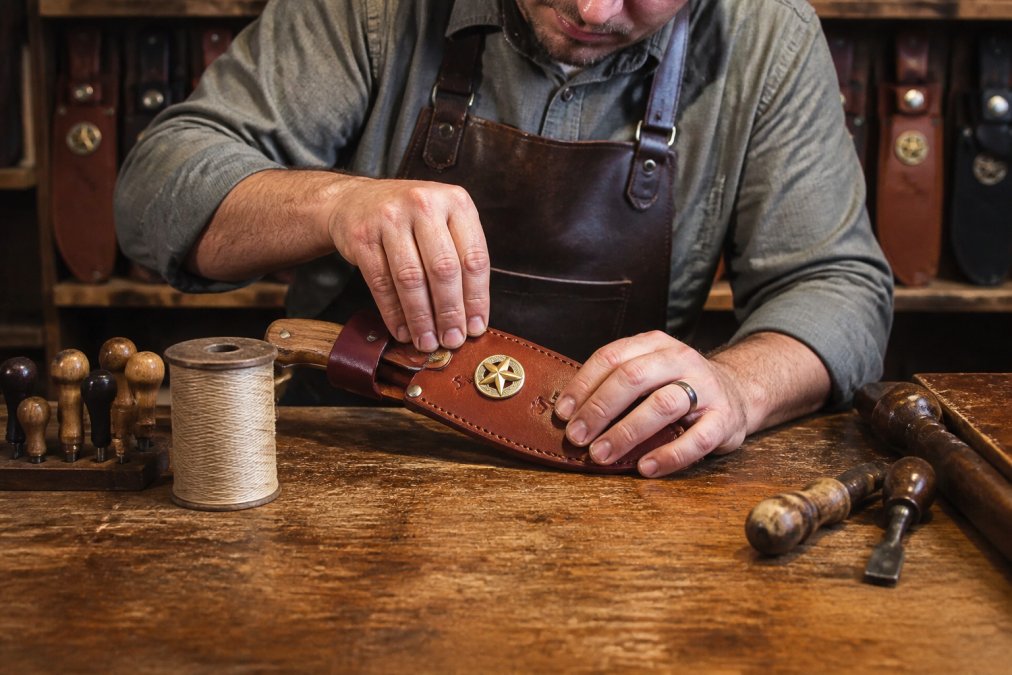
Handmade sheaths are built differently from the start. The leather is selected by hand for grain consistency and thickness. Each piece is cut, skived, and assembled individually. The stitching is done by hand, producing a stronger seam. The sheath is wet-molded to the actual blade profile or to the buyer's specifications, then dried in shape.
The result is structurally superior. The sheath holds its shape longer, the stitching lasts longer, and the leather develops a patina that improves with use rather than degrading.
The AnchorsAweighLeather Custom Leather Knife Sheath is hand-stitched from vegetable-tanned leather and available in three colors, starting at $49. The Rancher Pancake Knife Sheath ($42) uses the same top-grade veg-tanned leather in a pancake construction that sits slim against the belt. Both are handcrafted in the USA by a veteran-owned shop since 2017.

A handmade sheath can be built to your blade's exact dimensions, your preferred cant, your belt width, and your carry style. For anyone with a non-standard setup, custom work isn't a luxury, it's the only way to get a proper fit.
How to Clean a Leather Knife Sheath and Keep It Field-Ready
Proper cleaning and maintenance is the difference between a sheath that lasts 20 years and one that cracks and stiffens by year three.
Step 1: Remove surface dirt. Use a barely damp cloth to wipe down the exterior. For stubborn grime, a soft-bristled brush works well. Let it dry naturally, never use heat.
Step 2: Clean with a leather-specific cleaner. A pH-balanced leather cleaner removes oils, sweat, and residue without stripping the leather's natural moisture. Apply with a soft cloth, work it in gently, then wipe clean.
Step 3: Condition the leather. Once clean and fully dry, apply a quality leather conditioner. Neatsfoot oil, beeswax-based conditioners, and purpose-made leather balms all work well. Work the conditioner into the leather with a cloth, let it absorb for 15-20 minutes, then buff off any excess.
Step 4: Check the hardware. Wipe metal hardware with a dry cloth after cleaning. If you notice rust forming, address it immediately.
Maintenance frequency:
| Carry Frequency | Cleaning | Conditioning |
|---|---|---|
| Daily carry | Monthly | Every 2-3 months |
| Weekend carry | Every 2-3 months | Twice per year |
| Occasional use | Before/after each use | Once per year |
| Storage | Before storage | Before and after storage |
For vegetable-tanned sheaths specifically, conditioning is especially important because the leather is naturally more absorbent. A well-conditioned veg-tan sheath will darken and develop a patina over time, that's the leather doing what it's supposed to do. According to the American Leather Chemists Association's care guidelines, proper conditioning extends the functional lifespan of vegetable-tanned leather significantly compared to unconditioned leather.
For more on keeping your leather gear in top condition, the Leather Conservation Centre's guide to leather care provides detailed guidance on long-term maintenance for quality leather goods.
Choosing a leather knife sheath that holds up over years of daily carry comes down to material quality, construction integrity, and a fit that matches your blade and belt. The difference between a sheath that fails in six months and one that becomes a permanent part of your kit is whether the maker put in the work that doesn't show up in a product photo. Get started with AnchorsAweighLeather and carry something built to last, handcrafted in the USA by people who take the work seriously.
Frequently Asked Questions
What is the best leather for knife sheaths?
Full-grain vegetable-tanned leather is the top choice for knife sheaths. It is the densest, most durable cut of hide, and the vegetable tanning process produces a firm temper that molds to your blade over time without becoming brittle. Oil-tanned leather is a solid second option for wetter environments because it stays supple with less maintenance. Avoid sheaths labeled only 'genuine leather', that grade is made from lower layers of the hide and wears out significantly faster.
Are vertical or horizontal belt sheaths better for EDC?
It depends on your carry style and blade length. Vertical carry keeps longer fixed blades close to the body and is the most common setup for outdoor and hunting use. Horizontal or scout carry works well for shorter blades and makes the knife easier to reach across the body. The belt loop cant angle also matters: a slight forward or backward tilt changes draw speed noticeably. A leather knife sheath for belt carry should match both your dominant hand and how you typically move throughout the day.
How do you maintain a leather knife sheath?
Wipe the sheath down with a dry or barely damp cloth after each use to remove dirt and moisture. Every few months, apply a quality leather conditioner or neatsfoot oil to prevent the leather from drying and cracking. Keep the sheath away from prolonged direct sunlight and never store it wet. Avoid petroleum-based products, which can break down the leather's fibers over time. A well-maintained full-grain or vegetable-tanned leather knife sheath can last decades with minimal care.
Where should a knife sit on a belt?
Most EDC users position a knife sheath between the hip and the rear of the dominant-hand side for fast, natural access. Appendix or cross-draw positions work for shorter blades in horizontal sheaths. The key is that the belt loop holds the sheath snug without shifting during movement. Check that your belt width matches the sheath's loop, most handcrafted sheaths are cut for belts between 1.5 and 1.75 inches wide. A loose loop causes the sheath to rotate and slows your draw.
This article was written using GrandRanker
0 comments