
Table of Contents
- Audit Your Current Pocket Gear and Daily Needs
- Essential Everyday Carry Items for Your Pockets
- Choosing an EDC Pocket Organizer for Your Setup
- Building a Minimalist Everyday Carry Setup
- EDC Pouch Organization and Pocket Layout Strategy
- Comfort, Weight Distribution, and Pocket Arrangement
- Maintenance and Routine Loadout Checks
- Safety and Legal Considerations for Pocket Carry
- Frequently Asked Questions
Last Updated: October 6, 2026
Audit Your Current Pocket Gear and Daily Needs
Before learning how to organize your everyday carry pocket gear, take inventory of what you actually carry.
Empty your pockets and lay everything on a table. Ask honestly: do you use each item daily, weekly, or does it just take up space?
- What do I reach for every day?
- What do I carry "just in case" but rarely use?
- What items serve the same purpose?
This 10-minute audit reveals redundancy, gaps, and what truly matters. Once you know what stays, build a system around it, the goal isn't to carry more, it's to carry smarter.
Essential Everyday Carry Items for Your Pockets
Your EDC depends on your job, lifestyle, and routine, but certain items show up in most pockets.
Keys and Key Organization
Keys are the first thing most people grab, and a loose key ring creates bulk, weight, and noise.
The solution is a dedicated key holder. A leather key fob keeps keys compact and attaches to your belt loop, backpack, or bag with a swivel snap, separating them from other pocket items and preventing scratches.

AnchorsAweighLeather makes a leather key holder from premium vegetable-tanned leather. The 360-degree swivel snap keeps keys from tangling, and hand-burnished edges plus neatsfoot oil treatment make it last years.
Wallet, Cards, and Cash
Your wallet is your second-heaviest pocket item. A thick, overstuffed wallet ruins pocket geometry and makes sitting uncomfortable.
A minimalist card holder holds your ID, a few cards, and cash without the bulk. Audit your wallet: keep what you use weekly, leave the rest at home or in your bag.
AnchorsAweighLeather offers two solid options. The British Tan Slim Leather Card Holder holds up to 4 cards plus cash. The Alta Edition Minimalist Wallet is hand-stitched with waxed linen thread and holds cards, cash, and your driver's license.


Knife, Flashlight, and Small Tools
A knife is the cornerstone of practical everyday carry, handling everything from opening packages to cutting rope in an emergency. A pocket-sized LED flashlight comes next, it weighs almost nothing and solves darkness instantly. Small tools round out the setup: a whistle, a pen, maybe a multi-tool. Choose tools that earn their pocket space; a tool you never use is just weight.
Choosing an EDC Pocket Organizer for Your Setup
An EDC pocket organizer is optional, but it solves a real problem: loose gear bouncing around inside your pocket. An organizer pouch keeps items separated and accessible, so your knife doesn't scratch your wallet, your flashlight doesn't roll around, and you find what you need instantly.
When choosing an organizer pouch, consider:
- Material: Leather lasts forever; canvas wears out; nylon is cheap but doesn't age well.
- Size: Match it to your actual gear, not your fantasy loadout, an oversized pouch creates bulk.
- Compartments: You need separate slots for knife, flashlight, keys, and cash. MOLLE straps attach it to bags or belts.
A leather organizer pouch protects your tools, ages beautifully, and can last for a long time.
Building a Minimalist Everyday Carry Setup
Minimalist carry isn't a shorter gear list, it's a repeatable method for deciding what earns pocket space. The five-item starter kit (knife, flashlight, key holder, wallet, pen) is a reasonable default, but a nurse, a delivery driver, and a software engineer will land on three different loadouts from the same method.
The three-question filter
Run every candidate item through these questions:
- Did I use it in the last seven days? If no, it belongs in a bag, desk drawer, or glovebox.
- Does another item already do this job? A multi-tool with a blade makes a separate knife redundant for light tasks; a phone flashlight makes a dedicated light redundant until the battery dies, which is why most people keep a small light anyway.
- Would I notice its absence within an hour? If you'd only miss it in a rare scenario, it's a bag item, not a pocket item.
Items that pass all three earn a pocket slot; those that pass one or two go in a bag; those that pass none get removed.
A weight target you can actually measure
Most people have no idea what their pockets weigh. Put your full loadout on a kitchen scale. A common comfort range is roughly 8 to 16 ounces, above which waistbands pull and pant fit distorts. Body size, clothing cut, and belt stiffness change the threshold, but if you're over it, cut the heaviest item you use least.
Adapt the loadout to context, not to a fixed list
A single gear list can't cover every day. Build three versions and swap between them:
- Workday loadout: the five essentials, nothing more, slim pants and offices reward a tight footprint.
- Weekend or outdoor loadout: add a multi-tool, a brighter light, and a small first-aid item; cargo pants or a jacket absorb the bulk.
- Travel loadout: drop anything with a blade if flying, add a backup payment method, and keep everything in one organizer pouch so nothing gets left in a hotel room.
Match the loadout to your clothing and climate
Slim-fit jeans and dress trousers have shallow, tight pockets that tolerate a phone, a slim card holder, and a small knife, not much else.
Climate matters too: hot weather means lighter clothing and less pocket structure, so a smaller loadout or belt-mounted pouch works better, while cold-weather jackets add interior pockets that free your pants pockets for the essentials.
No-pouch and budget options
You don't need to buy anything to organize pocket gear:
- Use what you have. A rubber band around a folded bill, a hair tie around a pen and light, or a small zip pouch all separate gear effectively.
- Repurpose a glasses case for a flashlight, pen, and small tools, rigid, cheap, and crush-proof.
- Use a jacket's interior pockets as your organizer: free, no bulk in your pants, and metal stays away from your phone.
The best organizer is the one you'll actually use every day. If a free solution works, it beats a purchased pouch you leave at home.
Leather Key Holder, Leather Key Chain, Leather Key Ring, Key Chain, EDC →
EDC Pouch Organization and Pocket Layout Strategy
Most pocket-carry advice stops at "put your knife in your front pocket", that's a guess, not a strategy. A real layout starts with access priority, then assigns each item to a pocket based on how often you reach for it, its weight, and how it interacts with nearby items.
Step 1: Rank your gear by access frequency
Pull everything from your audit and sort it into three tiers:
- Tier 1, multiple times per day: phone, wallet, keys, primary knife. These need one-handed access without looking.
- Tier 2, daily but not constant: flashlight, pen, multi-tool, lip balm, medication.
- Tier 3, occasional or emergency: whistle, backup light, spare cash, bandage.
Tier 1 items earn the strongest pockets; Tier 3 items can live in a bag, jacket, or organizer pouch.
Step 2: Assign pockets by access and weight
A workable default layout for standard five-pocket pants:
- Dominant-side front pocket: primary knife and flashlight, your fastest-draw tools, found without crossing your body.
- Non-dominant front pocket: phone alone, or phone plus a slim card holder if the phone is small. Never stack a phone against keys or metal, screen scratches and pressure cracks are the most common pocket-carry damage.
- Dominant-side back pocket: wallet. It's the heaviest single item most people carry, and back pockets handle weight without distorting the front silhouette.
Step 3: Separate metal from everything else
Metal tools scratch phones, wear through wallet leather, and chip cards. The fix is physical separation, not careful placement. Options by cost:
- Free: put the knife in a different pocket from the phone and wallet, this alone solves most damage.
- Low cost: a slip pouch or folded microfiber cloth around the knife.
- Higher cost: a dedicated pocket organizer holding knife, light, and pen in one unit so they never touch your phone or cards.
Step 4: Use an organizer pouch when pockets alone aren't enough
An organizer pouch earns its place when you carry four or more small items that would otherwise rattle around, converting a loose pile into a single grab-and-go unit, especially useful when switching between pants, a jacket, or a bag.
When comparing pouches, check these in order:
- Footprint, not capacity. Measure your gear laid flat, then buy a pouch that matches. An oversized pouch is the number-one cause of pocket bulge.
- Retention method. Elastic loops stretch out; leather slots hold shape and age well; MOLLE webbing attaches the pouch to a belt or bag.
- Weight of the pouch itself. A leather organizer adds a few ounces before you load it. Weigh your full setup, if the pouch pushes you past your comfort threshold, downsize the pouch, not the tools.
Step 5: Test the layout in real conditions
The only layout that matters is the one that survives a normal day. Run this five-minute test:
- Sit in your car and in a chair. Nothing should dig into your thigh or hip.
- Bend over and pick something off the floor. Nothing should fall out.
- Walk a block. Nothing should jingle or shift.
- Reach for your phone, wallet, and knife without looking. If you have to think about which pocket, the layout is wrong.
Adjust one pocket at a time, changing everything at once makes it impossible to tell what fixed the problem.
Comfort, Weight Distribution, and Pocket Arrangement
Pocket geometry matters more than most people realize: an unbalanced load makes you lean, wears out one side of your pants, and makes sitting uncomfortable.
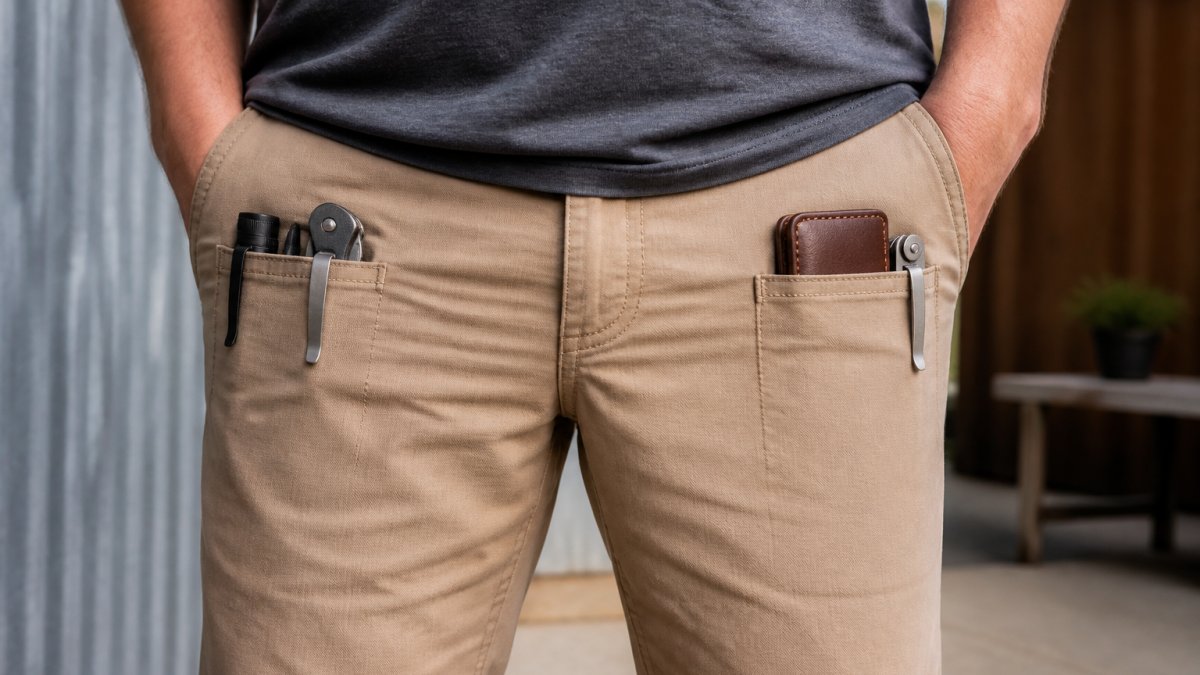
To properly distribute weight when you organize your everyday carry pocket gear, place heavy items like wallets in the back to keep front pockets light and prevent forward lean.
Maintenance and Routine Loadout Checks
Your everyday carry pocket gear needs maintenance. Leather needs conditioning. Blades need sharpening. Batteries need checking.
Monthly checks take 10 minutes:
- Inspect leather for cracks or damage
- Check knife blade for dullness
- Test flashlight battery
Condition leather every six months with neatsfoot oil or leather conditioner. This keeps it supple and prevents cracking. Quality leather ages beautifully when maintained.
Replace batteries before they die completely. A dead flashlight in an emergency is worse than no flashlight.
Safety and Legal Considerations for Pocket Carry
Pocket carry comes with responsibilities. Know your local laws before carrying a knife. Blade length restrictions vary by state and city.
Check your state's knife laws before purchasing. Most states allow pocket knives, but some have restrictions on blade length or locking mechanisms.
Carry responsibly.
Organizing your everyday carry pocket gear is about matching your load to your life. Start with an honest audit.
At AnchorsAweighLeather, we believe your gear should be built to last. Explore our leather key holders and minimalist wallets to start your organized carry today.
Frequently Asked Questions
What are the essential items for an everyday carry pocket setup?
A solid everyday carry essentials foundation includes keys, wallet, pocket knife, flashlight, and pen. Start with these core items, then add tools that match your daily routine, a whistle, multi-tool, or spare cash holder. The goal is to carry what you actually use, not everything possible. Assess your commute, job, and typical activities to determine which items serve you best.
How do I choose between an EDC pocket organizer and loose pocket carry?
An EDC pocket organizer keeps small items separated and prevents pocket clutter, making gear access faster and protecting items from damage. Loose carry offers simplicity but risks losing items or having them rattle around. If you carry a pocket knife, wallet, and multiple small tools, an organizer prevents them from mixing and wearing each other. For minimalist setups with just keys and a wallet, loose carry works fine.
How can I prevent my pockets from becoming too bulky with gear?
Distribute weight across multiple pockets rather than loading one side. Keep your heaviest item, usually your wallet, in a back pocket. Use a compact EDC pouch organization system to consolidate small tools. Choose slim, minimalist designs for wallets and organizers. Rotate seasonal items: carry a heavier flashlight in winter, lighter alternatives in summer. This balance prevents discomfort and keeps your silhouette clean.
What's the best way to organize a knife, wallet, and keys for quick access?
Assign each item a dedicated pocket or compartment. Keys work well on a belt loop or in a front pocket with a swivel attachment like a leather key fob. Your wallet belongs in a back pocket or dedicated organizer pouch. Keep your pocket knife in a sheath on your belt or in a front pocket organizer for safe, quick access. This separation prevents items from damaging each other and makes retrieval instant when you need it.
0 comments