
Table of Contents
- What You'll Need Before You Shop
- Leather Grade: Full-Grain vs Top-Grain Leather Wallets
- Construction Quality: Stitching, Edges, and Lining
- Wallet Styles and Capacity: Billfold, Bifold, Card Holder
- How to Care for Leather Wallets So They Last
- Best Leather Wallet for Men 2026: What to Look For
- Common Mistakes to Avoid When Choosing a Reliable Leather Wallet
- Frequently Asked Questions
Last Updated: September 15, 2026
What You'll Need Before You Shop
Choosing a reliable leather wallet starts with a few decisions you can make before opening a product page. At AnchorsAweighLeather, we've built wallets since 2017, and the same questions come up: What leather is it? How is it put together? Will it fit how I carry?

Here's your pre-shop checklist:
- Your current wallet's contents. Count your cards, cash, and IDs. That number decides your capacity needs.
- Carry position. Front pocket, back pocket, or jacket. This drives size and profile more than anything else.
- A budget range. Handcrafted full-grain wallets cost more up front because they last for years, not months.
- Your dealbreakers. RFID protection, a specific color, or a slim profile. Write them down before browsing.
A common mistake is shopping by photo alone. Grain texture and stitching density rarely show up in product images, so read the construction details instead.
Leather Grade: Full-Grain vs Top-Grain Leather Wallets
Full-grain leather is the strongest grade because it keeps the hide's complete grain structure intact. Top-grain leather has its top layer sanded away, making it more uniform but weaker over time. Genuine leather, despite the name, is the lowest grade and often splits or peels within a year or two.
That matters for a reliable leather wallet because grain structure determines how it ages. Full-grain develops a patina, a rich darkening that builds character with use. Sanded top-grain wears flat and uniform instead. If longevity is the goal, full-grain wins.
Vegetable-Tanned vs Chrome-Tanned Leather
Vegetable-tanned leather is processed with plant-based tannins over weeks, producing a firmer, denser hide that ages beautifully. Chrome-tanned leather is processed with chromium salts in a day or two, giving a softer feel at lower cost.
Neither is automatically better, but they behave differently. Vegetable-tanned leather holds shape, burnishes cleanly at the edges, and deepens in color over years. Chrome-tanned leather feels broken-in immediately but loses structure faster. For a wallet you carry daily for a decade, vegetable-tanned is more durable.
Construction Quality: Stitching, Edges, and Lining
Construction is where cheap wallets give themselves away. Look at three things: stitching density, edge finishing, and lining material.
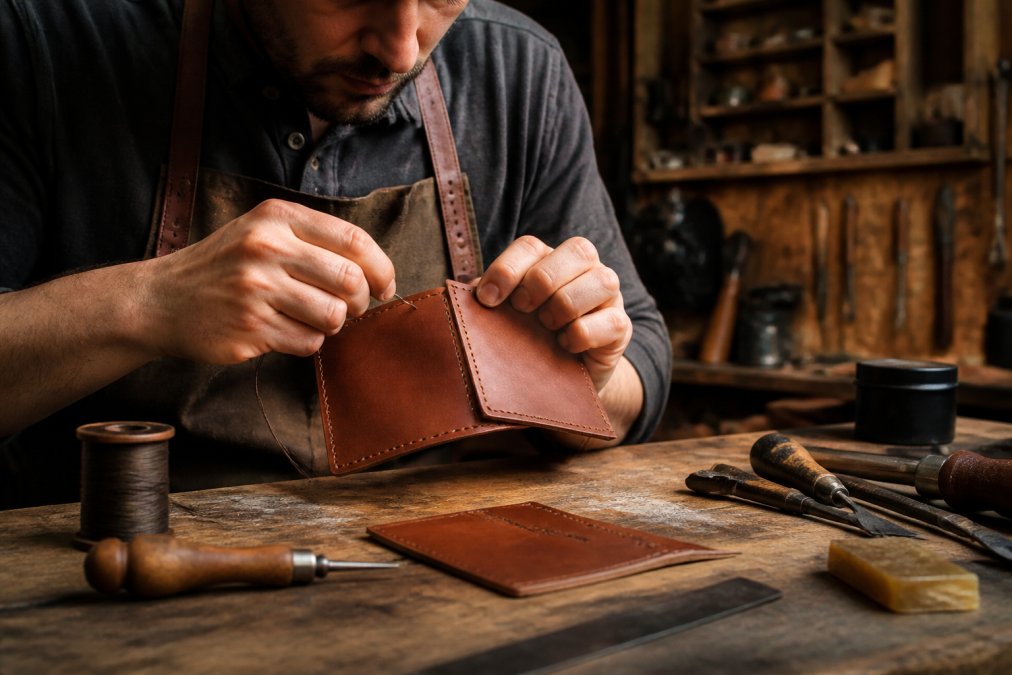
Machine stitching runs fast and even but can unravel if one stitch breaks. Hand-stitched saddle stitching uses two needles and a single waxed thread, so a broken stitch stays put. Burnished edges, sanded and waxed smooth, resist fraying better than raw or painted edges. A quality lining protects cards from scuffing inside.
Stitching Density and Saddle Stitching
Stitching density is the number of stitches per inch, and higher density generally means a stronger seam. Hand-stitched saddle stitching typically runs 6-8 stitches per inch, tight enough to hold under stress without perforating the leather. Sparse machine stitching can tear at stress points like the fold.
The real advantage of saddle stitching is repairability. If a thread breaks, surrounding stitches stay locked in place, so the wallet doesn't fall apart while you decide whether to repair it. That detail separates a wallet that lasts a decade from one that lasts a season.
Wallet Styles and Capacity: Billfold, Bifold, Card Holder
Wallet style should follow your carry, not the other way around. A billfold or bifold holds cash and cards in a traditional fold, a card holder keeps things minimal, and a card slip case sits in between. Match the style to your daily load and pocket, and to how long you sit and whether you carry in a back pocket, since those drive long-term discomfort.
| Style | Typical Capacity | Best For | Profile |
|---|---|---|---|
| Card holder | 3-6 cards | Minimalist front-pocket carry | Slimmest |
| Card slip case | 4-8 cards | Light everyday carry | Slim |
| Bifold | 6-12 cards plus cash | Standard daily use | Moderate |
| Trifold | 10+ cards plus cash | Heavy card carriers | Bulky |
A bifold is the safest default for most people. It carries enough without bulking up a front pocket, and a slim profile keeps it comfortable all day. If you carry fewer than six cards, a card holder or minimalist design will serve you better and cut pocket bulk.
Weight and Ergonomics: The Back-Pocket Problem
A loaded trifold can weigh several ounces, and that weight sits against one side of your pelvis for hours a day. Over years, the asymmetry shows up as lower-back discomfort, hip tightness, and shifting weight to one leg. Ergonomics writers flag the back-pocket wallet as a common contributor to what's sometimes called wallet sciatica, irritation from sitting on a thick, uneven object.
The fix is not complicated:
- Move the wallet forward. Front-pocket carry removes the pressure point and forces you to slim down, since a front pocket tolerates far less bulk.
- Match the wallet to the pocket. A bifold that feels fine in a back pocket can feel like a brick in a front pocket. Switching to front carry? Drop to a card holder or slip case.
- Weigh it loaded, not empty. A wallet that feels light can double in weight once you add cards, cash, and receipts. Empty it monthly.
- Consider a jacket or bag. If you carry more than a slim bifold's worth, a jacket pocket or small bag distributes weight better than any pants pocket.
Matching Style to Lifestyle
The right style depends on your day:
- Commuter with a desk job. A slim bifold in a front pocket is the sweet spot: enough capacity for cards and cash, without sitting on it for eight hours.
- Traveler. A card holder plus a separate passport or document sleeve beats one overstuffed bifold. Fewer cards means less to lose if it's stolen.
- Trades or field work. A bifold with a secure closure and burnished edges handles pocket friction better than a minimalist card holder, which can flex and lose cards.
- Minimalist. A card holder with 3-6 cards and a money clip covers most daily transactions. If you rarely use cash, this is the lightest reliable option.
How to Care for Leather Wallets So They Last
Leather care is simple and takes minutes, but skipping it shortens a wallet's life fast. The routine differs by tannage, and most guides flatten that distinction. Knowing whether you own vegetable-tanned or chrome-tanned leather prevents the two most common self-inflicted failures: over-conditioning and edge neglect.
Here's the baseline routine that works for most full-grain wallets:
- Wipe the surface with a dry, soft cloth to remove dust and grit. Grit is what actually abrades stitching, not friction from your pocket.
- Apply a small amount of conditioner with your fingertips, working it into the grain.
How Often to Condition, by Leather Type
Patina: What to Expect Over 5-10 Years
A few practical expectations:
Repairing Common Wallet Failures
Best Leather Wallet for Men 2026: What to Look For
Weight, Ergonomics, and Everyday Carry
Common Mistakes to Avoid When Choosing a Reliable Leather Wallet
Frequently Asked Questions
How can you tell the difference between genuine leather and full-grain leather?
Genuine leather is a broad label for the lower layers of a hide, often split and finished with a surface coating. Full-grain leather keeps the top layer intact, so the grain structure and natural markings remain visible. Full-grain develops a patina over time and holds up better, while genuine leather can crack or peel. Look for the words 'full-grain' or 'top-grain' on the label, not just 'genuine.'
How much should a good leather wallet cost?
A handcrafted full-grain leather wallet typically starts around $35 to $65. For example, AnchorsAweighLeather offers a hand-stitched Crusader bifold for $55 and a Longhorn minimalist wallet for $65. Cheaper wallets under $20 often use bonded or corrected leather that wears out fast. Paying a bit more upfront usually means the wallet lasts years longer.
Why is stitching quality important for a reliable leather wallet?
Stitching holds every panel together. Machine stitching can be loose or use thin thread that frays. Hand-stitched saddle stitching uses two needles and waxed thread, creating a lock that resists unraveling. Higher stitching density, around 6 to 8 stitches per inch, spreads stress across more points and prevents tearing at the corners and card slots.
What is the difference between vegetable-tanned and chrome-tanned leather?
Vegetable tanning uses plant tannins and takes weeks, producing leather that ages with a rich patina and is firm but supple. Chrome tanning uses chemical salts and takes hours, yielding softer, more uniform leather that resists water but may not develop character. For a wallet you want to keep for years, vegetable-tanned or a combination tannage is often the better choice.
Choosing a leather wallet is a decision you live with every day, and getting it wrong means replacing it again in a year. At AnchorsAweighLeather, every wallet is veteran-owned, handcrafted in the USA, and built to last from premium full-grain and vegetable-tanned leather, with free shipping on orders over $100. Custom orders are available if you need something specific. Get started with AnchorsAweighLeather and carry a wallet that only gets better with age.
0 comments