
Table of Contents
- Why Left-Handed Concealed Carry Requires a Different Approach
- Choosing the Right Left-Handed Concealed Carry Holster
- Concealed Carry Positions for Left-Handed Shooters
- Safe Draw Practice for Left-Handed Concealed Carry
- Testing Fit, Retention, and Comfort
- Left-Handed Concealed Carry Setup Checklist
- Frequently Asked Questions
Last Updated: October 14, 2026
Why Left-Handed Concealed Carry Requires a Different Approach
Being a left-handed shooter means your entire concealed carry setup needs rethinking, which is why concealed carry tips for left handed shooters differ significantly from standard guidance. At AnchorsAweighLeather, we build custom leather holsters specifically for left-handed carriers, and we've learned that getting this right changes everything about your carry experience.

The problem runs deeper than just flipping a holster. Your dominant hand, your body mechanics, your draw angle, and even how you access your firearm in a vehicle or tight space all shift when you're left-handed. A holster designed for right-handed carry won't retain your firearm the same way.
Here's what most guides miss: left-handed concealed carry isn't about finding a "left-handed version" of generic advice. It's about understanding how your body actually moves and building a setup that matches your natural mechanics. That's where custom work comes in.
Choosing the Right Left-Handed Concealed Carry Holster
Your holster is the foundation of everything. A bad holster makes every day miserable. A good one disappears, you forget you're wearing it.
Universal vs. Custom-Molded Holsters
Universal holsters fit multiple firearms, which sounds convenient until you actually use one. They offer loose retention because they can't be molded precisely to your specific gun. When you draw, the holster shifts. When you sit, it digs in differently than it would if it were molded to your exact firearm.
Custom-molded holsters, by contrast, are shaped to your specific gun. The leather is worked and formed around your firearm's exact profile. This means:
- Secure retention without excessive friction
- Consistent draw every single time
- Better concealment (tighter fit = smaller profile)
- Comfort that improves with break-in instead of getting worse
For left-handed carriers, custom molding matters even more. Your draw angle and hand position are different from right-handed shooters. A universal holster that happens to be "left-handed" is still a compromise. A custom piece made for your exact firearm and your left-handed draw is built right.
AnchorsAweighLeather offers both options. Our Custom Leather IWB Holster starts at $43.00 and works as a universal design, while our TEXAS REBEL IWB Conceal Carry Holster at $50.00 is custom-molded for a secure, snug fit. We also offer specialized options like the CCW Holster for Ruger LCP/LCPII and Smith & Wesson Bodyguard 380 at $48.00, and we build all of them for left-handed draw when you specify it.

Full-Grain Leather for Durability and Comfort
Material matters. Cheap synthetic holsters wear out fast. They crack, they harden, and they stop retaining your firearm properly. Full-grain leather, by contrast, actually improves with age. It molds to your body. It breathes. It lasts decades.
Full-grain leather is the hide with the outer layer intact. That's where the strength lives. It resists moisture, takes impact without cracking, and develops a natural patina over years of carry. When you sweat, it doesn't degrade.
The downside is price. Full-grain leather costs more upfront. But spread that cost over 10 years of daily carry, and it becomes the cheapest option available. A $50 holster you replace every 18 months costs more than a $50 holster you carry for a decade.
Concealed Carry Positions for Left-Handed Shooters
Where you carry changes your entire setup. Position determines holster type, belt requirements, clothing choices, and how quickly you can access your firearm. For left-handed shooters, the standard positions need adjustment.
Strong-Side Carry at 9 O'Clock
Strong-side carry means your holster sits on the same side as your dominant hand. For left-handed shooters, that's the 9 o'clock position on your waistband, roughly where your left hip sits when you're standing.
This is the most natural carry position for most people. Your hand naturally falls to your holster. Your draw is intuitive.
The trade-off: strong-side carry is visible when you bend or reach. Sit-down comfort depends on your belt and holster quality. In a vehicle, accessing your firearm becomes awkward because you're sitting on your draw side.
For left-handed shooters, 9 o'clock strong-side carry works best if you:
- Carry a full-size or compact pistol (smaller guns disappear better here)
- Spend most of your time standing or walking
- Wear cover garments that hang naturally over your hip
- Practice your draw regularly so it becomes automatic
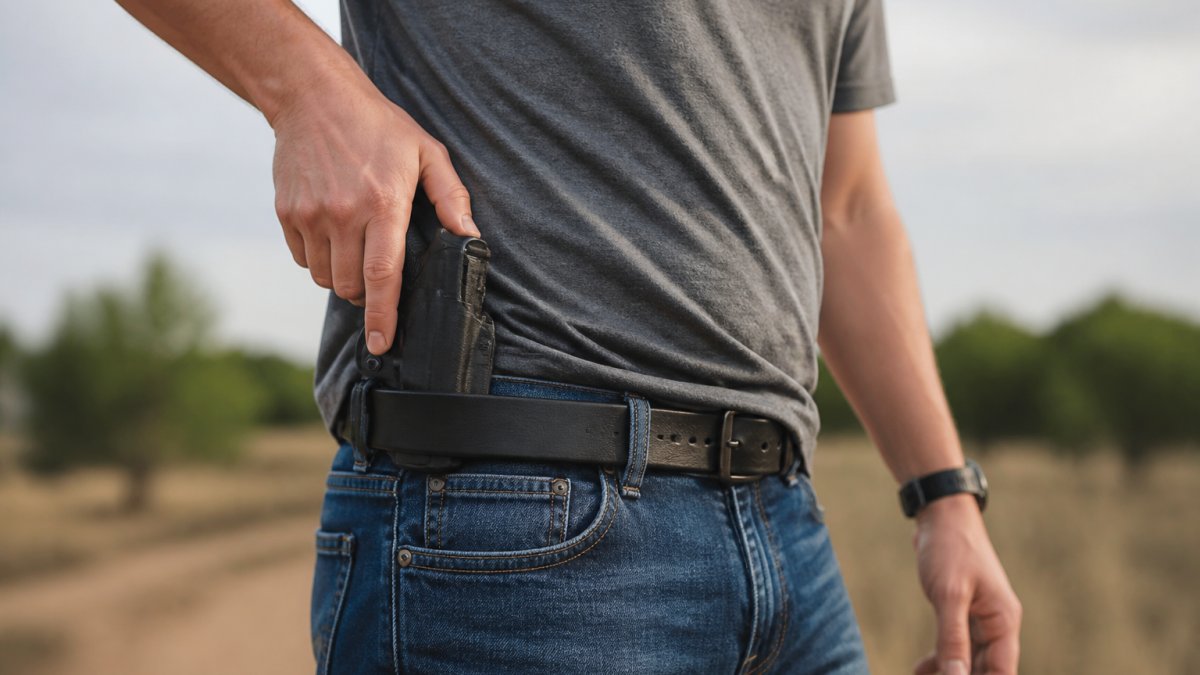
Left-Handed Appendix Carry
Appendix carry means your holster sits in front of your hip, roughly where your appendix is (hence the name).
Appendix carry offers several advantages. It's fast to access. You can reach your firearm from almost any position, sitting, standing, even lying down. Concealment is excellent because the holster sits under your shirt and belt.
The downside is the learning curve. Appendix carry requires practice. Your draw angle is different. Your presentation is different. If you're not careful with trigger discipline during the draw, you can flag your own body.
For left-handed concealed carry in appendix position, you need a holster specifically designed for left-handed draw, which is why concealed carry tips for left handed shooters emphasize custom molding over generic solutions.
Cross-Draw and Vehicle Carry for Left-Handed Carriers
Cross-draw carry means your holster sits on the opposite side of your body from your dominant hand. For a left-handed shooter, that's the right side of your waistband (roughly 3 o'clock position).
Cross-draw is less common today, but it has real advantages for specific situations. In a vehicle, cross-draw is faster than strong-side carry.
Custom Leather IWB holster, Leather Holster, Conceal Carry Holster →
The trade-off is that cross-draw is slower from standing positions. Your draw requires more movement. Concealment can be trickier because the holster sits more forward on your body.
Vehicle carry deserves its own consideration. Many left-handed carriers keep a second holster setup specifically for when they're driving. This might be a cross-draw holster, an appendix holster, or even a center-console mounted holster.
Safe Draw Practice for Left-Handed Concealed Carry
Carrying a firearm is one thing. Being able to access it safely and quickly is another. Most people carry for years without ever practicing their draw. That's dangerous.
Dry Fire Drills and Presentation Techniques
Dry fire means practicing your draw with an unloaded firearm. This is how you build muscle memory. Your hands learn the motion. Your grip becomes consistent. Your presentation becomes smooth.
Start with the basics:
- Clear your firearm completely (remove all ammunition from the room)
- Verify it's unloaded three times
- Practice drawing from your holster to a ready position (gun at chest level, pointed downrange)
- Focus on smooth, consistent movement, not speed
- Do this 50-100 times, several times per week
Once your draw feels natural, add presentation. Presentation means drawing and bringing your sights on target. For left-handed shooters, this feels different than right-handed presentations you might have seen online. Your body angle is different. Your sight picture is different. Your follow-up shot alignment is different.
Practice your presentation with specific targets in mind. Imagine scenarios: someone approaching from your left, someone approaching from your right, someone in front of you. Your draw changes based on the threat angle.
Addressing Left-Handed Controls and Malfunction Handling
Left-handed shooters face a specific challenge: most firearms are designed for right-handed operation. Your thumb naturally falls on the wrong side of the slide stop. Your fingers don't naturally reach the magazine release.
This matters in a real emergency. If you have to reload or clear a malfunction, you need to do it without thinking. Practice until it's automatic.
Start by identifying your firearm's controls:
- Magazine release location
- Slide stop location
- Safety (if your gun has one)
- Charging handle or slide manipulation method
Practice reloading your firearm one-handed with your dominant (left) hand. Manipulate the magazine release. Strip the old magazine. Insert a new magazine. Rack the slide. Do this until it feels natural.
Practice clearing malfunctions. The most common malfunction is a failure to feed (new round doesn't chamber). Clear it by racking the slide hard. Practice this motion until you can do it smoothly with your left hand even under stress.
Testing Fit, Retention, and Comfort
Before you commit to carrying a holster every day, test it thoroughly. A holster that feels good for five minutes might become unbearable after eight hours.
Fit means your firearm sits securely in the holster without excessive movement. Draw your firearm. It should come out smoothly with moderate pressure. Reholster your firearm.
Retention is how securely your firearm stays in the holster. A good holster holds your gun firmly enough that you can bend, twist, and move without the firearm shifting.
Comfort is personal. What works for one person won't work for another. Wear your holster for a full day. Sit, stand, bend, reach. Notice where it digs in.
For left-handed carriers, comfort testing is especially important because you're likely trying a new position or a new holster style.
Left-Handed Concealed Carry Setup Checklist
Building a complete left-handed carry setup requires more than just a holster. Here's what you need to consider:
- Firearm choice: Select a gun with ambidextrous controls or controls that work for your left-handed operation
- Holster type: Decide between strong-side, appendix, cross-draw, or vehicle carry
- Custom molding: Order a holster specifically molded for your firearm and left-handed draw
- Belt: Invest in a quality gun belt (1.5-inch minimum width) that supports your holster without flexing
- Cover garments: Choose clothing that conceals your holster reliably without printing (showing the outline of your gun)
- Dry fire practice: Spend 100+ repetitions practicing your draw from your chosen position
- Malfunction handling: Practice reloads and clearing common malfunctions one-handed
- Fit testing: Wear your complete setup for a full day before you carry live ammunition
- Retention verification: Verify your holster holds your firearm securely through normal movement
- Position adjustment: Test your chosen carry position in different scenarios (sitting, driving, bending, reaching)
- Backup plan: Consider a secondary carry position for situations where your primary position doesn't work (like vehicle carry)
Left-handed concealed carry doesn't have to be complicated. The key is starting with gear built for your specific needs. AnchorsAweighLeather specializes in custom leather holsters handcrafted for left-handed shooters. Our Custom Leather IWB Holster and HOSS IWB Leather Holster are built from premium full-grain leather and molded to fit your firearm precisely. When you specify left-handed draw during ordering, you get a holster engineered for your natural draw angle and body mechanics. With free shipping on orders over $100, quality gear built to last is within reach. Get started with AnchorsAweighLeather and carry with confidence knowing your setup is built specifically for you.

Frequently Asked Questions
What carry position works best for left-handed shooters?
Strong-side carry at the 9 o'clock position is the most natural for left-handed shooters, mirroring how right-handed carriers use 3 o'clock. Appendix carry and cross-draw are viable alternatives depending on your body type, clothing, and daily activities. Test each position to find what balances comfort, accessibility, and concealment for your lifestyle.
Can I use a right-handed holster if I'm a left-handed shooter?
No. Right-handed holsters position the firearm for right-hand draw and retention. Using one as a left-handed carrier compromises your draw speed, safety, and comfort. A left-handed concealed carry holster is purpose-built with the correct cant, retention, and access angle for your dominant hand and natural draw motion.
How should I practice drawing from concealment safely as a left-handed carrier?
Start with dry fire drills in a safe, controlled environment with an unloaded firearm and cleared space. Focus on presentation, smooth, consistent hand placement and draw motion, without rushing. Practice malfunction handling specific to left-handed controls (magazine release, slide stop). Once confident, move to range training with live fire under proper supervision and follow all firearm safety rules.
What should I look for in a left-handed appendix carry holster?
A left-handed appendix carry holster should have a forward cant that positions your firearm for a natural draw from the front-center of your waistband. Retention must be secure to prevent shifting during movement. Comfort is critical since appendix carry sits against your body all day. Full-grain leather provides durability, making custom-molded options ideal for left-handed appendix carriers.
0 comments