
Table of Contents
- What Is Full Grain American Leather
- Full Grain vs. Genuine Leather: What Actually Separates Them
- Durability and Strength: Why Full Grain Outperforms Other Grades
- The Leather Patina Process and How Full Grain Ages
- How to Identify Real Full Grain Leather
- Best Leather Wallet for Men 2026: Full Grain Construction
- Environmental Impact and Sustainable Sourcing
- Frequently Asked Questions
Last Updated: September 26, 2026
What Is Full Grain American Leather
Full grain American leather is the highest quality grade available, the complete hide with the outermost layer intact, preserving the natural grain pattern. Unlike lower grades that are sanded, buffed, or corrected, full grain retains every mark and imperfection, which proves its authenticity and superiority.
At AnchorsAweighLeather, we work exclusively with full grain American leather because it's the only material worthy of handcrafted goods built to last. When you're holding a full grain leather wallet or holster, you're holding the raw material in its truest form, without artificial coatings or surface treatments masking what lies beneath.
The Outermost Layer and Natural Grain
The outermost layer contains the most densely packed fiber structure, which is why full grain leather develops character over time. The natural grain pattern is unique to each hide, visible markings including brand stamps, scars, and natural variations are proof of authenticity, not flaws.
When manufacturers sand or buff the grain surface, they remove the strongest part of the hide and apply artificial patterns to create uniformity. Full grain skips this process, what you see is genuine animal hide with its natural surface intact.
The tightly woven fiber structure allows full grain leather to develop a rich patina over time. The surface breathes naturally, allowing moisture to move through the material, which contributes to durability and comfort.
Why the Tanning Process Matters
Two primary tanning methods exist: vegetable tanning uses natural tannins from tree bark and creates material that ages gracefully; chrome tanning uses chemicals and produces uniform, water-resistant leather but lacks the living quality of vegetable-tanned hides.
Full grain American leather for premium goods is typically vegetable-tanned. This slower, costlier method produces leather that improves with age, becoming softer, more supple, and richer in color through wear and exposure.
Properly tanned full grain leather is porous enough to breathe but dense enough to resist water penetration, critical for holsters and sheaths that must protect tools while remaining flexible and durable.
Full Grain vs. Genuine Leather: What Actually Separates Them
"Genuine leather" is misleading marketing, it technically means the product contains leather but reveals nothing about quality. Genuine leather can be made from scraps bonded with adhesives and topped with synthetic coatings. Full grain is the complete, unaltered hide from a single animal.
How Genuine Leather Is Made
Genuine leather products often start with scraps shredded, mixed with polyurethane binders, and pressed into sheets, bonded leather with the structural integrity of particle board. A plastic coating creates uniformity and hides the composition.
These products fail within months of regular use, the bonded layer separates, the plastic coating cracks and peels. It's a leather-based composite masquerading as genuine leather.
Genuine leather products are priced low because manufacturing costs are low and products are designed for short-term use, which is why manufacturers use the term "genuine leather" so prominently in marketing.
Why Full Grain Costs More
Full grain leather costs more because full hides are expensive to source and vegetable tanning takes months instead of hours. Imperfections aren't hidden, they prove authenticity.
When you buy full grain American leather from AnchorsAweighLeather, you're paying for material that will outlast you and can be repaired decades from now. Genuine or bonded leather products are designed to be discarded and replaced.
Full grain leather develops character and improves with age; genuine leather degrades and fails. Spending more upfront on full grain means spending less over your lifetime on replacements.
Durability and Strength: Why Full Grain Outperforms Other Grades
Full grain leather's tensile strength, the force required to tear it, is significantly higher than corrected or bonded leather. This is measurable and proven through decades of real-world use.
Tensile Strength and Fiber Structure
Full grain leather's intact fiber structure runs through the entire thickness, creating a network that resists tearing, puncturing, and abrasion. Sanding or buffing disrupts this network, weakening the surface.
Tensile strength in full grain leather typically ranges from 2,000 to 4,000 PSI, compared to hundreds for bonded leather. This means full grain handles daily carry, repeated flexing, and exposure without degrading.
The hide thickness also contributes to durability. Full grain leather used for holsters and sheaths is typically 2.5 to 4 millimeters thick, providing enough material to absorb impact and protect what's inside. This thickness is possible because the entire hide is usable, there's no need to thin it out to compensate for surface damage or corrections.
How Moisture Absorption Affects Longevity
Full grain leather's porosity keeps it supple and prevents cracking, but requires occasional conditioning with neatsfoot oil or similar products to replenish natural oils depleted by use and exposure.
Properly maintained full grain leather becomes more water-resistant as natural oils and tannins build up, creating a protective patina layer that adds aesthetic appeal and functionality.
The Leather Patina Process and How Full Grain Ages
Patina is the visible transformation when full grain leather is exposed to light, moisture, and use, not damage, but improvement. The surface darkens, develops a subtle sheen, and gains character marks that tell the story of use. This aging process is unique to full grain leather.
What Causes Patina to Develop
Patina develops through oxidation, moisture absorption, and natural darkening of tannins. UV rays deepen color, while environmental moisture causes slight swelling and contraction that brings out the grain pattern.
Frequent handling darkens and smooths areas as natural oils from hands transfer to the leather, creating a distinctive appearance that reflects the item's history of use.
Scratches and marks during normal use add character, evidence of real-world performance, not failure.
Patina as a Sign of Quality
The ability to develop a rich, attractive patina defines high-quality full grain leather. Lower-grade leather either doesn't change or deteriorates; full grain becomes more attractive and valuable with age.
Vintage full grain leather items command premium prices because patina proves authenticity and demonstrates durability through real use.
Visible patina development within the first year of regular use indicates authentic full grain leather. If it doesn't change, you likely didn't purchase genuine full grain.
How to Identify Real Full Grain Leather
Identifying real full grain leather requires understanding what to look for and what to feel for. Visual inspection is important, but tactile evaluation is equally critical. Real full grain leather has characteristics that are impossible to fake convincingly at close range.
Visual and Tactile Inspection
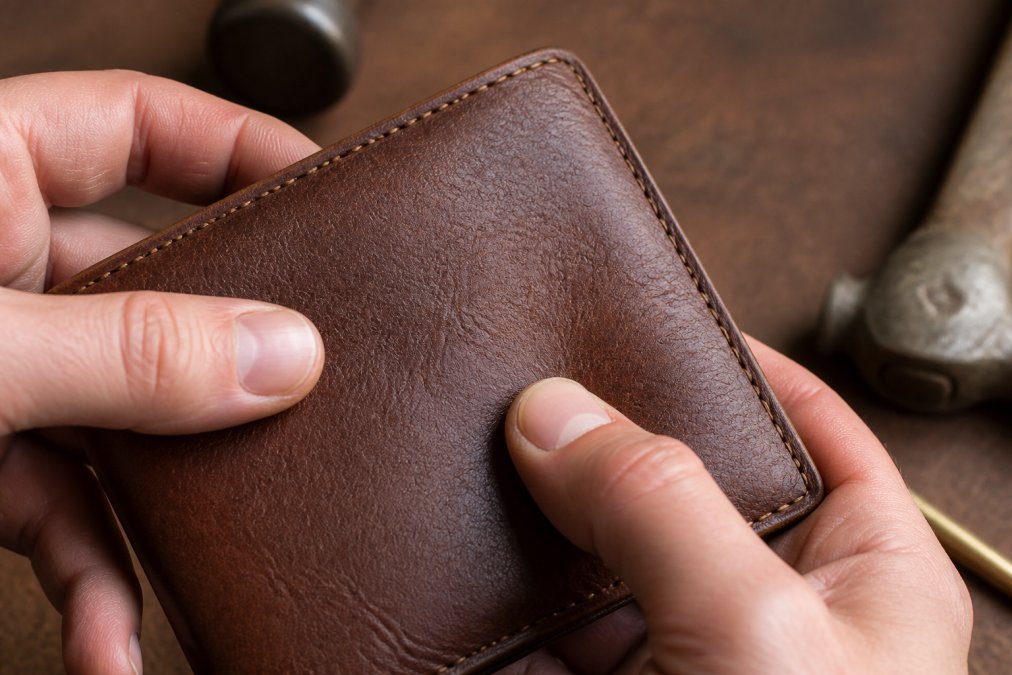
Real full grain leather has visible pores distributed across the surface, the breathing holes of the original hide. The grain pattern is irregular and natural-looking, never perfectly uniform. Perfectly consistent patterns indicate corrected grain.
Full grain has a slightly textured, organic feel with subtle variations in height and texture. You should feel natural characteristics including slight ridges and grain variations. Genuine leather products often feel slick or plastic-like.
Full grain leather edges show natural hide color throughout the entire thickness with no artificial layers.
What to Look for in Stitching and Finish
Stitching should be tight, even, and placed through the full thickness of the leather without gaps.
Best Leather Wallet for Men 2026: Full Grain Construction
The best leather wallets for men in 2026 are built from full grain American leather by craftspeople who understand the material. A quality full grain wallet is an investment piece that improves with age and develops unique character.
Why Full Grain Wallets Stand Out
Full grain wallets perform and look better than alternatives, stronger, more durable, and more beautiful as they age. A full grain wallet purchased today will likely outlast its owner.
Repairability and Long-Term Value
One of the most overlooked advantages of full grain leather is repairability. When a full grain wallet or holster is damaged, it can be repaired by a skilled leather worker. A torn seam can be re-stitched. Worn edges can be refinished. A damaged section can be replaced. This repairability means a full grain wallet can be restored to functional condition multiple times over its lifetime.
Environmental Impact and Sustainable Sourcing
The environmental impact of leather production is significant, but full grain leather sourced responsibly is actually one of the more sustainable material choices available. The tanning process matters enormously, vegetable tanning uses natural compounds and is far less harmful than chrome tanning, which requires chemical processing and creates waste streams that are difficult to manage.
Frequently Asked Questions
Is full grain leather considered real leather?
Yes. Full grain leather is the highest quality form of real leather because it retains the complete hide with the natural grain intact. Unlike genuine leather, which is made from split layers and ground-up scraps bonded together, full grain comes from the outermost layer of the animal hide and preserves the entire fiber structure. This makes it genuinely superior in durability and longevity.
What is the difference between full grain and top grain leather?
Full grain leather keeps the entire hide surface, including all natural markings and imperfections. Top grain leather has the outermost layer buffed or sanded down and is often corrected with artificial grain patterns. This removes some of the hide integrity. Full grain is more durable and develops a rich patina; top grain is more uniform in appearance but less breathable and won't age as gracefully over time.
Does full grain leather develop a patina over time?
Yes. Full grain leather develops a natural patina as it ages, darkening and gaining character through wear and exposure to moisture and sunlight. This aging process is one of the most valued qualities of full grain leather. The patina tells the story of how the item was used and actually improves its appearance. This is why handcrafted full grain items like wallets and holsters become more attractive with age.
Why is full grain leather more expensive than other types?
Full grain leather costs more because the entire hide is usable and no material is wasted through splitting or grinding. The tanning process is more careful to preserve the natural grain, and craftsmanship standards are higher. Because full grain hides are limited in quantity and the material resists damage better, manufacturers can charge premium prices. The longevity and repairability of full grain items also justify the higher upfront cost.
0 comments