
Last Updated: October 25, 2026
Quick Summary
Holster ride height concealment depends on your body shape, clothing, firearm, and carry position, there's no universal answer. Your ideal ride height balances three competing demands: how well your gun stays hidden, how fast you can draw it, and how comfortable you are wearing it all day. Testing your ride height takes about an hour and costs nothing, letting you find your actual balance point before committing to a holster.
- A higher ride exposes more grip for faster draws but reduces concealment; a lower ride hides the gun better but makes reaching the grip harder.
- Your belt matters: a rigid belt holds your holster in place and lets ride height adjustments work, while a soft, stretchy belt defeats the purpose.
- Test ride height in your normal daily clothes, not generic outfits, and perform both concealment checks and draw tests at each position.
- Adjust your holster in quarter-inch and half-inch increments, testing in both standing and sitting positions until you find your balance point.
- Once you've found your ideal ride height through testing, order a custom holster built to that exact specification instead of using a universal one.
Table of Contents
- Understanding Holster Ride Height and Concealment
- How Holster Ride Height Adjustment Changes Your Carry
- IWB Holster Positioning: Finding Your Balance Point
- Holster Cant Adjustment and Its Effect on Draw
- Holster Comfort and Draw Access: The Real Trade-Off
- Step-by-Step: Testing and Adjusting Your Ride Height at Home
- Finding Your Ideal Carry Setup with a Custom Holster
- Frequently Asked Questions
Understanding Holster Ride Height and Concealment
Holster ride height concealment is one of the most misunderstood aspects of carrying a firearm.
Here's what most people get wrong: they assume higher is always better for concealment, or lower is always better for access.
At AnchorsAweighLeather, we understand the challenges carriers face in finding the right holster setup.
The good news: testing your ideal ride height takes about an hour, costs nothing, and solves most carry problems before you commit to a holster.
How Holster Ride Height Adjustment Changes Your Carry
Adjusting your ride height shifts the entire geometry of your carry setup.
The relationship isn't linear. Moving your holster up by half an inch might gain you a quarter-second on your draw but lose an inch of concealment.
What changes when you adjust ride height:
- Grip exposure: Higher ride = more grip visible = faster draw access
- Concealment: Lower ride = less gun printing = better hidden carry
- Comfort: Ride height affects where the holster digs into your hip and how the gun sits against your body
- Draw angle: Higher ride makes the gun easier to reach; lower ride forces a steeper angle
One detail most guides skip: your belt matters. A rigid belt holds your holster in place and lets ride height adjustments actually work.
Adjusting your ride height creates specific trade-offs across these key carry factors.
| Carry Factor | Higher Ride | Lower Ride |
|---|---|---|
| Grip exposure | More grip visible | Less grip visible |
| Concealment | Less hidden | Better hidden |
| Draw access | Faster, more natural | Harder, steeper angle |
| Comfort | Affects hip pressure differently | Can concentrate pressure on one spot |
| Printing risk | More visible outline | Less visible outline |
IWB Holster Positioning: Finding Your Balance Point
Inside-the-waistband carry has a narrow window for success. Too high and your grip prints badly. Too low and you can't reach it.
Your body shape determines where that balance actually sits. Left-handed shooters need to account for additional positioning variables when finding their ideal ride height.
The positioning variables:
- Natural belt line: Where your pants naturally sit, this is your zero point
- Body shape: Larger midsection typically needs lower ride; lean builds can go higher
- Carry position: Appendix is different from 3 o'clock, which is different from 4 o'clock
- Clothing fit: Tight shirts demand lower ride; loose shirts can tolerate higher
- Firearm size: Compact guns hide easier; full-size guns need more real estate
The mistake people make is choosing a ride height based on someone else's body or carry style.
Holster Cant Adjustment and Its Effect on Draw
Cant is the forward or backward angle of your holster. It's separate from ride height, but the two interact.
Most IWB holsters have a slight forward cant built in, usually around 15 degrees. This helps with concealment and comfort.
How cant affects ride height perception:
- Forward cant: Makes the gun sit tighter against your body; helps concealment but can reduce grip access
- Rearward cant: Exposes the grip more; easier draw but more printing potential
- No cant: Neutral angle; works for some carry positions but not ideal for appendix
When you're testing ride height, keep cant constant. If your holster allows cant adjustment, set it to whatever feels most natural for your body and carry position, then don't change it while you're testing ride height.
Holster Comfort and Draw Access: The Real Trade-Off
This is where the theory meets reality. Comfort and draw access exist in tension.
The actual trade-off depends on how much time you spend carrying. If you carry eight hours a day, comfort wins.
Comfort factors that change with ride height:
- Hip pressure: Lower ride can concentrate pressure on one spot; higher ride distributes it differently
- Shirt length: Shorter shirts need lower ride; longer shirts tolerate higher
- Belt tension: Tighter belts make any ride height more uncomfortable; proper belt tension matters more than ride height itself
- All-day wear: If you're sitting for hours, lower ride is usually more comfortable; if you're standing and moving, higher ride feels better
- Printing: This is the main discomfort, visible gun outline makes you adjust your shirt constantly, which is exhausting
The solution isn't to choose one over the other. Choosing the right concealed carry clothing for your body type and carry position directly affects how your holster sits and performs.
Step-by-Step: Testing and Adjusting Your Ride Height at Home
This is the process we recommend. It takes about an hour and requires no special equipment. The goal is to find your actual balance point, not the theoretical one.
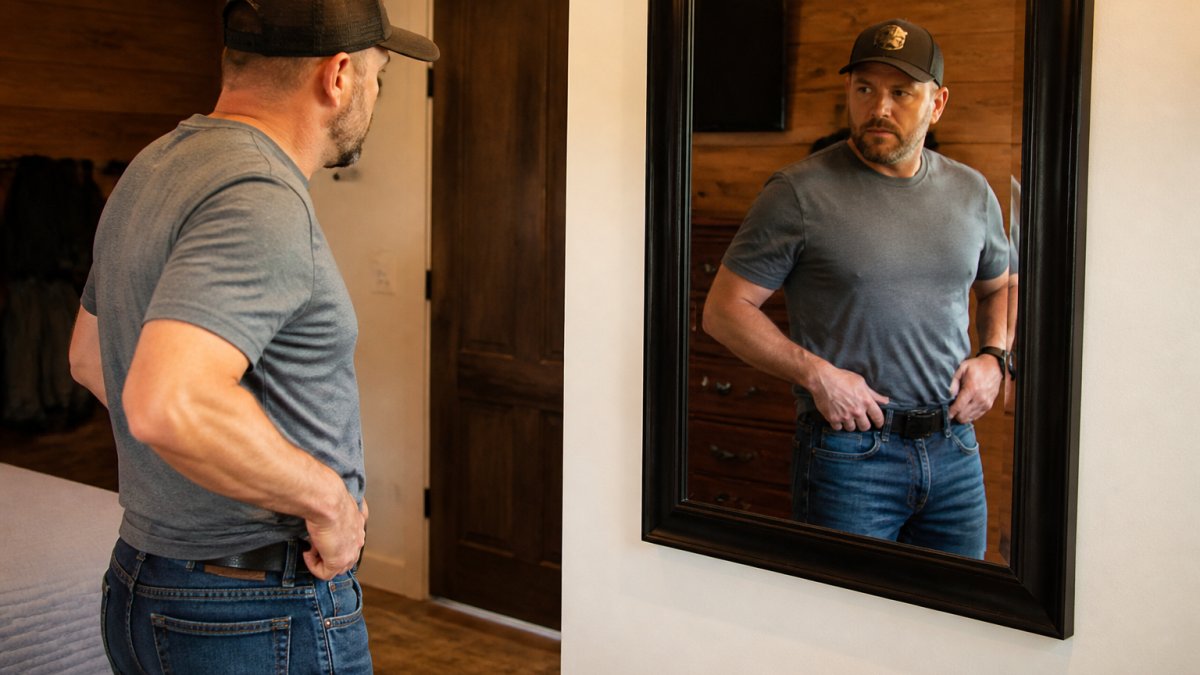
What You'll Need Before You Start
- Your firearm (unloaded, safety first)
- Your current holster or a holster with adjustable ride height
- A rigid belt (not a soft, stretchy one)
- Your normal daily clothes in two weights (a t-shirt and a button-up or light jacket)
- A mirror (preferably full-length, or a phone camera)
If your holster doesn't have adjustable ride height, you can still do this test by repositioning the holster on your belt and noting where it sits. But an adjustable holster makes the process much faster.
Step 1: Establish Your Baseline Position
Start with your holster at your natural belt line. This is the point where your pants naturally sit without you cinching the belt tight. Mark this position on your belt with a pen or note the exact spot.
Custom Leather IWB holster, Leather Holster, Conceal Carry Holster →
Load your unloaded firearm into the holster and wear it for five minutes while standing and sitting. Don't draw yet. Just notice how it feels. Does it dig into your hip? Does it feel stable? Does the gun shift when you sit?
Write down your observations. This baseline is your reference point for all adjustments.
Step 2: Test Concealment in Your Daily Clothes
Put on your normal t-shirt over the holster and stand in front of a mirror.
Now put on your button-up shirt or light jacket. Does the concealment improve? How much of the gun is still visible at the edges?
Repeat this test at your baseline position. Write down exactly what you see. Be honest about what prints and what doesn't.
Step 3: Assess Grip Clearance and Draw Speed
This is where most people skip steps. They check concealment and stop. But if your grip isn't accessible, concealment doesn't matter.
From your baseline position, perform a slow draw. Pay attention to how your hand reaches the grip. Is it a natural motion?
Now perform a faster draw. Does anything catch? Does the shirt bind? Does your holster shift on your belt?
Perform five draws at your normal speed. Each one should feel the same. If the first draw feels different from the fifth, your holster is moving or your body position is changing, both problems.
Step 4: Check for Printing and Adjust Incrementally
Now adjust your ride height up by half an inch. Repeat steps 2 and 3. Write down what changes.
Then adjust down by half an inch from baseline. Repeat steps 2 and 3 again.
You should now have three data points: baseline, plus half an inch, minus half an inch. One of these will feel better than the others. That's your direction.
Continue adjusting in quarter-inch increments in that direction until you find the point where concealment and access both work. This is your balance point.
Safety check after each adjustment: After you move your holster, draw five times and make sure every draw feels the same. If your draws are inconsistent, your holster is still moving. Tighten your belt or adjust your holster retention before continuing.
Common Mistakes to Avoid When Adjusting Ride Height
Changing your belt. A soft belt will make any ride height feel unstable.
Adjusting too much at once. Moving your holster an inch between tests makes it hard to identify the exact balance point.
Testing while sitting only. Comfort while sitting is different from comfort while standing and moving. Test both positions.
Skipping the draw test. You can have perfect concealment and terrible draw access. Both matter. Never skip the draw test.
Assuming one ride height works for all your clothes. If you carry in both t-shirts and button-up shirts, you might need two different ride heights. Test in each. If you can't find one height that works for both, prioritize your most-worn outfit.
Finding Your Ideal Carry Setup with a Custom Holster
Once you've found your balance point through testing, the next step is getting a holster built to that specification. You can order a custom leather IWB holster tailored to your exact ride height and specifications.
At AnchorsAweighLeather, we build custom leather IWB holsters that are handcrafted in the USA from premium full-grain leather.

The benefit of testing first is that you know exactly what you're ordering. You've already done the work to find your balance point. You're not guessing. You're not hoping.
Frequently Asked Questions
What does holster ride height mean?
Holster ride height is how high or low your holster sits on your belt line. It's measured from the top of the belt to the top of the holster. A high ride exposes more of your grip, making the draw faster but potentially visible under tight clothing. A low ride hides more of the firearm but can make accessing your grip slower and less natural. Finding the right holster ride height for concealment means balancing these factors based on your body, clothing, and carry needs.
How does holster ride height affect concealment?
Higher ride heights expose more grip, which can print (show the outline of your firearm) under tight or thin clothing. Lower ride heights hide more of the firearm and reduce printing, but they may force you to reach deeper to achieve a full grip. Your body shape, shirt length, and cover garment thickness all influence how much ride height affects concealment. Test your setup in the clothes you actually wear daily to find the right balance for your situation.
How do I adjust the ride height on an IWB holster?
Most IWB holsters allow ride height adjustment through belt loop positioning or holster wedge placement. If your holster has adjustable loops, move them higher on the holster body to raise the ride height, or lower to reduce it. Some holsters use wedges or shims to change cant and ride height together. Start with small adjustments, then test in your regular clothing before making larger changes. AnchorsAweighLeather's custom IWB holsters are handcrafted in the USA from premium full-grain leather, built to last a lifetime.
Should I choose a high or low ride height for concealment?
There's no universal answer, it depends on your body shape, clothing choices, and carry position. A higher ride height gives faster access and a more natural draw but exposes more grip. A lower ride height hides the firearm better under tight clothing but requires a deeper reach to get a full grip. Most everyday carry users find a middle ground that keeps the grip mostly covered while still allowing a smooth, quick draw. Test both positions in your actual daily clothes to determine what works best for you.
Choosing the right holster ride height for concealment isn't complicated once you test it properly. Most carry problems, printing, slow draws, discomfort, trace back to a ride height that was never tested in your actual clothes and body position. Spend an hour testing before you invest in a custom holster. Find your balance point. Then build or order a holster that locks it in. That's how you get a carry setup that actually works.

0 comments