
Table of Contents
- Why Leather Holster Quality Matters for Concealed Carry
- Stitching Integrity, Reinforced Construction, and the Welt
- Full Grain vs Top Grain Leather for Holsters
- Retention, Molded Fit, and Trigger Guard Coverage
- Hardware, Belt Attachment, and Comfort for Daily Wear
- How to Break In a Leather Holster (and What New Leather Should Feel Like)
- Choosing the Best Appendix Carry Leather Holster
- Conclusion
- Frequently Asked Questions
Last Updated: September 12, 2026
Why Leather Holster Quality Matters for Concealed Carry
A leather holster is a safety device before it is an accessory, and leather holster quality shows up in construction long before it shows up in looks. This guide breaks down what separates a holster that lasts a decade from one that sags in a season.

Here's the uncomfortable truth most buying guides skip: a holster that loses its shape can block your draw or fail to cover the trigger guard, and that's a safety problem, not a cosmetic one. The NRA guide to holster safety and selection puts it plainly: the holster must hold the firearm securely and cover the trigger guard at all times.
Below, we'll show you how to inspect stitching, leather grade, retention, and hardware so you can judge quality with your own hands.
Stitching Integrity, Reinforced Construction, and the Welt
Stitching integrity is the fastest quality test you can run. Look for two rows of heavy thread at every stress point, consistent spacing, and no loose or frayed ends.
The welt is the strip of leather sewn between the front and back panels. It keeps the mouth open, protects the front sight from snagging, and gives the stitching something solid to bite into. Without one, the mouth collapses, making one-handed reholstering difficult.
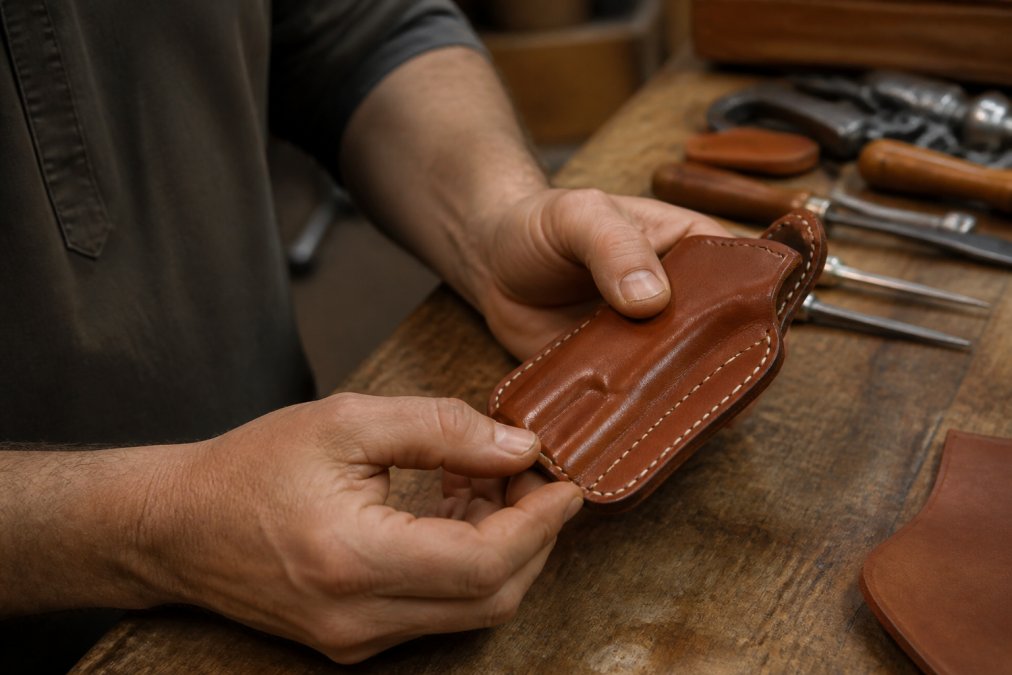
Reinforcement matters just as much at the belt attachment points. Hand-stitched seams, burnished edges, and doubled leather at the throat signal a maker who expects daily use.
Full Grain vs Top Grain Leather for Holsters
Full grain leather is the strongest grade available because the grain structure, the tight fiber layer on the outer surface, remains intact. Top grain leather has that layer sanded away to remove imperfections, making it smoother but weaker. The grain layer is the densest part of the hide, resisting abrasion, moisture, and stretching under load.
For a holster, full-grain leather is the right choice almost every time: it resists abrasion, holds a molded fit longer, and develops a patina instead of cracking. Top grain can work for a dress holster with light use, but breaks down faster under daily carry. Bonded leather, sometimes marketed as "genuine leather," is shredded fibers glued into a sheet with no grain structure, a red flag on any defensive holster.
How to Tell Them Apart in Your Hands
Most buyers can't distinguish grades by feel alone, so use these checks:
- Look at the surface under raking light. Full grain shows a natural, slightly irregular pore pattern and visible range marks, scars, or growth lines. Top grain looks uniformly smooth because the imperfections were sanded off. A flawless, plastic-smooth surface usually signals a corrected or bonded hide.
- Press a thumbnail into the surface. Full grain springs back and shows fine grain lines at the crease. Corrected and bonded leathers crease flat and papery or stay dented.
- Check the cut edge. Full grain shows a dense, fibrous cross-section burnished smooth. Bonded leather shows a fuzzy, layered edge like pressed cardboard.
- Smell it. Vegetable-tanned full grain has an earthy, slightly sweet smell. Chrome-tanned hides smell faintly chemical. Bonded leather often smells like glue.
Why the Tanning Method Changes Everything for Carry
The tanning process matters as much as the grade. Vegetable-tanned leather, or veg tan, is tanned with plant-based tannins rather than chromium salts. It's firmer, takes a molded fit beautifully, and holds that shape through years of draw-and-reholster cycles, which is why custom makers favor it for holsters that must stay open at the mouth.
Chrome-tanned leather is softer, more pliable, and faster to produce, which is why it dominates furniture and garments. For a holster, that softness works against you: chrome-tanned hides collapse at the mouth and lose molded retention faster under body heat and sweat. Some makers use it for comfort-panel backings, but the structural shell of a quality holster is almost always veg tan.
The Sweat and Humidity Factor
Vegetable-tanned leather absorbs sweat and humidity, then releases it as it dries, which is why a well-cared-for veg tan holster develops a patina rather than delaminating. Chrome-tanned leather can leach residual tanning salts when soaked, and those salts are hard on both the leather and the firearm's finish. That's why appendix carriers who sweat heavily get better long-term results from a firm veg tan shell paired with a sweat shield.
In a humid climate, expect the leather to feel softer on hot days and firmer in dry air. That's normal for a natural material, not a defect.
Retention, Molded Fit, and Trigger Guard Coverage
Retention is how firmly the holster holds the firearm; molded fit is how that retention is achieved. A properly molded holster is shaped to your specific firearm, with friction at the trigger guard and slide providing the hold.
Trigger guard coverage is non-negotiable. The holster must fully enclose the trigger guard so nothing can reach the trigger while the firearm is holstered. Any gap there is a defect, full stop.
A molded fit should feel snug but not stuck: a smooth, consistent draw stroke with enough friction that the firearm won't fall out if you turn the holster upside down. If retention comes from a strap or tension screw alone, the molding wasn't done well.
| What to Check | Good Sign | Red Flag |
|---|---|---|
| Trigger guard | Fully enclosed | Any exposed gap |
| Retention | Firm friction fit | Falls out when inverted |
| Molded fit | Firearm-specific shaping | Generic pouch shape |
| Draw stroke | Smooth and consistent | Binding or rattling |
Hardware, Belt Attachment, and Comfort for Daily Wear
Hardware and belt attachment determine whether a holster carries well or fights you all day. Look for solid metal hardware, reinforced belt loops, and attachment points that match your actual belt width. A holster built for a 1.5-inch belt will shift and rotate on a 1.25-inch belt, no matter how good the leather is.
A Hardware Inspection Checklist
Run these checks before you commit to a holster:
- Snaps and closures: Snap and unsnap them several times. A quality snap seats with a firm, audible click and doesn't wobble; cheap snaps loosen within weeks and can pop open during a draw.
- Screws and tension hardware: If screws adjust retention, confirm they have thread-locking compound or a locking washer. A screw that backs out mid-carry can let the holster shift or the firearm sit loose.
- Belt loops and clips: Metal clips should be spring steel, not stamped sheet metal that bends by hand. Leather loops should be doubled and stitched, not single-layer.
- Edge finish: Run a fingertip along every edge that will touch your skin. Burnished, waxed edges feel slick and rounded. Raw or painted edges feel sharp and will chafe within an hour of carry.
- Rivets and eyelets: Tug them. A properly set rivet won't move. A loose one will eventually tear through the leather.
Ride Height, Cant, and the Comfort Trade-Off
Ride height and cant, the angle the holster sits at, both affect comfort and concealment. Too high prints; too low digs into your hip when you sit. Good makers offer adjustable cant and ride height.
Comfort comes down to a few details: a sweat shield that keeps leather and hardware off your skin, burnished edges that won't chafe, and a backing that distributes pressure. Supple leather feels good on day one, but too soft won't hold retention. You want firm leather that breaks in, not soft leather that sags.
How Body Oils, Salt, and Humidity Wear a Leather Holster
This is why two identical holsters can look completely different after a year of carry: leather reacts to everything your body produces.
- Body oils and sebum soak into the leather where it contacts your skin, darkening the surface and softening fibers over time. A sweat shield slows this but doesn't stop it. The area behind the trigger guard and along the slide usually darkens first.
- Salt from sweat is the bigger long-term threat. Salt is hygroscopic, pulling moisture into the leather and holding it there. Left unmanaged, salt buildup stiffens the leather, dulls the finish, and can corrode metal hardware and the firearm's finish. A wipe-down with a slightly damp cloth followed by a dry buff every few weeks removes surface salt before it migrates deeper.
- Humidity softens leather and accelerates break-in, which sounds good until the holster loses its molded shape. In humid climates, condition more often with a leather-specific product and store the holster somewhere dry, not in a damp range bag or closed plastic case.
- Dry heat does the opposite: it pulls moisture out, stiffens the leather, and eventually cracks it along flex points like the mouth and belt loop fold. In arid climates, condition more often and avoid leaving the holster on a dashboard or in a hot vehicle.
A simple maintenance rhythm that works in most climates: wipe the holster down monthly, condition it two to four times a year depending on humidity and sweat, and inspect stitching and hardware every time you condition. Leather cleaned and conditioned on schedule outlasts leather that's ignored and holds its molded fit far longer.
How to Break In a Leather Holster (and What New Leather Should Feel Like)
A new leather holster should feel tight, not comfortable. Break-in works the leather until the molded fit matches your firearm and draw stroke, and it takes patience, not force.
Here's the procedure:
- Confirm the firearm is unloaded and all ammunition is stored separately.
- Insert the firearm into the holster and let it sit for several hours, or overnight.
- Draw and reholster 20-30 times, slowly, feeling where the friction is tightest.
- Repeat daily for the first week. Most holsters loosen noticeably within 3-5 days of regular wear.
- Never soak the leather in water or oil to speed this up.
On day one you should feel firm resistance at the trigger guard and slide, a mouth that stays open when the firearm is out, and stiff leather overall. You should not feel wobble, rattle, or any spot where the firearm shifts on its own.
Environment plays a role most owners ignore. Humidity softens leather; dry heat stiffens and cracks it. In humid climates, expect faster break-in and condition more often; in dry climates, condition more often to prevent drying and grain loss.
Choosing the Best Appendix Carry Leather Holster
The best appendix carry leather holster balances a high ride height, a slight forward cant, and full trigger guard coverage in a package slim enough to disappear under a shirt. Appendix carry demands more from a holster than any other position.
A few things to weigh:
- Ride height: Higher keeps the grip accessible and reduces printing when you bend.
- Cant: A slight forward angle (around 10-15 degrees) keeps the grip tucked toward your centerline.
- Sweat shield: Essential for appendix carry, since the holster sits against bare skin.
- Reinforced mouth: You need to reholster one-handed and blind, so the mouth must stay open.
This is where a handcrafted holster earns its keep. AnchorsAweighLeather builds its holsters from full-grain and veg tan leather with hand-sewn, reinforced construction, and custom orders are available for shooters who need a specific fit, including left-handed appendix carriers. The HOSS IWB Leather Holster is a universal-fit inside-the-waistband option built for daily carry, and the OWB Avenger line covers open-carry setups in the same veg tan construction.

Coming from a mass-produced nylon or Kydex holster, expect leather to feel heavier and stiffer at first. That's the point, the same reason a good leather belt outlasts three cheap ones.
Conclusion
Judging a leather holster comes down to a handful of visible details: stitch density, leather grade, tanning method, molded fit, trigger guard coverage, and hardware quality. Get those right and the holster will outlast your carry gun.
At AnchorsAweighLeather, every holster is handcrafted in the USA from full-grain and veg tan leather, backed by veteran-owned craftsmanship and built to hold up to daily wear. Custom orders are available, and shipping is free on orders over $100. Get started with AnchorsAweighLeather and carry a holster that's still holding its shape years from now.
Frequently Asked Questions
What type of leather is best for gun holsters?
Full-grain leather made through vegetable tanning is the top choice for leather holster quality. It keeps the hide's natural grain structure intact, which gives it higher tensile strength and abrasion resistance than corrected or split leathers. Full-grain also develops a patina over years of carry instead of cracking. Top-grain leather is sanded smooth and can look dressier, but it removes the strongest outer layer, so it breaks down faster under daily concealed carry.
How can you tell if a leather holster is well-made?
Check the stitching first: even, tight lines with no loose threads signal real craftsmanship, and hand-stitched or double-stitched seams around the welt last far longer than single stitching. Look at the welt, the extra strip of leather at the holster's mouth, since it keeps the opening rigid for a smooth draw stroke. Burnished edges, solid hardware tension, and a molded fit that holds your firearm without rattle round out the signs of a high-quality leather holster.
Do leather holsters lose retention over time?
Yes, leather holsters loosen with use as the leather fibers flex and absorb moisture, but the rate depends on construction. A holster with a reinforced welt, double stitching, and a proper molded fit holds retention much longer than a flimsy pouch. Break-in accelerates this slightly, which is normal. If retention drops too far, you can tighten hardware tension on models that use adjustable screws.
How should a high-quality leather holster feel when new?
A new leather holster should feel rigid and slightly tight, not soft or floppy. Expect a firm, molded fit that grips the firearm with a bit of friction on the draw, then loosens over a short break-in period. The leather should smell like real hide, not chemicals, and the edges should feel smooth rather than raw. If it arrives feeling like a limp sock, that is one of the clearest signs of poor quality leather in holsters.
0 comments