
Table of Contents
- Why American Made Leather Holsters Outperform the Rest
- IWB vs. OWB: Choosing Your Carry Position
- The HOSS IWB: Universal Fit, Serious Retention
- The Texas Rebel: Custom-Molded Comfort for All-Day Carry
- The Avenger OWB: A Professional-Grade Leather Holster
- The Rancher Saddle Holster: Built for the Outdoors
- Finding the Best Appendix Carry Leather Holster for Your Body Type
- How to Maintain Leather Gun Holsters for Decades of Use
- Frequently Asked Questions
Last Updated: September 5, 2026
A leather holster is a precision piece of equipment that molds to your firearm and body over time. The best American made leather holsters are built from full-grain leather, hand-stitched with saddle techniques, and constructed to outlast cheap imports. At AnchorsAweighLeather, a veteran-owned shop in San Antonio, Texas, we build exactly that kind of gear.
A handcrafted holster offers a custom molded fit that secures your firearm through friction and tension. Below, we cover the top IWB and OWB options, how to match a holster to your body type, and break-in procedures.
Why American Made Leather Holsters Outperform the Rest
The difference between a quality holster and a disposable one comes down to materials and method. Full-grain leather retains the natural fiber structure of the hide, making it dense, durable, and capable of holding a molded shape for decades. Vegetable-tanned leather, treated with natural tannins rather than harsh chrome chemicals, is the standard for holster work because it accepts molding well and hardens to a firm, protective shell around your firearm.
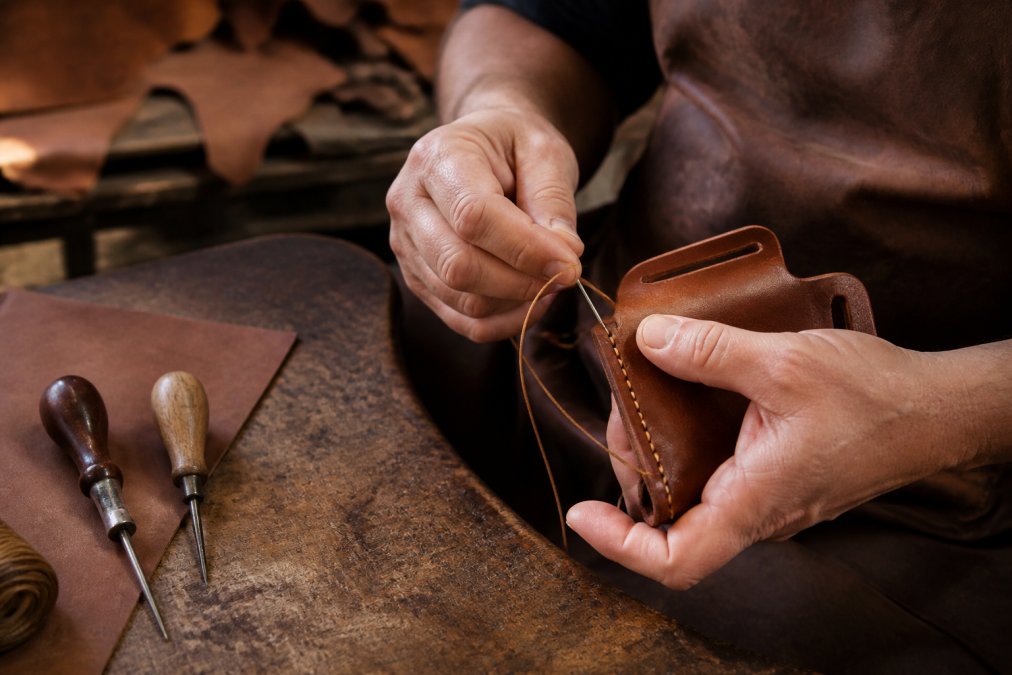
Mass-produced holsters often use bonded leather, a mix of shredded fibers and adhesive that peels and loses shape quickly. Hand-stitched construction, using the traditional saddle stitch technique, is another hallmark of quality. Each stitch is pulled tight by hand, creating a seam that will not unravel even if a single thread is cut, unlike machine stitching that fails completely when one link breaks. Add a reinforced opening and a properly fitted trigger guard coverage, and you have a holster built for the long haul.
IWB vs. OWB: Choosing Your Carry Position
Choosing between inside-the-waistband (IWB) and outside-the-waistband (OWB) carry depends on your body type, daily activity level, wardrobe, and climate. A holster that disappears on a 6-foot-tall, 180-pound frame can become a painful, printing mess on a shorter or heavier build.
The Mechanics of IWB Carry
IWB holsters ride between your belt and pants, using belt tension and body pressure to hold the firearm in place. The primary advantage is concealment, but the holster occupies space your body needs for bending, sitting, and twisting. For appendix carry, a longer sweat shield is critical for larger body types; slimmer individuals often need a shorter sweat shield with a claw attachment to prevent printing.
The Mechanics of OWB Carry
OWB holsters offer a more natural draw and greater comfort for all-day wear, especially with larger handguns. A pancake-style holster pulls the firearm tight against the hip; a saddle-style holster, like our Rancher, distributes weight across a wider area of the belt for outdoor work. The critical mechanism is the cant: a neutral or slight forward cant (15 degrees) is standard for strong-side carry, while a severe forward cant (30+ degrees) for small-of-the-back carry is widely discouraged due to spinal injury risk.
Matching Position to Body Type and Activity
For a larger midsection, IWB at the 3 o'clock or 4 o'clock position is often more comfortable than appendix; for a leaner build, appendix is frequently the most concealable. If you are in and out of a vehicle, an IWB holster with a low ride height prevents the muzzle from digging into your thigh when seated. If you are on your feet all day, an OWB pancake holster with a high ride height offers the most stable platform.
The Climate Factor
In hot, humid climates where a t-shirt is the only outer layer, IWB carry is often the only viable option. In cooler climates, an OWB holster under a jacket becomes practical. High humidity can soften leather and reduce retention, while dry conditions can cause cracking.
The Verdict: Start with Your Daily Routine
Instead of asking 'IWB or OWB?', ask 'What does my day look like?' If you are running errands and sitting at a desk, an IWB holster with a claw is likely your best bet. If you are working outdoors or carrying a full-size handgun, an OWB pancake or saddle holster will serve you better.
The HOSS IWB: Universal Fit, Serious Retention
For a first IWB holster that works across multiple firearms, our top pick is The HOSS IWB Leather Holster. Handcrafted from premium full-grain leather, it has a universal fit design, making it a smart starting point if you rotate between firearms.

The HOSS delivers secure retention through a molded friction fit, holding your firearm firmly while allowing a smooth, natural draw. Priced at $60.50, it is built for all-day wear, with the leather conforming to your body shape after a proper break-in period. For those who want a reliable, no-fuss IWB holster from a veteran-owned American leather goods maker, this is the choice.
The Texas Rebel: Custom-Molded Comfort for All-Day Carry
If you carry the same firearm daily and want a holster that fits like a glove, The Texas Rebel IWB Conceal Carry Holster is the better option. At $50.00, it is handcrafted and custom molded for a secure, snug fit around your specific handgun, minimizing movement for a consistent draw every time.

The Rebel is designed for comfort during extended wear. Its full-grain leather construction and inside-the-waistband design keep the profile slim. For appendix carry, the molded fit and smooth leather backing reduce pressure points against the leg and abdomen.
The Avenger OWB: A Professional-Grade Leather Holster
For those who prefer outside the waistband carry, the OWB Leather Holster, known as the Avenger, is a professional-grade choice. Constructed from high-quality vegetable-tanned leather, it offers a rugged yet refined profile suitable for hunters, competitive shooters, and industry professionals, fitting most semi-automatic handguns with barrels up to 4.5 inches.

The Avenger's design uses a neutral cant and a close-to-body fit, which promotes a clean concealment profile under a light jacket. Priced at $57.00, the reinforced opening allows for easy re-holstering, a feature that becomes essential after years of daily use.
The Rancher Saddle Holster: Built for the Outdoors
Outdoor enthusiasts and those who carry while working on the land need a holster that stays secure through physical activity. The Rancher Saddle Holster is a classic OWB design that rides close to the body for a clean profile and a natural draw. It is handcrafted in the USA from premium full-grain leather and built for the man who carries every day.
The saddle design distributes the firearm's weight across a wider area of the belt, making it more comfortable for larger handguns. Priced at $67.00, The Rancher is ranch-tested and American-made, offering durability that cheap nylon or poorly stitched leather holsters cannot match. Its close-body fit minimizes snagging.
| Holster Model | Carry Style | Price | Best For | Key Feature |
|---|---|---|---|---|
| The HOSS IWB | IWB | $60.50 | Universal fit, multiple firearms | Fits most semi-autos up to 4.5" barrel |
| The Texas Rebel | IWB | $50.00 | Daily carry, custom fit | Molded to your specific firearm |
| The Avenger | OWB | $57.00 | Professionals, hunters | Veg tan leather, neutral cant |
| The Rancher | OWB | $67.00 | Outdoor, active use | Saddle design, close-body fit |
Finding the Best Appendix Carry Leather Holster for Your Body Type
Appendix carry has become popular for its concealment and quick access, but the best holster depends heavily on your body type. For slimmer individuals, a shorter sweat shield with a claw attachment helps prevent printing. For larger body types, a longer sweat shield prevents the firearm from digging into the abdomen when sitting.
A higher ride height makes the draw easier but can be less comfortable when bending. A neutral cant is standard for appendix carry. A custom molded fit is crucial: a universal holster may shift or rotate, while a molded holster stays locked in place for a consistent draw.
How to Maintain Leather Gun Holsters for Decades of Use
A quality leather holster is an investment meant to outlast a decade of daily carry. Without a disciplined maintenance routine, even the finest full-grain leather will dry out, crack, or lose its molded retention.
The Break-In Process: Why It Matters and How to Do It Right
New leather holsters are stiff by design and only conform to your firearm and body after a period of use. Skipping a deliberate break-in leads to frustration, a difficult draw, and potentially unsafe re-holstering.
The most effective method is the plastic bag technique. Here is the step-by-step process:
- Unload your firearm completely. Verify the chamber is empty and remove the magazine. This is non-negotiable.
- Wrap the firearm in a thin plastic bag. A standard kitchen zip-top bag works best. Press the bag tight against the firearm to remove excess air, creating a thin barrier between the leather and the gun's finish.
- Insert the wrapped firearm into the holster. Push it in fully until it seats properly. You should feel resistance.
- Let it sit for 24 to 48 hours. The leather will slowly stretch and begin to take the shape of the firearm.
- Remove the firearm and test the draw. Unwrap the gun, then re-holster it without the bag. If the draw is still too tight, repeat the process with the bag for another 24-hour cycle.
Most practitioners find that 2 to 3 cycles over a week are sufficient for a proper fit. Do not rush this process by forcing the firearm in without the bag; this can stretch the leather unevenly and permanently deform the holster's mouth.
The Role of Heat and Moisture in Molding
Some users accelerate break-in with a hair dryer on a low setting, but overheating can scorch the leather. A better approach is to wear the holster for short periods (1-2 hours) around the house with the unloaded firearm inserted. Your body heat will gradually soften the leather and mold it to your specific shape.
The Conditioning Schedule: Less Is More
Once broken in, the enemy of leather is dryness. The solution is periodic conditioning, but over-conditioning softens the leather and reduces friction-based retention.
Condition every 3 to 4 months, depending on climate. The best products are neatsfoot oil or a high-quality conditioner like Lexol. Apply a thin coat, let it absorb for 15-20 minutes, then buff off excess. Avoid silicone-based products, which leave a residue that attracts dust.
Long-Term Wear: What to Watch For
After a year of daily use, the leather will darken where it contacts your body and firearm. This is normal. Watch for retention loss: if your firearm shifts or rattles, the leather has stretched beyond tolerance, which can happen if you use a slightly too-large firearm or over-condition the leather.
Check the stitching periodically: a single loose stitch can be re-tightened, but multiple loose stitches mean it is time to consider replacement.
The 1-Year Checkup: A Practical Test
After 12 months of regular carry, perform a retention test: unload your firearm, holster it, and hold the holster upside down. The firearm should remain in place. If it slides out, the holster needs to be replaced or professionally re-molded.
Frequently Asked Questions
Are leather holsters better than Kydex for everyday carry?
Leather and Kydex each have strengths. Kydex offers a hard, audible click and requires no break-in. Leather, especially full-grain, conforms to your body for all-day comfort, distributes pressure more evenly, and is quieter against clothing. A quality leather holster from a maker like AnchorsAweighLeather will last for decades with proper care. For many who carry daily, the comfort of a molded leather holster makes it the preferred choice over rigid synthetics.
How do I properly break in a new leather holster?
Start by wearing the holster around the house for a few hours each day to let the leather warm and begin molding. The goal is a snug friction fit that releases your firearm cleanly on the draw, which typically develops within one to two weeks of regular wear.
What should I look for in a high-quality custom leather holster?
Start with full-grain, vegetable-tanned leather, which is dense and durable. Look for hand-stitched seams using the saddle stitch technique, as it won't unravel like a machine lock stitch. The holster should be molded to your specific firearm for a secure friction fit with full trigger guard coverage. Check that the opening is reinforced and the belt loops are sized for your belt.
How do I choose the best leather holster for concealed carry?
Your choice depends on your body type, typical clothing, and carry position. For appendix or strong-side IWB carry, look for a holster with a sweat shield and adjustable cant for comfort and concealment. For OWB carry, a pancake or saddle style that hugs the body offers a lower profile. For example, the HOSS IWB is a universal fit option, while the Texas Rebel is custom-molded to your gun. Consider your primary carry position and prioritize a holster that offers a smooth draw and secure retention.
0 comments