
Table of Contents
- Why Mass-Produced Leather Falls Short for Concealed Carry
- Kydex vs Leather Holster Pros and Cons
- The Importance of Holster Retention in Your Carry Choice
- Custom Leather Holster Benefits Over Off-the-Shelf Options
- Hybrid Holster Construction: The Middle Ground
- Inside-the-Waistband vs Outside-the-Waistband Carry
- Making Your Decision: Which Alternative Fits Your Lifestyle
- Frequently Asked Questions
Last Updated: September 24, 2026
Why Mass-Produced Leather Falls Short for Concealed Carry
Mass-produced leather gear dominates the concealed carry market, but it often fails to deliver where it matters most. Mass-produced holsters often compromise on retention, durability, and fit. The problem isn't leather itself, it's how it's made.
Most mass-produced options cut corners to hit price points, using lower-grade leather and rushing the molding process. The result: holsters that shift during draw, wear out in months, or never fit your specific firearm properly.
Concealed carry alternatives to mass-produced leather gear are accessible.
Kydex vs Leather Holster Pros and Cons
Kydex holsters offer consistent molding, immediate retention, and moisture resistance without break-in. The drawback: it can be uncomfortable against skin during all-day IWB carry.
Leather holsters, particularly full-grain vegetable-tanned options, mold to your body over weeks and breathe better against skin for all-day comfort. The trade-off: quality leather requires break-in and conditioning.
For concealed carry alternatives, the choice depends on your lifestyle. If you carry appendix or strong-side IWB for 12+ hours daily, leather can offer a comfort advantage. If you prioritize zero break-in and minimal maintenance, Kydex wins. Hybrid construction, combining both materials, splits the difference and deserves serious consideration.
The Importance of Holster Retention in Your Carry Choice
Retention is the single most critical factor in holster selection, and it's where mass-produced gear often fails.
Passive retention relies on friction and fit alone. Full-grain leather provides excellent passive retention once molded, but cheap leather stretches over time. Kydex maintains consistent friction indefinitely.
Active retention adds a mechanical barrier like a thumb break or hood, increasing security but slowing draw slightly. Many concealed carry users skip it to prioritize draw speed and profile reduction.
Retention quality depends on trigger guard design and material density. Custom molding matters because your specific firearm's geometry determines whether off-the-shelf retention actually works.
Custom Leather Holster Benefits Over Off-the-Shelf Options
Custom leather holster benefits extend far beyond fit. When you commission a handcrafted holster, you're paying for precision that mass production can't deliver.

A custom holster is molded to your specific firearm, eliminating micro-movements that cause wear. Draw speed improves with exact fit, and comfort increases with leather shaped to your body's contours.
Handcrafted leather uses full-grain hides with hand-stitched seams. The break-in period is shorter, and after 6-12 months of carry, a custom leather holster reaches its optimal state and stays there for years.
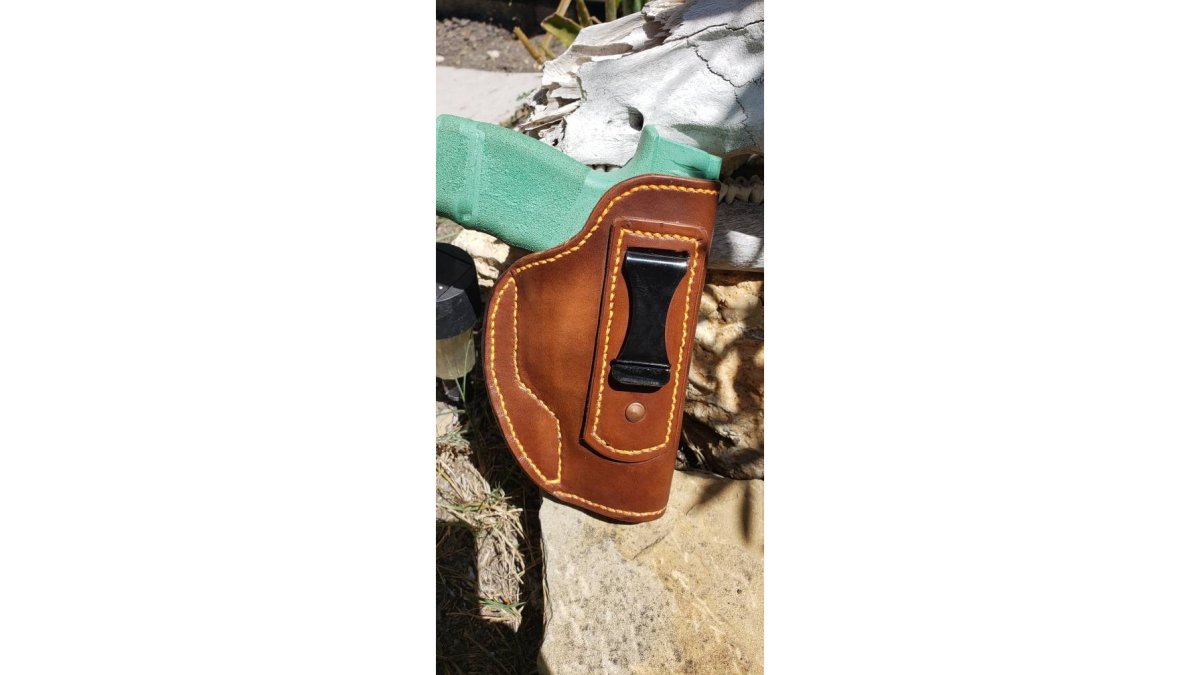
AnchorsAweighLeather's Custom Leather IWB Holster ($43.00) lets you specify your exact firearm, carry position, and hand orientation.
Hybrid Holster Construction: The Middle Ground
Hybrid construction combines leather with thermoplastic or nylon, addressing the weaknesses of each material alone.
How Hybrid Construction Actually Works
A typical hybrid uses full-grain leather on the body-facing side for comfort, paired with Kydex or nylon for the gun-contact side. The rigid plastic shell prevents the leather from deforming under draw cycles and losing retention over time.
A hybrid's plastic shell can create a moisture-resistant barrier protecting the firearm from sweat and mildew.
Break-In and Comfort Timeline
Leather alone requires 2-4 weeks to mold properly and feels stiff during break-in. A hybrid is functional immediately, with the leather side adjusting slightly over weeks for enhanced comfort.
Skin Sensitivity and Long-Term Carry Fatigue
All-day IWB carry with rigid Kydex can cause chafing for sensitive skin or high-friction positions like appendix. The leather component in a hybrid can reduce friction and absorb micro-movements.
Material Density and Weight Distribution
A hybrid balances weight distribution: the plastic provides structural support while the leather distributes weight more evenly. Users carrying strong-side OWB report less hip and lower-back fatigue with hybrid construction.
Cost and Value Proposition
Hybrid construction typically costs 15-30% more than mass-produced leather but 10-20% less than premium custom leather.
When Hybrid Isn't the Answer
Hybrid construction isn't optimal for every use case. Pure Kydex is faster if draw speed is paramount. Pure leather suits those valuing aesthetics and willing to break it in. Pure Kydex wins in harsh environments.
Inside-the-Waistband vs Outside-the-Waistband Carry
The choice between IWB and OWB determines everything about your holster design and depends on your specific carry pattern and body mechanics.
Inside-the-Waistband: Maximum Concealment, Distributed Weight
The HOSS IWB Leather Holster, CCW →
Inside-the-waistband (IWB) carry conceals your firearm entirely and requires a quality gun belt to distribute weight properly. IWB works for appendix, strong-side, and appendix-reverse positions.
An IWB holster spreads the firearm's weight across your entire waistband through a quality gun belt. Without it, you concentrate weight on your pants' waistband, causing sagging and discomfort.
Draw speed from IWB is slightly slower than OWB due to fabric friction.
Comfort in IWB depends heavily on holster design. A poorly made IWB holster creates a pressure point at the gun's muzzle or trigger guard that becomes unbearable. A well-designed IWB distributes pressure across the holster's body-facing surface, eliminating hot spots. This is why custom molding matters for IWB, a holster shaped to your specific body contours and firearm profile can eliminate pressure points.
Outside-the-Waistband: Faster Access, Concentrated Stress
Outside-the-waistband (OWB) carry keeps the holster outside your pants, visible if your shirt rides up. OWB offers faster draw speed because there's no fabric interference. Reholstering is easier and more intuitive. For larger firearms, OWB is ergonomically superior because the gun sits higher and further from your body, reducing printing and discomfort.
The concealment profile is larger, so OWB works best under jackets, loose shirts, or in environments where printing is acceptable. Pancake-style OWB holsters sit close to your body and minimize printing, but they still require adequate cover garments.
The mechanical trade-off most guides miss: OWB concentrates weight on a single attachment point, your belt loop. A 2.5-pound firearm hanging from one belt loop can create asymmetrical stress on your lower back and hip. Over 8-12 hours of daily carry, this can create noticeable fatigue. Users who carry strong-side OWB may report lower-back pain and hip discomfort that disappears when they switch to IWB with a proper gun belt.
The stress concentration also affects your pants. A single belt loop attachment point can create localized wear and can eventually tear the belt loop itself, especially if you're carrying a heavier firearm (3+ pounds). IWB distributes this stress across multiple attachment points, which can extend the life of your pants and belt.
Carry Position Specifics
Appendix IWB (front waistband, 1-3 o'clock position) offers maximum concealment and fastest access. It requires a holster molded precisely to your gun's profile, universal fits can create printing and discomfort in this position. Appendix carry also requires a quality gun belt and proper cant (angle) to avoid printing. The trade-off: appendix can be uncomfortable for extended sitting, and it requires careful holster design to avoid printing when you bend or sit.
Strong-side IWB (3-4 o'clock position) is versatile and comfortable for all-day carry. It works with less precision than appendix but still benefits from custom molding. Strong-side OWB is faster to access but can create asymmetrical stress.
Appendix-reverse (8-9 o'clock position, cross-draw) is less common but offers good concealment and comfort for some users. It requires a holster designed specifically for this position and works best with smaller firearms.
Decision Framework: How to Choose
Start by answering these questions:
-
How long do you carry daily? If 8 hours or less, OWB's speed advantage and ease of access may outweigh IWB's comfort benefit. If 10+ hours, IWB with a proper gun belt can be superior for long-term comfort.
-
What's your primary carry position? Appendix carry almost always requires IWB for concealment. Strong-side works with both, but IWB is more comfortable for extended wear. OWB works best for strong-side or appendix-reverse.
-
Do you change clothes frequently? If you switch between multiple outfits daily, OWB is faster to move between holsters. If you wear the same outfit for 12+ hours, IWB's comfort advantage compounds.
-
What's your firearm size? Larger firearms (4+ inch barrel) are more comfortable in OWB because they sit higher and further from your body. Smaller firearms (subcompact, single-stack) are easier to conceal in IWB.
-
Do you have existing back or hip issues? If so, IWB with a proper gun belt is strongly recommended. The asymmetrical stress of OWB can aggravate existing pain.
The Real-World Pattern
Most experienced carriers use both and switch based on their day's demands. A business day with dress clothes calls for IWB. A weekend outdoors with a jacket calls for OWB. Your lifestyle determines which works best as your primary carry method, but understanding both positions means you can adapt to different situations without compromising on comfort or concealment.
Making Your Decision: Which Alternative Fits Your Lifestyle
Choosing the right concealed carry alternative depends on matching your specific situation to the right solution.
Start with your carry duration and environment. If you carry 8 hours or less in an office setting, a simple mass-produced option might suffice. If you carry 12+ hours in varied environments, you need durability and comfort that only custom or hybrid construction delivers. The upfront investment pays for itself in longevity.
Next, consider your firearm and carry position. Appendix carry requires a holster molded precisely to your gun's profile, universal fits can create printing and discomfort. Strong-side IWB works with less precision but still benefits from custom molding.
Frequently Asked Questions
What is the best material for a concealed carry holster?
The best material depends on your lifestyle and priorities. Full-grain leather offers durability, comfort during long carries, and develops character over time, but requires maintenance. Thermoformed thermoplastic (Kydex) provides superior retention and minimal break-in. Hybrid constructions combine leather's comfort with Kydex's retention. Custom-molded options in any material outperform mass-produced alternatives because they fit your specific firearm precisely, improving draw speed and security.
Why does holster retention matter for concealed carry?
Retention determines whether your firearm stays secure during movement, bending, or physical activity. Passive retention uses friction and fit; active retention adds mechanical devices. Poor retention risks accidental loss or unauthorized access. Full-grain leather with proper molding and Kydex both deliver reliable retention when properly fitted. Custom leather holster benefits include hand-molded fitment that matches your exact firearm, creating superior passive retention without mechanical complexity.
Is a hybrid holster a better alternative to mass-produced leather?
Hybrid holsters combine leather's comfort against skin with Kydex's rigid retention and durability. They reduce break-in time compared to pure leather while maintaining all-day wearability. For appendix carry or extended wear, hybrids can be a good option. However, they're heavier than pure Kydex and cost more than basic mass-produced leather.
How long does a custom leather holster take to break in?
Premium full-grain leather requires a break-in period of regular carry before it molds to your body and firearm. During break-in, the leather softens and conforms to your specific draw angle and body shape. Custom leather holster benefits include faster initial comfort because the maker molds the leather to your firearm before shipping, rather than requiring you to do it yourself.
0 comments